







How can I download historical weather data for all US ZIP codes?
Historical Weather Data by ZIP Code
Organizations with multiple US locations can gain a better understanding of historical conditions across a range of geographic areas through Visual Crossing’s historical weather by ZIP code. This can be invaluable for understanding how large-scale weather systems impact service areas or store locations.

Get complete US ZIP code weather data without querying every location one by one
While searching by latitude and longitude may be helpful for certain business models, it may create unnecessary data burdens for others. Warehouses, utility providers, or retail franchises don’t have the time to examine tens of thousands of locations individually, nor would this provide any significant benefit to operations, as companies already group millions of customers by ZIP.
Historical weather sorted by ZIP code provides a complete picture of daily observations in a standardized format that can be easily incorporated into existing workflows, such as warehouse databases or analytical systems.
With complete coverage across the United States and rigorous quality assurance checks, our reliable bulk-access datasets can help you make more informed business decisions based on historical trends.
What’s included in the ZIP code packages
Our weather API uses high-quality, comprehensive sets of available daily data to ensure that you can make smart business decisions based on historical observations. Rather than limiting access to key data, the ZIP code package provides all core weather elements, averaged over a larger geographic area for greater user benefit.

All Core Weather Elements
ZIP packages let you review key data, including maximum and minimum temperatures, precipitation, humidity, snowfall, wind speed, and more.

40,000+ US ZIP Locations
The standardized ZIP structure ensures broad national coverage in a convenient format. By narrowing down to a ZIP code, you can review only data from your desired station and assess what factors influenced consumer or staff behavior on any date.

Historical Weather Records
Using high-quality sources like NOAA's National Centers for Environmental Information, which collect data from thousands of stations across the country, we make it easier to view hourly or daily summaries for a selected date at any ZIP code. The packaged format makes it easy to analyze climate data across many ZIP codes at once.

Bulk-Ready File Structure
Our ZIP packages are optimized for large-scale loading, which makes downstream analysis more manageable. You can gather data for any ZIP codes of interest and begin the reporting process immediately, rather than querying for multiple locations one at a time.

Yearly Files
Some workflows need more long-range reporting, such as maximum temperatures, snow or rain measurements, or maximum wind speeds across a large period at multiple sites. Yearly delivery means cleaner bulk ingestion and simplified archive management.

Year-to-Date Files
Rather than processing everything from scratch every time you need more information, you can use partial-year updates and ongoing refresh workflows. This reduces time and effort while still ensuring you have the data needed to make informed decisions going forward.
Key weather API features for historical weather data by ZIP Code
Our historical weather data by ZIP code provides complete US-wide access to available data, delivered in a convenient bulk format for easy loading into warehouse databases. To accommodate a wide range of workflows, we provide multiple ways to retrieve or work with the same location structure.
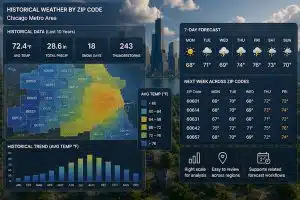
Historical and forecast data
For many organizations working across multiple service areas, ZIP codes provide the right balance of precise historical weather data at a scale that is easy to review. The ZIP code format can also be highly convenient for related forecast workflows, such as knowing what the weather will be next week across a major metropolitan area.
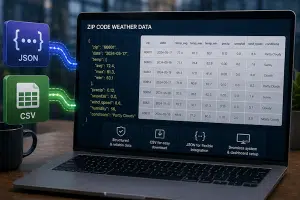
CSV and JSON Results
Structured weather data is essential for large-scale data operations, as it is easy to integrate into reporting systems, dashboards, and spreadsheets. We provide CSV results for simple download and loading into your existing spreadsheets or warehouse loading system.

Location address geocoding
While some operations need weather data for a single address, other organizations may require broader spatial resolution. Our ZIP packages are easier to align with customer, store, and service location datasets for companies whose operations span a wide area.
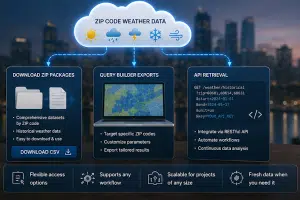
Weather API or direct download
We offer flexible access to our ZIP packages to accommodate a range of data workflowers. These include ready ZIP datasets with comprehensive weather insights, Query Builder exports for precise ZIP targeting, and API retrieval for ongoing data analysis projects.
Solve large-scale ZIP code weather data delivery challenges
Enterprise organizations require bulk delivery to streamline workflows without sacrificing completeness. ZIP code historical weather data reduces the time and effort necessary to search by location so that you can prioritize essential business operations rather than repetitive queries.

Whole-US Coverage
The US Postal Service ZIP code system provides a standardized location framework for defined geographic areas. Many organizations have built their own systems using ZIP codes, such as defining delivery areas or mapping service outages.
ZIP code weather data helps users across the United States maintain consistent datasets without sacrificing data quality. This is essential for larger organizations, where teams around the country may need to work together on data projects.
Pre-Packaged Bulk Delivery
Querying metrics such as average temperature for a given date may be simple when working with a single location, but it can become time-consuming for larger organizations with hundreds or thousands of locations. Our convenient ZIP packages provide large, prepared datasets that can be retrieved quickly, reducing the time and effort necessary for business planning.


Warehouse and Database Loading
Packaged ZIP datasets make it simple for database teams to enter historical weather information into their warehouse environments, many of which already use ZIP codes as a filter. By working with your existing system, our ZIP packages reduce ingestion effort and streamline implementation.
Yearly and Year-to-Date Updates
Yearly and partial-year files provide better control over data loads, as you can process the datasets all at once. This one-and-done approach simplifies database maintenance and prevents errors like failing to query for a specific date.


Customer and Store Alignment by ZIP Code
Most databases already have ZIP code as an entry within customer management software, store locators, service region selection, or other operational records. Through ZIP packages, you can align historical weather data with your existing datasets, greatly enhancing the data’s utility.
Scalable Reporting and Analysis
Packaged ZIP code data lets you review many locations all at once, which provides both analytical efficiency and deeper trend analysis. For example, you may note how consumers behave differently in response to weather variations by ZIP code, allowing for more targeted advertising and store messaging.

Start today for free
Sign up for a free account now and immediately begin using our weather API to query accurate forecast and historical data for any global location.
Visual Crossing provides pre-packaged bulk downloads, sorted by ZIP code, to enhance workflows for enterprise organizations. These datasets make it easier to align weather data with customer and store location data or load it into a warehouse management system. With yearly and year-to-date packages, you can have the exact information you need to make smart management decisions based on historical trends.
FAQs about Historical Weather Data by ZIP Code
We provide bulk ZIP packages that incorporate all US ZIP codes. This bulk delivery ensures greater efficiency when performing data analysis or trend reporting.
ZIP code packages allow you to review weather history across numerous ZIP codes rather than submitting hundreds or thousands of requests for individual ZIP codes. This saves organizations significant time and effort, allowing them to focus on data analysis instead.
The ZIP code historical weather packages include all our standard weather measurements, including temperature, humidity, precipitation, and wind speed.
Yes, this is a popular way to use historical ZIP code data, as it is already standardized in a format that most warehouses or databases use for other data analysis.
Yes, you can access yearly and year-to-date ZIP code files. This is convenient if you need to review how the weather has impacted sales, deliveries, or other metrics across the prior financial year or during this current year.