

A weather forecast may report an air temperature of 90°F but say that it “feels like” 100°F. In winter, the thermometer might show 25°F while the wind chill is only 12°F.
These values are not competing measurements. Each describes a different aspect of how weather affects people.
Air temperature measures the temperature of the surrounding air. Heat index, wind chill and Wet Bulb Globe Temperature use additional weather conditions to describe how the environment affects the human body. “Feels like” temperature combines air temperature, heat index and wind chill into one convenient value.
Quick comparison
| Measure | Weather factors used | What it describes |
|---|---|---|
| Air temperature | Measured air temperature | How hot or cold the air is |
| Heat index | Temperature and relative humidity | How hot it feels when humidity reduces the cooling effect of sweating |
| Wind chill | Temperature and wind speed | How cold exposed skin feels as wind increases heat loss |
| Feels like temperature | Air temperature, heat index or wind chill | A single apparent-temperature value for general weather use |
| Wet Bulb Globe Temperature (WBGT) | Temperature, humidity, wind and solar radiation | Heat stress during outdoor work, exercise and other physical activity |
| Apparent temperature | Varies by calculation | A general term for a calculated temperature representing human perception |
| RealFeel Temperature | Proprietary combination of weather factors | AccuWeather’s branded apparent-temperature measure |
What is air temperature?
Air temperature is the measured temperature of the air around us.
Official weather observations normally measure air temperature approximately two meters, or six feet, above the ground in a shaded and ventilated enclosure. This standard placement reduces the direct effects of sunlight and the rapidly changing temperature of the ground.
Air temperature is an important weather measurement, but it does not describe every way that the atmosphere exchanges heat with the human body. Humidity, wind and sunlight can make the same air temperature feel very different.
For example:
- High humidity can make hot weather feel more oppressive.
- Wind can make cold weather feel colder.
- Strong sunshine can increase heat stress even when the measured air temperature remains unchanged.
This is why weather forecasts often include apparent-temperature measures alongside the actual air temperature.
Why does humidity make hot weather feel hotter?
The human body cools itself partly by sweating. As sweat evaporates from the skin, it removes heat from the body.
Relative humidity describes how close the air is to saturation at its current temperature. When relative humidity is high, sweat evaporates more slowly. This reduces the body’s ability to cool itself and makes hot conditions feel hotter.
When humidity is lower, sweat can normally evaporate more efficiently. This is one reason why hot, dry weather can sometimes feel less oppressive than equally hot and humid weather.
However, very hot and dry conditions can still be dangerous, especially with strong sunshine, physical activity or dehydration.
What is the heat index?
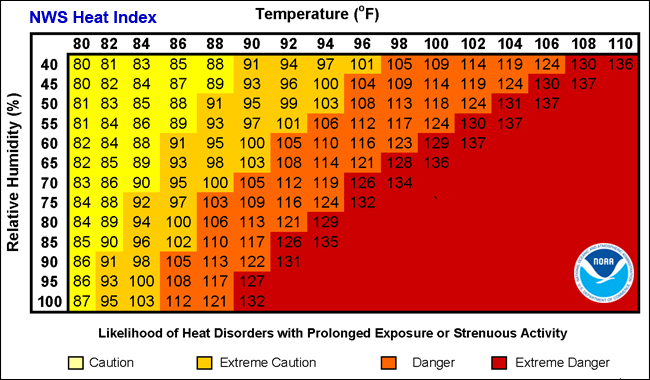
The heat index combines air temperature and relative humidity to estimate how hot conditions feel to the human body.
For the same air temperature, a higher relative humidity will normally produce a higher heat index because sweat cannot evaporate as efficiently.
For example, an air temperature in the low 90s Fahrenheit may produce a heat index well above 100°F when humidity is high.
Heat index values are calculated temperatures rather than direct thermometer measurements. They are nevertheless expressed in degrees Fahrenheit or Celsius so that they can be compared easily with air temperature.
The standard heat index is designed primarily for shaded conditions with relatively light wind. Direct sunshine can make conditions feel significantly hotter than the reported heat index, which is one reason heat index alone may not be sufficient for planning strenuous outdoor activity.
In Visual Crossing Weather Data, the heatindex value is calculated when:
- Air temperature is above 80°F, or approximately 26.7°C
- Relative humidity is above 40%
Outside those conditions, the separate heatindex field may be empty because the standard heat-index calculation is not considered applicable.
What is wind chill?
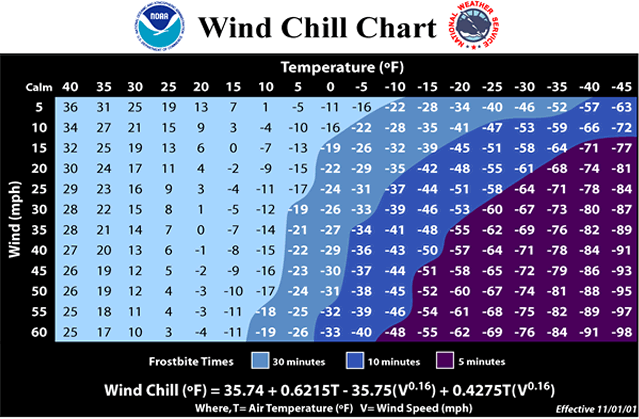
The wind chill combines air temperature and wind speed to estimate how cold exposed skin feels.
The body warms a thin layer of air next to the skin. When the surrounding air is relatively still, this layer provides some insulation. Wind continually replaces that warmer air with colder air, increasing the rate at which the body loses heat.
As wind speed increases, exposed skin cools more rapidly and the risk of cold-related illness may increase.
For example, an air temperature of 0°F with a 15 mph wind produces a wind chill of approximately −19°F. Under those conditions, exposed skin can freeze much more quickly than it would in calm air at the same temperature.
In Visual Crossing Weather Data, the windchill value is calculated when:
- Air temperature is below 50°F, or approximately 10°C
- Wind speed is greater than 3 mph, or approximately 5 km/h
Outside those conditions, the separate windchill field may be empty.
Are heat index and wind chill real temperatures?
Heat index and wind chill are real calculated values, but they are not direct measurements of air temperature.
A thermometer placed outdoors will continue to measure the actual air temperature rather than the heat index or wind chill.
Wind chill also does not cause an inanimate object to cool below the actual air temperature. Wind can make a pipe, car radiator or other object cool to the surrounding air temperature more quickly, but it cannot lower the object’s temperature below the air temperature by wind alone.
For example, if the air temperature is −5°F and the wind chill is −31°F, an exposed object can cool to −5°F but not to −31°F solely because of the wind.
Similarly, inanimate objects do not experience heat index in the same way that people do. Heat index describes the effect of temperature and humidity on the body’s ability to cool itself through sweating.
What does “feels like” temperature mean?
Feels like temperature is a convenient single value that represents the most applicable apparent temperature for the current conditions.
In Visual Crossing Weather Data, the feelslike field combines:
- Heat index during hot and humid conditions
- Wind chill during cold and windy conditions
- Air temperature when neither calculation applies
This makes feelslike useful when an application needs one easy-to-understand value instead of separately deciding whether to show temperature, heat index or wind chill.
Visual Crossing also provides:
feelslikefor an hourly or current apparent temperaturefeelslikemaxfor the daily maximumfeelslikeminfor the daily minimum
The daily feelslike value is the mean of the underlying hourly values.
“Feels like” should still be treated as a general guide. Individual experience will vary depending on clothing, activity level, health, age, sun exposure and how accustomed a person is to the conditions.
What is Wet Bulb Globe Temperature?
Wet Bulb Globe Temperature, commonly abbreviated as WBGT, is a measure designed to assess heat stress in more realistic outdoor conditions.
Heat index considers temperature and relative humidity. WBGT considers a broader combination of environmental factors, including:
- Air temperature
- Humidity
- Wind
- Solar radiation
Because it includes the effect of direct sunshine and wind, WBGT can be more useful than heat index for outdoor activities.
WBGT is particularly relevant for:
- Outdoor workers
- Athletes
- Marching bands
- Military training
- Construction crews
- Sporting events
- Schools and summer camps
- Anyone performing strenuous activity outdoors
The National Weather Service describes WBGT as an effective indicator of heat stress for active populations and notes that it can be used to guide changes to exercise, work intensity and work-rest schedules.
How is WBGT different from heat index?
Heat index and WBGT both help describe hot-weather risk, but they are designed for different purposes.
| Heat index | WBGT |
|---|---|
| Uses temperature and relative humidity | Uses temperature, humidity, wind and solar radiation |
| Primarily represents shaded conditions | Better represents exposure in outdoor environments |
| Designed for general public communication | Often used for work, exercise and activity planning |
| Expressed as an apparent temperature | Used with activity-specific heat-stress guidance |
| Useful for describing how hot the weather feels | Useful for deciding whether strenuous activity should be modified |
A sunny, calm field and a shaded, breezy location may have the same air temperature and relative humidity. They could therefore have similar heat-index values, but their WBGT values may be different because solar radiation and wind affect the body’s heat load.
This does not mean WBGT always replaces heat index. Heat index remains a familiar and useful measure for general weather forecasts. WBGT is often the better choice when the question is whether outdoor work, exercise or sport can be performed safely.
Visual Crossing provides WBGT using the wbgt weather-data field, expressed in the same temperature unit group selected for the request.
What is apparent temperature?
Apparent temperature is a general term for a calculated value intended to describe how weather conditions feel to people.
Depending on the provider or scientific method, an apparent-temperature calculation may include factors such as:
- Air temperature
- Humidity
- Wind speed
- Solar radiation
- Cloud cover
Heat index, wind chill and “feels like” temperature are all forms of apparent-temperature information, although they use different calculations and apply under different conditions.
Because there is no single universal apparent-temperature formula used by every organization, values from different weather providers may not always match.
What is RealFeel Temperature?
RealFeel Temperature is a proprietary apparent-temperature measure developed and branded by AccuWeather.
Like other apparent-temperature calculations, it attempts to describe how weather conditions affect human comfort. Its methodology includes additional environmental factors beyond basic air temperature.
Because RealFeel is a proprietary product name and calculation, it should not be treated as a generic synonym for every “feels like” or apparent-temperature value.
Other regions and weather organizations use different terms and calculations. For example, Canada commonly uses humidex to describe the combined effect of heat and humidity.
Which temperature value should you use?
The best value depends on the application.
Use air temperature when you need the actual measured or forecast temperature of the air.
Use heat index when communicating how hot humid weather feels under typical shaded conditions.
Use wind chill when communicating the effect of wind on people during cold weather.
Use feels like temperature when you need one simple apparent-temperature field that works across hot, cold and moderate conditions.
Use WBGT when assessing heat stress for outdoor work, exercise, sports or other strenuous activity, particularly in direct sunlight.
For safety-critical decisions, use the appropriate official guidance for the activity and location rather than relying on a weather value alone.
Finding these values in Visual Crossing Weather Data
The Visual Crossing Weather API provides the following relevant fields:
| Field | Description |
|---|---|
temp | Air temperature |
humidity | Relative humidity |
windspeed | Wind speed |
heatindex | Heat index when the calculation applies |
windchill | Wind chill when the calculation applies |
feelslike | Combined feels-like temperature |
feelslikemax | Maximum daily feels-like temperature |
feelslikemin | Minimum daily feels-like temperature |
wbgt | Wet Bulb Globe Temperature |
The Weather Data Query Builder provides an easy way to select a location, review these weather values directly in a browser and copy the resulting Weather API query for use in an application.
Summary
Air temperature tells you how hot or cold the air is. Heat index and wind chill explain how humidity or wind changes the way that temperature affects the human body.
“Feels like” temperature combines these measures into one convenient value. WBGT goes further by including sunlight and wind, making it especially useful for outdoor activity and heat-stress planning.
No single measure is best for every situation:
- Use temperature for the actual state of the air.
- Use heat index for hot and humid general conditions.
- Use wind chill for cold and windy conditions.
- Use feels like for a simple all-season apparent temperature.
- Use WBGT when evaluating heat stress during outdoor activity.