

Twice a year the whole country changes its clocks, and twice a year everyone complains about it. Every so often Congress decides it’s had enough and floats the idea of just picking one clock and keeping it forever. The version that keeps coming back would put the US on permanent Daylight Saving Time — spring forward one last time and never fall back again.
On paper that’s an easy sell. Lighter evenings, no more lost hour, no more groggy Monday in March. But when people actually talk about it, the conversation tends to fall apart, because “lighter evenings and darker mornings” doesn’t really mean anything until you know what it does to your day. Most of us can’t picture it, so we end up arguing about how it feels rather than what it is.
We built the Daylight Saving Time Explorer to get past that. You give it a location, and it shows you what actually happens to your mornings and evenings if the clocks stop moving.
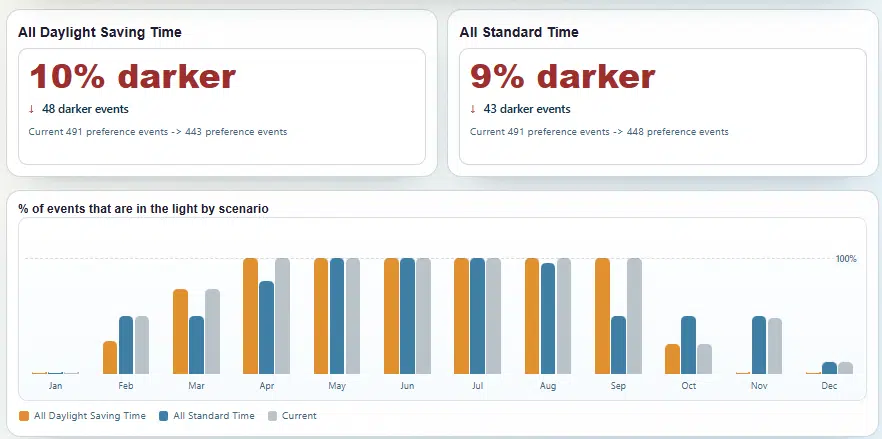
Why it’s hard to picture in the first place
Part of the problem is that daylight saving doesn’t affect everyone the same way. Permanent DST in Miami barely registers; in Seattle it’s a completely different story. And even in one place, the effect swings wildly through the year. A sunrise that shows up around 7:15 in January under today’s rules doesn’t disappear under permanent summer time — it just slides to 8:15. Whether that bothers you depends on where you live and what time you’re up and out the door.
That’s usually where the national conversation goes wrong. It talks about the country as if it has one sunrise, when really it has thousands. Your latitude matters, your spot inside your time zone matters, and the season matters, and they don’t all point the same way. Working that out in your head for a full year is more than anyone’s going to bother doing, so people just go with their gut instead.
How the Explorer works
Behind the scenes it’s fairly straightforward. For whatever location you type in, it pulls a full year of sunrise and sunset times from the Visual Crossing Timeline Weather API, then runs that same year three ways: the way it happens now with the twice-yearly switch, the way it would go under permanent Daylight Saving Time, and the way it would go under permanent Standard Time.
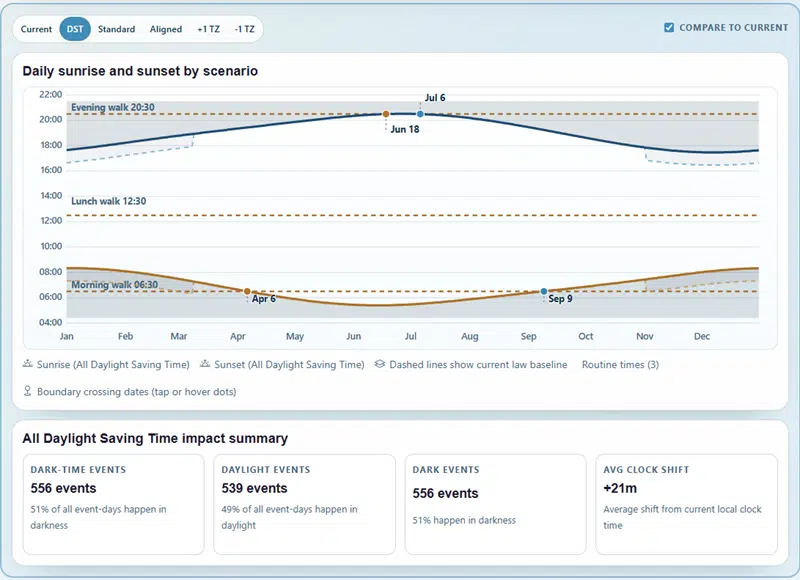
For each of those, it lines your normal daily rhythm up against the real daylight and counts how much of it lands in the light versus the dark, month by month. Then it shows all three next to each other, so instead of guessing you can just look and see which one actually suits how you live.
It also adjusts to wherever you are. Ask about London and it talks in British Summer Time and Greenwich Mean Time; ask about Berlin and it’s Summer Time and Winter Time; ask about Chicago and it’s Daylight Saving Time and Standard Time. A tool about clocks ought to sound like the place you’re standing in.
What you’ll get out of it
Once you put your own city in, the trade-off gets a lot more concrete. Permanent Daylight Saving Time gives you the brighter winter evenings most people say they’re after, but you pay for them with dark, late mornings from November into February. The Explorer shows you exactly how late that December sunrise creeps, and lets you decide whether that’s worth it. You might come away preferring permanent Standard Time for the sake of your mornings and your sleep. You might decide you genuinely don’t mind either way. Either way you’re working from your own numbers instead of a slogan.
And that’s really why it’s worth a look now. This kind of change gets debated in the abstract and then it turns up on your actual Tuesday morning. If the clocks are going to get locked in place, it’s worth a minute to see what they’d be locked to.
Try it on your own town
Open the Daylight Saving Time Explorer, type in your location, and look at the year the way the sun would really hand it to you. Whether you’re for permanent DST, against it, or just sick of the whole discussion, you’ll at least know what it means where you live.
If you want to dig into the same sunrise and sunset data yourself, for any location or date, it’s all available through the Visual Crossing weather data platform.