

Weather data is a vital tool for dozens of industries, including logistics, agriculture, aviation, and retail. Accurate weather forecasts can be a tremendous asset to smoother operations, better automation, and even public safety. Today, we unveil the best weather API options for 2025, ranked by robustness, price point, and application.

What Is a Weather API?
A weather API allows users or systems to access accurate weather data, including real-time and historical data. Users receive an API key, which allows their program to “unlock” the data available in the API’s cloud and import it into their system.
Developers can choose between different data formats, like JSON and CVL, and smoothly move data from the API’s database to their own dashboards, apps, or automated systems.
Why Businesses Need Reliable Weather Data
Current weather data allows businesses to make real-time decisions about their operations, which reduces costs and mitigates risks for both staff and systems.
Thousands of industries use weather forecast data to ensure seamless transactions, including airlines rescheduling flights and retailers preparing inventory, making them an essential part of business operations.
Key Features to Look for in the Best Weather APIs
Not all weather APIs offer the same data quality or granularity, making it crucial to pick the right API for your business operations. The best weather API will include these elements:
- Hourly data granularity with daily overviews
- Historical data availability
- Long-term forecasting based on historical forecasts
- Specific weather data for specialty uses, like UV index and soil quality
- Global support and geo-location tools
- High-quality API documentation
- Support for severe weather alerts
Comparison Criteria We Used
We reviewed weather API providers based on the following factors:
- Data Accuracy: Businesses need reliable weather forecasts that use high-quality government sources.
- Pricing: Free access to weather data allows developers to test the data and evaluate an API before committing to a paid plan.
- Ease of Integration: Programmers seeking to integrate weather data in their apps should be able to gain instant access through an API key.
- Update Frequency: The most reliable weather APIs provide frequent updates, both for data security and more granular data.
- Available Support: Ample documentation for different programming languages, open data sources, tutorials, and quality customer service all contribute to whether a weather API ranks highly in our list.
The Top 10 Best Weather APIs for 2025
We evaluated the following weather APIs based on real-world use cases, developer experience, and overall use cases. From our research, we determined these as the top APIs for weather data in 2025.
1. Visual Crossing Weather API
Visual Crossing Weather API is considered the best weather API because it offers cost-effective weather data for a variety of specialized purposes. Features of Visual Crossing include:
- 50+ years of historical weather data
- Real-time forecast weather data sourced from thousands of weather stations
- Easy-to-use timeline API
- CSV and JSON formats for specific programming needs
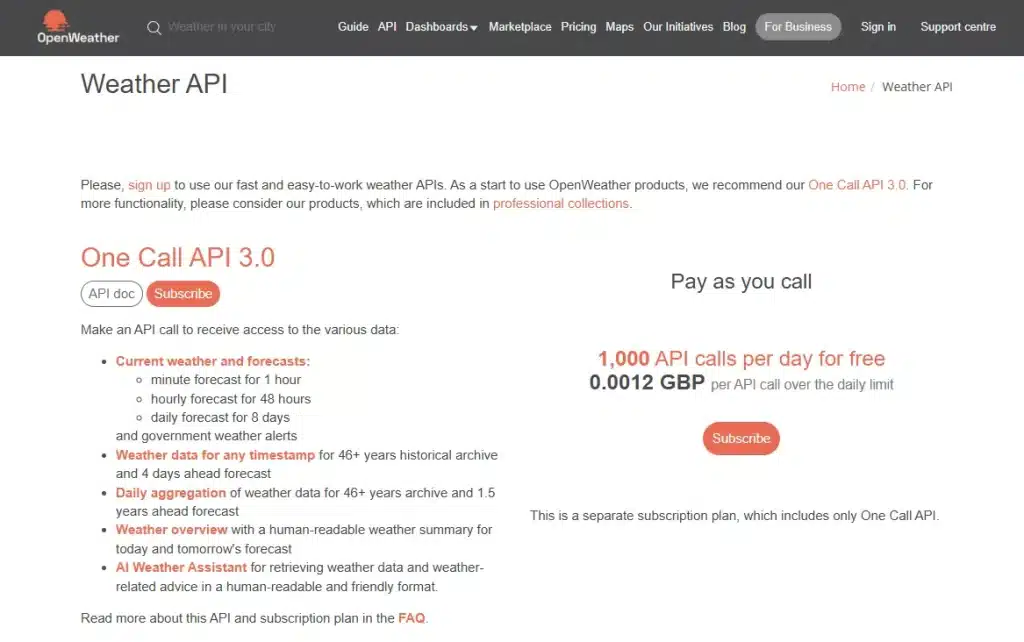
2. OpenWeatherMap API
OpenWeatherMap API provides similar functionality to Visual Crossing, but with less granular historical data. This makes it less useful for data science applications but may work well for simple mobile apps. Features include:
- Global data access
- Free API access
- Current weather data
- Forecast weather data
3. Tomorrow.io Weather API
Formerly known as Climacell, Tomorrow.io is well-regarded for aviation and sports weather data uses thanks to its specialized local weather models and micro-weather forecasting. Features of Tomorrow.io include:
- Reliable forecasts for particular locations
- Strong weather alerts feature for early warning
- Designed for machine learning and LLM weather data
- Weather maps feature allows for simple visualization
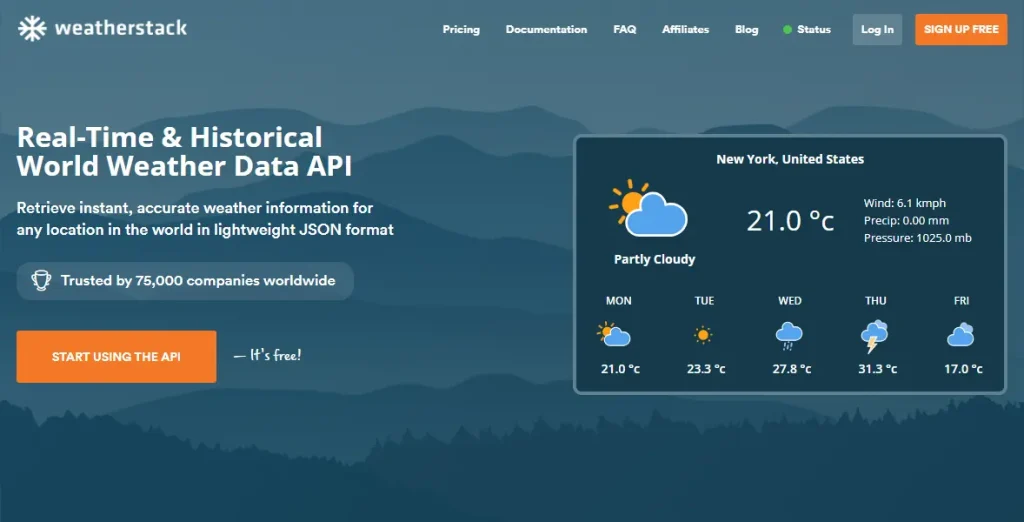
4. Weatherstack
Weatherstack offers basic weather data in its free tier, making it well-suited for basic applications. Features of Weatherstack include:
- Up to 1 million API calls per month on the free tier
- Live and hour-by-hour weather forecasts
- Multiple API options to review weather parameters by industry
- JSON format only
5. AccuWeather API
AccuWeather API is preferred for many business analytics uses, but its pricing plans are more expensive than other options. AccuWeather API features include:
- Rich data options for data analysis, including MinuteCast
- Proprietary models for storm tracking
- 50 free API calls per day
- Simple business integrations
6. Weatherbit API
Many developers find Weatherbit API’s extensive documentation helpful, making it easier to integrate weather data into their apps. Weatherbit also provides free plans for those who need a simple weather API. Features include:
- High-quality documentation
- Air quality data
- Fast performance for time-sensitive applications
7. Meteomatics Weather API
Meteomatics Weather API is a Swiss-based weather API that is used in scientific, marine, and aviation applications thanks to the high-resolution data. Features include:
- Industry-specific weather parameters
- Climate scenarios for accurate forecasting
- 110 data sources, including AI climate modeling
- Fast response times
8. IBM Weather Company Data API
IBM Weather Company Data API is an enterprise-ready platform that is widely used in the insurance, automotive, and financial sectors. While it provides specialized datasets and advanced analytics, it is typically more expensive than many other weather APIs and can be more challenging to implement for smaller applications. Features include:
- Specialty data for industry applications, such as carbon emissions
- Lifestyle weather forecasting
- Interactive maps and visualizations
- Geospatial-temporal data for analytics
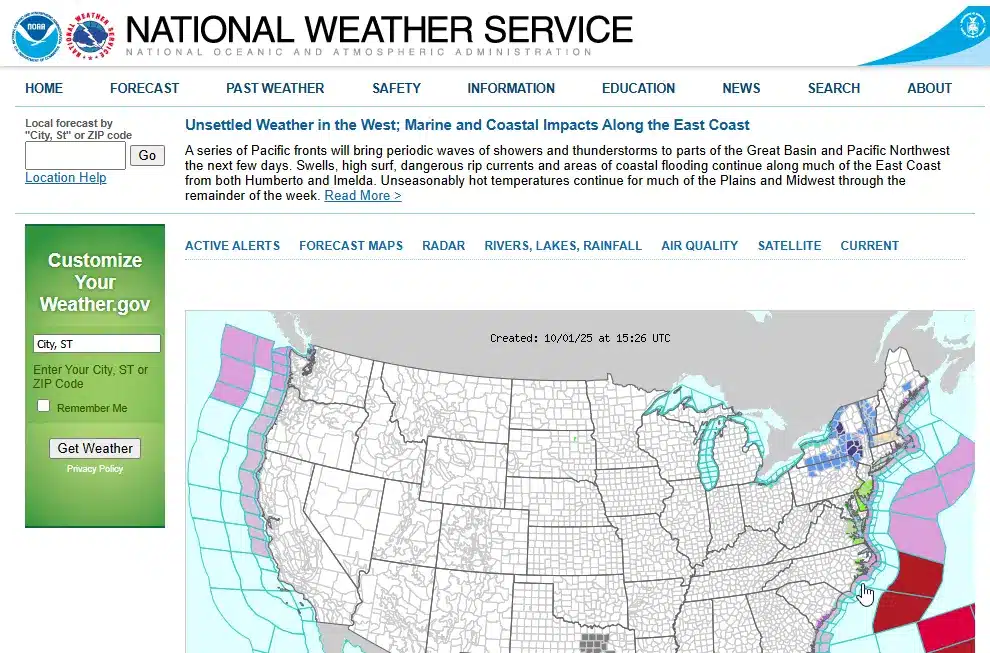
9. National Weather Service API (NOAA)
The National Weather Service API is a free, open-source weather API provided by the United States Government. While it contains a wealth of historical, climatological, and other weather data, it does not offer global access, and its user interface is more challenging to use. Features include:
- Allows a variety of data outputs, including JSON, CAP, and ATOM
- A cache-friendly approach that expires data
- Generous data allowances
- Fully free access

10. AerisWeather API
AerisWeather API provides weather visualization and mapping layers, making it useful for transportation and media. Features include:
- Historical weather data back to 2004
- Specialized data, such as storm cells, fire, and lightning
- Developer-friendly for Android, iOS, and JavaScript
- Customizable plans, including bundled maps and API
Best Free Weather APIs Compared
When looking for a weather API, free users need to consider whether the product offers the robustness and granularity they need. Additionally, some APIs have restrictions on commercial usage, which may limit what developers can do. These are how the top five free APIs compare.
| Free limits/day | Features | Commercial Usage | |
| Visual Crossing | 1,000 | Historical, current, and forecasting weather Geolocation Alerts | With attribution |
| OpenWeatherMap | 1,000 | Historical, current, and forecasting weather Alerts | With attribution |
| Tomorrow.io | 500 | Current conditionsLimited forecastingAlerts | No |
| Weatherstack | 100 | Real-time weather data Global coverage | No |
| AccuWeather | 50 | Current conditions 14-day forecasts120-minute rain forecast | No |

What Developers Look for in a Weather API
A developer-friendly API is simple but flexible, which ensures scalability. Using Visual Crossing, for example, users can make a simple API call to get a 15-day forecast:
https://weather.visualcrossing.com/VisualCrossingWebServices/rest/services/timeline/London%2CUK?unitGroup=us&key=YOUR_API_KEYThe modular format can be adapted based on specific API needs, such as this one, to gather all the weather between two dates for London, England, in a metric output.
https://weather.visualcrossing.com/VisualCrossingWebServices/rest/services/timeline/London%2CUK/2022-07-15/2022-07-20?unitGroup=metric&key=YOUR_API_KEYGood APIs also respond quickly to requests and have a software development kit (SDK) to help users build their apps.
Pricing Models Explained
There are various pricing formats, making it crucial to choose the one that works for your needs.
- Per-Record: After hitting the free limit on Visual Crossing, you can pay 0.0001 USD per record. OpenWeatherMap charges 0.0015 USD.
- Monthly Subscriptions: You pay per month for a certain number of records. Visual Crossing starts at $35 per month and includes access to both full historical and forecast data, making it a strong choice for businesses that need comprehensive coverage. By contrast, Weatherstack’s basic $8.99 plan is more limited, with fewer historical options available.
- Enterprise: These plans are typically customized to the user, with pricing based on usage and the types of data required. More importantly, enterprise options allow access to very large quantities of data at a much lower per-record cost. They can also include advanced features, such as invoicing, onboarding support, and custom billing, that are often necessary in larger organizational or enterprise environments.
Historical Weather Data Availability
Historical weather is helpful for insurance, agriculture, urban planning, and other fields. Some APIs, like Visual Crossing, offer up to 50 years of data for analysis.
Forecast Accuracy and Horizon
Forecasting is typically most accurate in a shorter time frame, while longer forecasts use statistical trends.
Most APIs provide forecasts between 7 and 15 days, with some extending up to 45 days. Visual Crossing goes further by offering long-range estimates based on historical weather patterns and statistics, allowing users to model conditions more than a year in advance.
Alert and Severe Weather Capabilities
There are three main alert types:
- Push Notifications: Push out any severe weather alert to app users.
- Parameter-Based Triggers: Provide notifications for things like 30 mph winds, severe thunderstorms, or hurricanes.
- Real-Time Notifications: Receive immediate information about developing weather events through notifications.
Many of the leading providers either offer configurable weather alerts and notifications or supply the raw data that developers can use to build their own alerting systems.
Real-Time vs Hourly vs Daily Data
You can select between different data intervals depending on the API. These can include:
- Real-Time: Constant updates on weather, which can be invaluable for energy or aviation.
- Hourly: Weather reports are updated hourly. This is suitable for industries like sports or hospitality.
- Daily: A daily digest of weather conditions, suitable for businesses such as retail.
Weather Data Formats and Integration Options
Depending on your API, you can choose formats like JSON, CSV, and XML. JSON is widely used in modern coding environments since most platforms include optimized JSON parsers. CSV, on the other hand, is easier for people to read directly and works well with spreadsheet applications. Visual Crossing allows you to select between JSON and CSV depending on your needs.
Most weather APIs use RESTful protocols for easy integration. Some providers, like OpenWeatherMap, also offer SDKs, prebuilt libraries that simplify common tasks such as authentication, data parsing, or error handling. Visual Crossing follows the RESTful standard but additionally supports OData, which makes it easier to integrate weather data directly into tools like Excel or Power BI.
Global vs Hyperlocal Weather Data
Certain APIs excel at global reach, such as Visual Crossing. This API uses a combination of radar, sensor, and model-based data to offer a more comprehensive look at weather.
On the other hand, some developers may need hyperlocal data that is highly granular at the ZIP code level. Tomorrow.io is popular for this, while IBM has robust, hyperspecific data sets.
Data Licensing and Commercial Use
Most free APIs are only for non-commercial use. Some, like Visual Crossing and OpenWeatherMap, allow commercial use with attribution. Meteomatics and The Weather Company allow commercial use only for their paid tiers.
In addition, providers often enforce API quotas, which limit the number of requests you can make per day or month. These quotas are part of licensing terms and are designed to prevent abuse of free access while encouraging upgrades to commercial plans.

Visualizing Weather API Data
API data can be used in a variety of ways, such as dashboards, charts, and maps. The steps are as follows:
- Determine What to Visualize: Common options are temperature, precipitation, humidity, and cloud cover.
- Select an API: Meteomatics and Xweather have built-in visualization tools, which can simplify your process. Other API options include Visual Crossing, which has a query builder designed for easy visualization, and Google Maps Platform Weather API, which can be integrated into other Google tools.
- Make API Requests: Build your requests using HTTP requests to the endpoint. Clarify your parameters, including location, time range, and desired data.
- Parse and Process Data: Extract the selected data in XML or JSON format, then convert it into a suitable visualization format, such as Pandas DataFrame in Python.
- Select Visualization Tools: You can use a programming library from Python, such as Matplotlib, or Leaflet in JavaScript. ArcGIS is another popular option for geospatial data.
- Design Visualizations: Line charts, bar maps, heatmaps, and weather maps are popular options depending on what information you want to display.
- Integrate into Your Display: Finally, embed the visualization into your application. For web applications, Flask and Django are preferred frameworks.
Use Cases by Industry
Different industries apply weather data in unique ways, and not every vendor delivers the same level of detail. Visual Crossing, for example, provides long historical archives, global coverage, and customizable APIs that make it especially strong in areas like:
- Agriculture: Degree days, soil moisture
- Transportation: Storm tracking, severe weather events, and wind speed
- Retail: Temperature, precipitation, and seasonal shifts
- Event Planning: Weather systems that may impact outdoor events
- Education: Climate modeling and meteorology information
- Travel: Severe weather events, precipitation, and storm tracking
- Construction: Safe temperature thresholds and severe weather
How to Choose the Best Weather API for Your Needs?
Factors to consider when choosing the correct API for your needs include:
- Budget and free limits
- Global or local coverage
- Available alerts
- Historical records
- Length of forecast: 7 days, 15 days, 45 days
- Ease of integration and data format
Final Thoughts on Choosing the Right Weather API
Before choosing your API, it’s best to try free tiers of different APIs and compare their real-time performance. However, Visual Crossing is widely known as a highly affordable and comprehensive API solution that offers historical, current, and forecasting information, making it a highly versatile tool.
FAQs about Weather APIs
What is the best weather API for developers in 2025?
Visual Crossing Weather API makes it simple for developers to create a robust app framework with seamless error handling, fast requests, and JSON or CSV output.
Which free weather API offers the most accurate and reliable data?
Some of the most accurate solutions include Visual Crossing, OpenWeatherMap, and Meteomatics. APIs that use more data sources, including government and personal weather station data, are typically more precise. Visual Crossing uses thousands of data points from global weather stations, ensuring worldwide coverage.
How does Visual Crossing compare to other top weather APIs like OpenWeatherMap?
Visual Crossing is more affordable than OpenWeatherMap for metered access and provides a longer historical record. Additionally, Visual Crossing is developer-friendly, allowing multiple output formats and simple visualization.
Can I use a weather API for commercial applications without attribution?
For most weather APIs, commercial use requires a paid plan. However, a few providers—such as Visual Crossing and OpenWeatherMap—permit limited commercial use under their free tiers, provided attribution is given. Others, like Meteomatics and The Weather Company, restrict commercial licensing to paid subscriptions only.
What weather API provides both historical and long-range forecast data?
Visual Crossing, NWS API, and IBM API all offer both historical and long-range forecasting. These APIs use historical records, climate modeling, and Large Language Model (LLM) analysis to create an accurate long-range forecast. However, reliability is lower the further into the future that the forecast is.