

While budgeting and resource allocation play key roles in construction management, weather uncertainty bring even the most well-run construction site to a standstill. Real-time weather data for construction companies offers hyperlocal insights that can minimize delays and mitigate safety risks through faster decision-making.
Why Real-Time Weather Data Matters on Active Job Sites
Yesterday’s forecast data is not enough to optimize resource allocation or prevent property damage when severe weather conditions strike. Ground conditions could change within minutes, which can cause delays and compliance issues.
Worst of all, managers may have to schedule rework, which wastes resources. Real-time weather information enables optimized scheduling, subcontractor coordination, and informed decision-making that can keep a project on track.
The Biggest Weather Risks That Disrupt Construction Schedules
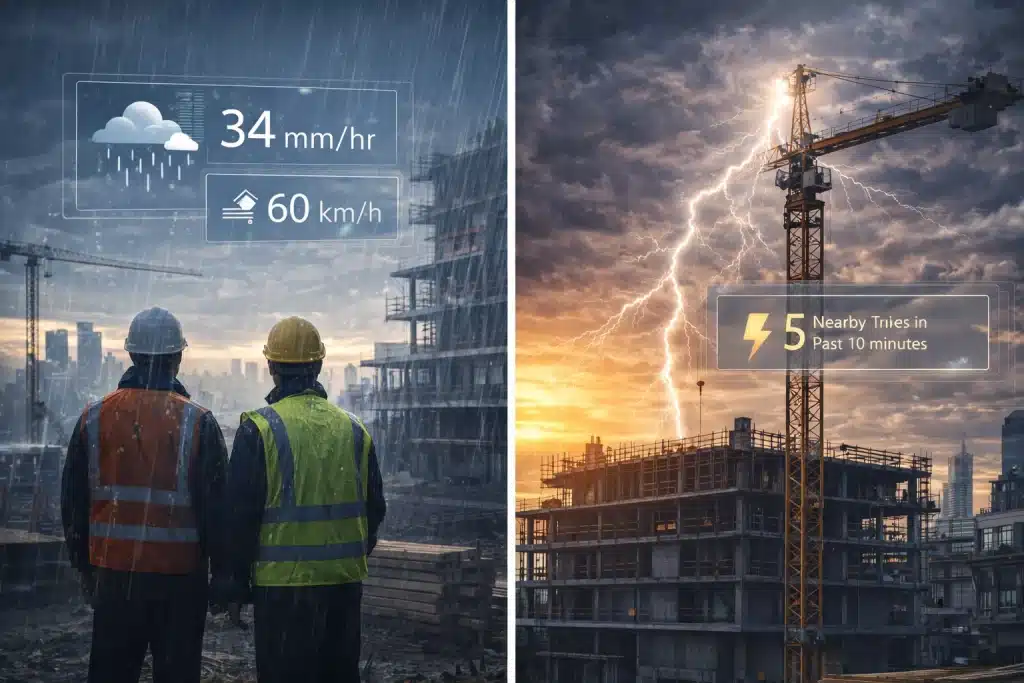
- Precipitation: Heavy rain can prevent concrete pours, which leads to chain-reaction delays.
- Lightning: Lightning storms require work stoppage, especially on electrical components and scaffolds.
- Wind Storms: High wind speeds and gusts can endanger workers at height, such as roofers, and damage expensive equipment like cranes.
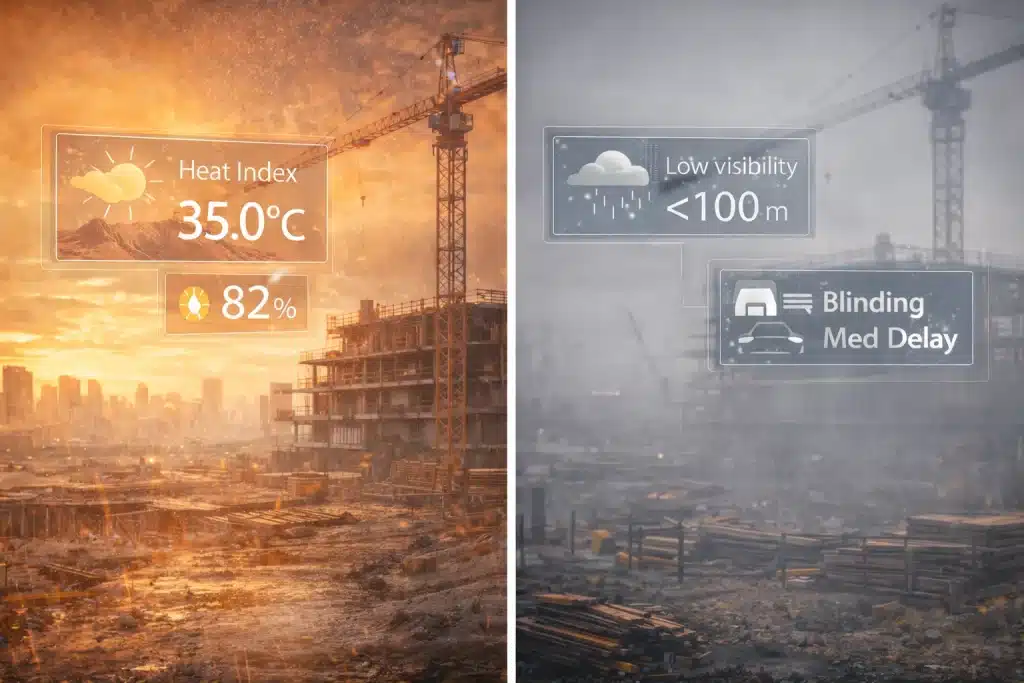
- Extreme Heat: Laborers are at high risk of heat exhaustion or heat stroke when the heat index rises about 80°F, leading to both delays and compliance issues.
- Freezing Temperatures: Concrete, exterior paint, and adhesives cannot set properly when the temperature is below a certain threshold. Extreme cold can also damage equipment and endanger workers.
- Low Visibility: Fog, mist, or rain may seem like ordinary weather events for the average person, but they can lead to total work stoppages for high-rise construction sites or roofing projects. Deliveries may also be delayed or stopped due to these issues.
How Construction Teams Use Hyperlocal Forecasts for Smarter Scheduling
Hyperlocal forecast data comes from the area directly around a construction site, not a regional weather map. The information may come from local weather stations, weather buoys, or from specialized data processing techniques like downscaling. When combined with other sources, like satellite imagery and radar, this hyperlocal weather data gives a comprehensive look at current conditions.
These tools are crucial for the construction industry because severe weather events do not move uniformly through a given city or region. One area may be untouched by a heavy storm, while another has to stop work for the rest of the day. Companies may also be managing construction activities at several sites, meaning they may be able to transfer workers from one site to the other depending on conditions.
Through hyperlocal insights on current conditions, companies can optimize operations like subcontractor scheduling, crew allocation, and daily tasks. This prevents unnecessary delays or rushed work.
Using Real-Time Weather Data to Improve Job Site Safety Planning
High-quality weather forecasts let site managers stay one step ahead of the storm. Lightning data can initiate stand-downs, while wind speed information helps keep lift operators safe. Managers can also develop heat stress and extreme cold protocols so that construction workers can act quickly if certain parameters are crossed.
Weather-Driven Risk Management for Materials, Equipment, and Site Access
Weather plays a pivotal role in equipment storage and maintenance cycles. Moisture can quickly damage or warp porous materials like insulation or drywall, while concrete and adhesives do not cure properly when solar irradiance, humidity, or temperature are too high or low.
Construction equipment can cause thousands or even millions of dollars, and while it is typically built to withstand harsh climates and seasonal shifts, managers shouldn’t stress-test these parameters. Wind shear, water exposure, and freezing temperatures can damage components like hydraulics or brake lines. Knowing potential conditions ensures each piece of equipment can remain in service.
Lastly, weather influences construction site access. Impassible roads, heavy mud, and icy surfaces all pose serious dangers not just to workers, but also to equipment and timelines.
Where Real-Time Weather Data Fits Into Construction Operations and Reporting
Weather and climate data can be easily integrated into daily standups and progress reports to contextualize issues like work stoppages or schedule changes. By incorporating weather data into documentation, contractors can also better justify management decisions to other stakeholders, which can prevent costly disputes or miscommunication.
Weather API Integration for Construction Software and Dashboards
A weather API enables seamless integration of weather data into resource planning tools, management dashboards, internal reporting platforms, analytical tools, and industry apps. Rather than having to check multiple dashboards, everything is available in one place.
With an API response, contractors can access global weather data, including hyperlocal and real-time information, or query historical weather data to predict potential conditions several months out. These APIs also provide customized alerts for chosen parameters like wind direction and speed, or severe weather like hurricanes, depending on your needs.
What to Look for in a Real-Time Weather Data Provider for Construction?
To find the right provider, consider the hyperlocal resolution and accuracy. Frequent updates ensure that you’re never surprised by severe weather, while added historical weather data provides important context and improves planning. Alerting capacity, ease of integration, and reliable access also ensure that you have the information you need to succeed.
Another key factor is scalability. Enterprise customers may need high-resolution information for a range of areas, like Western Europe and South America, in addition to the US. Look for a provider that can reliably handle high-volume requests.
Lastly, specialized datasets like energy generation data or degree days may prove valuable to your construction projects if accurately integrated. A good provider can help walk you through your data options and determine the right datasets for your needs.
Keeping Construction Projects on Track With Real-Time Weather Data
Real-time information keeps construction projects on track, on budget, and in compliance with all regulatory standards. When combined with other tools like global historical weather data and government weather alerts from sources like the National Weather Service, this data ensures that construction professionals have everything they need for comprehensive resource planning.
A weather API can easily provide both real-time and historical data, cleaned and compiled for statistical analysis or immediate deployment in dashboards. Tools like Visual Crossing use a convenient CSV or JSON format that is simple to incorporate into a database. By collecting information from a range of sources, APIs ensure high accuracy.
Whether you operate a small construction site or manage a multinational corporation, consider how quality weather data and API-driven workflows may help enhance productivity and mitigate risk.
FAQs about Real-Time Weather Data for Construction
This is locally sourced, accurate weather data that is updated in real time. The difference between this weather data and general sources is the resolution and focus on condition thresholds.
Hyperlocal forecasts are highly accurate and often outperform regional weather analysis. They typically rely on AI models and on-site, Internet of Things (IoT) sensors that can identify small climate shifts that larger forecasts miss.
These alerts allow managers and construction crews to quickly adapt to changing conditions. In many cases, real-time data enables teams to take preventative measures, such as covering sensitive equipment or delaying concrete pours by several hours. Even if a delay occurs, the knock-on effects are reduced by quick action.
Precipitation, such as rain and storms, is the most common schedule disruption. While a small rainstorm may not cause significant delays, timing and intensity matter. A sudden downpour could prevent concrete from curing, soak porous materials, and damage equipment, even if the shower only lasts a few minutes.
To minimize delays and prevent costly mistakes, construction companies should incorporate weather data into their planning dashboards and project management tools. This way, they will always be prepared for changing conditions.
Yes, a weather API can be integrated into construction project management tools. Companies like Visual Crossing offer several ways to easily integrate weather data into workflows, including Excel Weather Workbooks and Multi-Site Forecast Workbook. You can set up alert parameters, choose locations, and receive a steady flow of forecast data for minute-by-minute decision-making.