

Commercial weather API integration helps businesses access key weather data that can significantly impact their operations. Real-time, historical data, and weather alerts can help with last-minute schedule adjustments, trend analysis, and future planning. Through this tool, businesses can build smarter operations and enhance ROI.
Understanding Commercial Weather API Integration
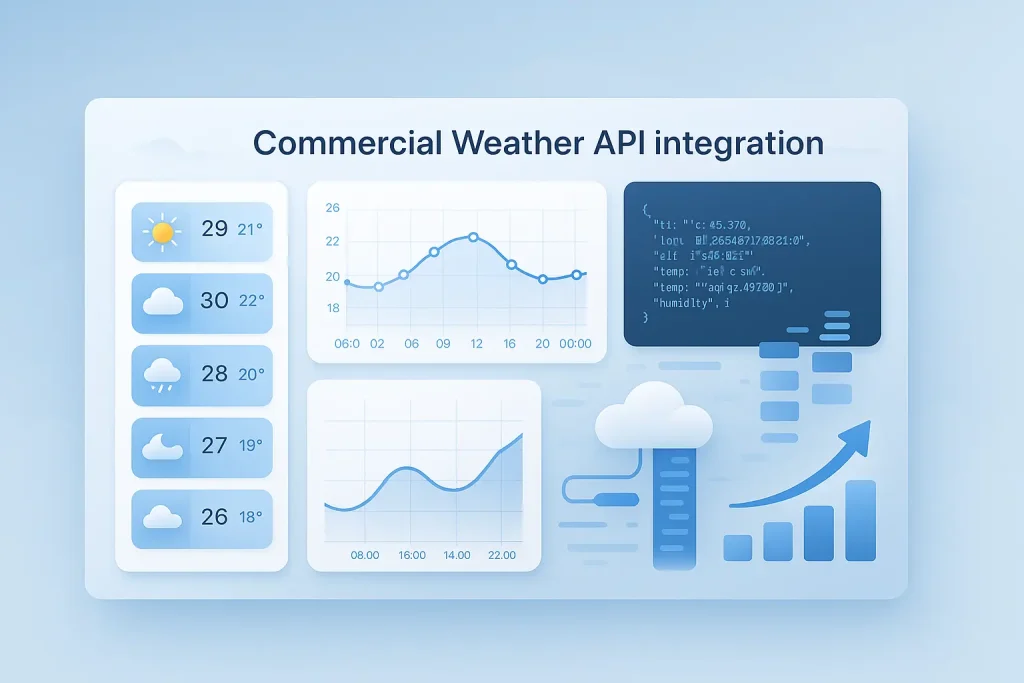
Integrating weather API tools involves securing an API key. This serves as a passcode to the cloud-based weather data servers. The user then makes an API call, which is a request for specific data. The API response then includes the requested data in the preferred output format, such as JSON format or CSV format.
The Importance of Weather Data for Commercial Applications
Dozens of industries leverage weather data for commercial use, including retail, energy, sports, entertainment, and logistics. Through daily forecasts and historical data, businesses can make real-time decisions based on the available information, which ensures more seamless business operations.
Key Features of Commercial Weather APIs
While free access to weather data may be useful for the general public, enterprise companies may hit their daily limit within only hours. To ensure access to the best information, they need an enterprise-level tool. Benefits of a commercial weather data tool include:
- Real-time access by geo-location
- Global reach through trusted sources like NOAA, National Weather Service, and European Centre for Medium-Range Weather Forecasts
- Specialized weather data like UV index and soil moisture
- Rich historical data for trend analysis
- Reliable access with high uptimes and dedicated support
ROI Benefits of Commercial Weather API Integration
The weather API ROI is immense, easing operations in nearly every aspect of a company. This includes:
- Improving operational efficiency
- Reducing costs
- Boosting customer satisfaction
- Increasing profit margins
Optimizing Commercial Applications with Weather Data
Optimizing commercial apps with weather data enables the development of smarter, more comprehensive, and user-friendly tools. By embedding weather intelligence into applications, companies can allow clients to see a more holistic perspective of current conditions, supplemented by industry-specific elements like wind speed or air quality.
Enhancing User Experiences with Weather Insights
Customer-facing apps can also benefit from weather integration. By incorporating weather forecasts, customers can receive personalized recommendations tailored to the current weather, thereby enhancing safety. Additionally, a more comprehensive tool will boost engagement, which builds brand loyalty and trust.
Reducing Risks Through Weather-Driven Decisions
Weather poses challenges to companies across industries. These can include:
- Supply chain disruptions
- Staff safety during adverse weather
- Under- or overscheduling
- Regulatory compliance issues
- Lost time or wages
Through weather tools, companies can mitigate their risks, increase compliance, and ensure customer satisfaction.
Technical Aspects of API Integration
Integrating this tool requires some technical knowledge. Firstly, you will need an API key, which is a unique identifier that allows your specific account to access the server. The key can be used with almost any programming language and will produce outputs in JSON, XML, or CSV.
To retrieve data, such as a historical forecast for a certain location, you must build a query. This is always formatted in a specific way and always includes your key. We have example queries available in our documentation that demonstrate how to produce a query. Query Builder can help you format your query for the preferred parameters. Additionally, you can use our AI code generator to create your query for any supported language.
Security Considerations in Commercial API Integration
Security is key for commercial weather data operations. Not only must you be compliant with your government’s data security regulations, but customers will lose trust if there is a data breach due to an unsecured key.
Visual Crossing does not store or access confidential data except in very specific circumstances that are always in your control. While a third party gaining access to your key would mean they can make weather queries under your account name, it would not allow them to access any other information on your servers. All payment information provided to Visual Crossing is stored on our third-party payment provider’s servers, not ours.
For APIs, the primary personally identifiable information (PII) is your location. In the event that another party gains access to your API key, location-based queries may be used to determine your business location or expose business operations. However, this can be avoided by structuring your query for a more general location rather than a specific latitude and longitude. You would also want to avoid using the Name parameter, which allows you to name frequently requested locations for more streamlined querying.
Data security is important on an organizational level as well. Ensure that you train your employees on what an Application Programming Interface is, how it works, what data we have access to, and how to secure the key so that third-party actors cannot exploit it.
The Role of Historical Weather Data in Commercial Applications
While real-time data is important for immediate decision-making, historical weather information can also be invaluable to an organization. By understanding typical weather patterns, companies can forecast future conditions and optimize their operations to account for any severe weather events.
When considering “How does Visual Crossing help with commercial weather applications?” a common use case is reviewing historical data in the insurance industry. This allows companies to assess the risk of common weather events like flooding and set premiums accordingly.
Another common use case is for event planning, such as deciding when to host an outdoor festival or sports tournament. Planners can look at historical averages across multiple factors, such as temperature and humidity, for a given date range, and determine whether conditions may be suitable for their chosen activity. If the given period has historically been in the triple digits with high humidity, then planners may decide that the risk is too high and move the dates. By doing so, they can reduce their weather insurance premiums, optimize supply chain management, and protect the safety of both spectators and participants.
Real-Time Forecasting for Operational Efficiency
Real-time updates are critical for certain industries, including transportation and retail. This enables last-mile decisions, such as whether to reroute a delivery due to a snowstorm or to adjust staffing levels during a rainstorm. This way, a company can use all of its resources for maximum impact without wasting time or money.
Scaling Applications with Weather Data
Scalable integration ensures that companies can make as many requests as are necessary to support their operations. Companies should choose a provider with an enterprise option, which can handle high data loads with minimal downtime. Additionally, these tools should provide
Choosing the Right Commercial Weather API Provider
Choosing the right provider can make a significant difference in whether you have access to high-quality, global weather data right when you need it. Consider these key factors when selecting a provider.
- Data Accuracy: A good tool will draw from multiple sources, including government and hyper-local data, for enhanced accuracy.
- Scalability: While a free key is useful, it may not have the robustness necessary for an enterprise operation. A good provider has multiple tiers depending on your needs, so that you’re only paying for as much as you use.
- Global Coverage: Global forecasting is especially important for logistics companies, which may have shipments from across the world, but it can also prove helpful for retail, energy, and agricultural operations. A good provider should have data sources from around the globe.
- Support: Extensive documentation, a dedicated support system, and helpful forums are all vital for ensuring you get the help you need at any time.
Cost Considerations and Licensing Models
While every provider differs, most have several options: free, metered access, and subscription tiers. A free key typically has non-commercial licensing, meaning that you must use Creative Commons attribution if you want to include it in your own tools. Additionally, there are strict limits on how many records you can request per day, which may not be enough for your needs.
Metered pricing allows you to pay only for the number of records you need at any time, making it a good option if you are testing the tool for a limited release. As you require more data, a subscription model gives you limits on how much you can request per day and may include additional, specialized data pools.
Measuring ROI After Integration
Measuring ROI is crucial to ensuring that you’re gaining the most benefit from the service. Key performance indicators include:
- Reduced downtime
- Cost savings
- Decreased waste
- Higher percentages of on-time deliveries
- Improved customer engagement
Future Trends in Weather API Technology
Weather technology continues to improve, making it even more helpful for businesses of all sizes and industries. Future innovations include AI-powered forecasting, more granular analytics, machine learning integrations, and more precise data.
Common Challenges in API Integration and How to Solve Them
- Data Overload: Companies may request irrelevant data as they are not sure exactly what they need, then have to sift through all the information to find actionable insights. A good plan is to start with the basics, like temperature and precipitation, then assess whether more information is required.
- Compatibility: While an API key is compatible with most applications, companies may still struggle with integrating it into their existing software. Thankfully, Visual Crossing has developed an AI assistant that can immediately answer your questions and guide you through the integration process step by step.
- Downtime: Some products have more downtime than others, which can prove frustrating when you need immediate data. If you are purchasing an enterprise license, ensure that uptime guarantees are included in the contract.
Best Practices for Commercial Weather API Integration
While weather data is exceptionally helpful for businesses of all sizes, a smooth integration is key to gaining the most benefits. Consider these elements before you implement an Application Programming Interface.
- Consider Scalability: Before signing a contract, ensure the provider has tiered options that will let your company grow in the future.
- Testing: Start small with minimal data to avoid requesting more than you need. Conduct beta tests to assess whether the product meets your needs before adding more options.
- Schedule Reassessments: Whether on a monthly or quarterly basis, test whether the weather data is providing a strong ROI, what information may be more helpful, and whether you need to upgrade your system.
- Solicit Feedback: Collect information from end users to understand how they are interacting with the weather data and whether it is meeting their specific needs.
Through these steps, you can harness the tremendous potential of weather data in all aspects of your operations, from logistics to sales.
FAQs on Commercial Weather API Integration
What is a commercial weather API?
A commercial weather API is a tool that integrates accurate weather data into applications, such as logistics applications.
How does commercial weather API integration improve ROI?
Integration can help companies make informed decisions based on current weather conditions. This can improve ROI by reducing downtime and streamlining operations.
Which industries benefit most from weather API integration?
Various industries can benefit from these tools, including logistics, e-commerce, retail, agriculture, construction, and utilities.
What types of weather data are available through APIs?
A full range of weather data is available through APIs, including precipitation, temperature, wind gusts and speed, solar irradiance, soil moisture, air quality, and historical data.
How secure is a commercial weather API?
Visual Crossing uses robust security measures to protect your data, including next-level encryption through API keys.
How can weather data be used in commercial applications?
APIs offer seamless integration into commercial programs and can be used for a broad range of data-driven decisions, including logistics, transportation, event planning, agricultural operations, and energy generation.
What is the difference between free and commercial weather APIs?
A commercial tool provides a broader range of information, including access to historical weather data and specialized weather forecasts. Free APIs typically only include a small range of current weather data.
How does historical weather data support ROI analysis?
Historical weather data can help companies connect past weather conditions to ROI fluctuations while also helping to predict future weather conditions.
Can commercial weather APIs provide global coverage?
Yes. The best weather APIs, like Visual Crossing, include seamless access to global weather data from thousands of sources, including government databases and local weather stations.
How do businesses measure success after API integration?
The success of API integration can be measured based on revenue generation, API calls, user experience, cost savings, and user engagement.
What technical requirements are needed for API integration?
We provide detailed information on technical requirements in our documentation, which includes accessible endpoints, data formats, encryption, and input validation.
How reliable are commercial weather APIs in terms of uptime?
Enterprise tools are highly reliable. Visual Crossing boasts a 99% uptime and a dedicated support team, ready to address any concerns.
How does weather API integration help with customer experience?
API data provides severe weather alerts, keeps customers informed of potential delays, and enhances communication.
Are commercial weather APIs scalable for large enterprises?
Yes, commercial weather APIs are highly scalable. With an enterprise plan from Visual Crossing, you can submit an unlimited number of requests and receive real-time updates.
What future innovations are expected in weather API integration?
Weather data is a powerful tool that continues to grow stronger every year. Machine learning is improving the precision of daily and hourly forecasts, while more advanced weather imagery is enhancing the current data to be even more useful to businesses of all types.
How does API integration improve route optimization in logistics?
Real-time and forecast data help logistics companies avoid hazardous conditions, optimize delivery routes, and reduce downtime.
What role does real-time forecasting play in commercial weather API ROI?
Knowing current conditions significantly enhances ROI, as it helps businesses make split-second calculations based on emerging weather situations.
How can businesses combine weather APIs with other data sources for better insights?
Businesses can combine weather data with API calls from other services, such as fleet management or grid stability calculations, to enhance their decision-making.