

Following a multi-year R&D cycle, we are excited to be entering the final deployment phase of our upgraded weather forecast infrastructure. This release represents a fundamental shift in our weather forecast data processing logic, model ensemble weighting, and delivery latency, providing the foundation for our 2026 roadmap and beyond.
Core Weather Forecast Infrastructure & Model Expansion
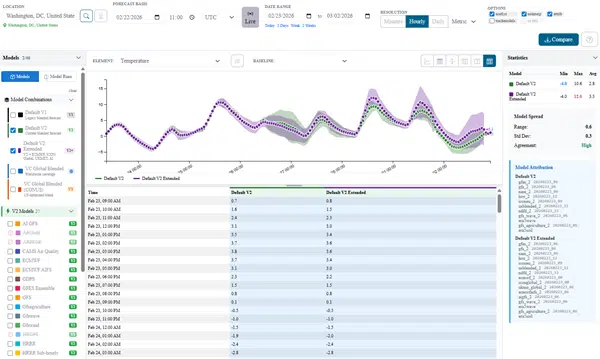
We are significantly broadening our multi-model ensemble to move beyond standard hourly global and regional forecasts. This update integrates more high-cadence regional models to eliminate the “smoothing” effect found in coarser datasets, providing sharper precision for localized events.
- Sub-Hourly Tier: We now ingest data at much higher temporal resolutions, including 15-minute intervals from HRRR Sub-hourly, 5-minute data from the DWD, and near real-time, 2-minute precipitation tracking via MRMS.
- Regional Refinement: We have integrated additional regional models including UKMO (UKV), AROME, ARPEGE, and ICON-D2 across Europe, alongside the NDFD, HRDPS, and RDPS in North America.
- AI & Physics: This release incorporates next-generation AI models like ECMWF AIFS and AI-GFS, supplemented by specialized physics layers such as GFS Wave (sea-state) and CAMS AQ (air quality).
- More models will be added to the infrastructure in the months following our initial release.
Note: While we have previously utilized global versions of these models, this release integrates the raw, sub-hourly, and high-resolution regional variants previously unavailable in our standard pipeline.
Probabilistic Intelligence: Weather Forecast Spread & Confidence
This migration marks an expansion from deterministic forecasting to a probabilistic framework. By processing multiple ensemble members, simultaneous model runs with perturbed starting conditions, we can now quantify atmospheric uncertainty.
- Ensemble Spread: We are exposing the Standard Deviation across ensemble members. A low spread indicates high model convergence and stability, while a high spread notifies users of increased volatility.
- Confidence Scores: We provide a confidence element that analyzes current ensemble agreement and model agreement. This allows users to programmatically determine if a forecast is more or less reliable than is typical for that specific location and lead time.
Near real-time weather forecast data ingestion
We have overhauled our ingestion architecture, shifting to a stream-oriented pipeline that achieves near real-time ingress. Most models are now served via the Weather API within minutes of their release by originating weather agencies. This shift also permits raw weather model run access, allowing users to retrieve unchanged model runs and previous iterations for analysis and side-by-side model auditing.
Optimized Model Blending & High-Resolution Radar
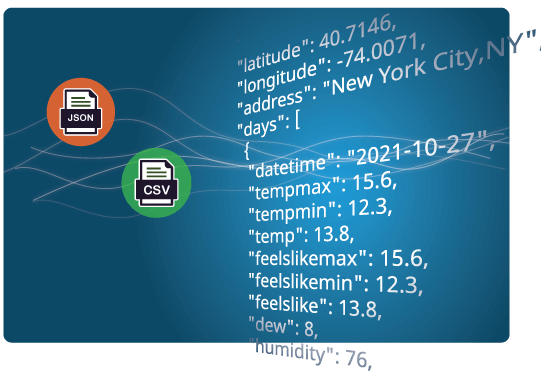
Our forecast model now utilizes a deep machine learning layer for regional weighting. Instead of a static blend, the system analyzes per-grid-cell performance to prioritize models with the lowest Mean Absolute Error (MAE) for specific coordinates. Simultaneously, our radar footprint is expanding across North America, the UK, and Germany, delivering raw reflectivity and derived products like real-time, hyperlocal precipitation estimates, hail probability, and precipitation typing with near-zero latency.
Roadmap: 1km Resolution & Historical Persistence
Increased storage retention now allows for retrospective analysis of the forecast at any historical timestamp. This infrastructure supports our transition toward a 1km grid resolution or better in supported regions, with upcoming integrations for satellite-derived cloud/hail data and high-granularity solar irradiance metrics.
In addition, this infrastructure will allow users to retrieve historical forecasts for particular times of day.
How to access the new weather forecast data and FAQs
Preview Access: Early access to new model outputs is available for testing by existing subscribers. Please contact our technical support team for a preview-authorized API key.
API Billing: Standard request structures and existing elements remain at current pricing. Specialized features like raw model downloads or 1km resolution may fall under premium tiers.
Schema Changes: The update is fully backward API compatible; no weather API query modifications are required.