

Weather uncertainty is the gap between forecast weather conditions and actual on-the-ground conditions. While this may be a minor inconvenience for the average person, it can lead to serious issues for construction site managers, including unexpected delays and potential compliance concerns.
As construction projects are highly sensitive to weather disruptions, nearby city forecasts are not enough. Site managers and construction planning teams need site-specific, real-time weather monitoring for resource allocation, worker safety, and project management.
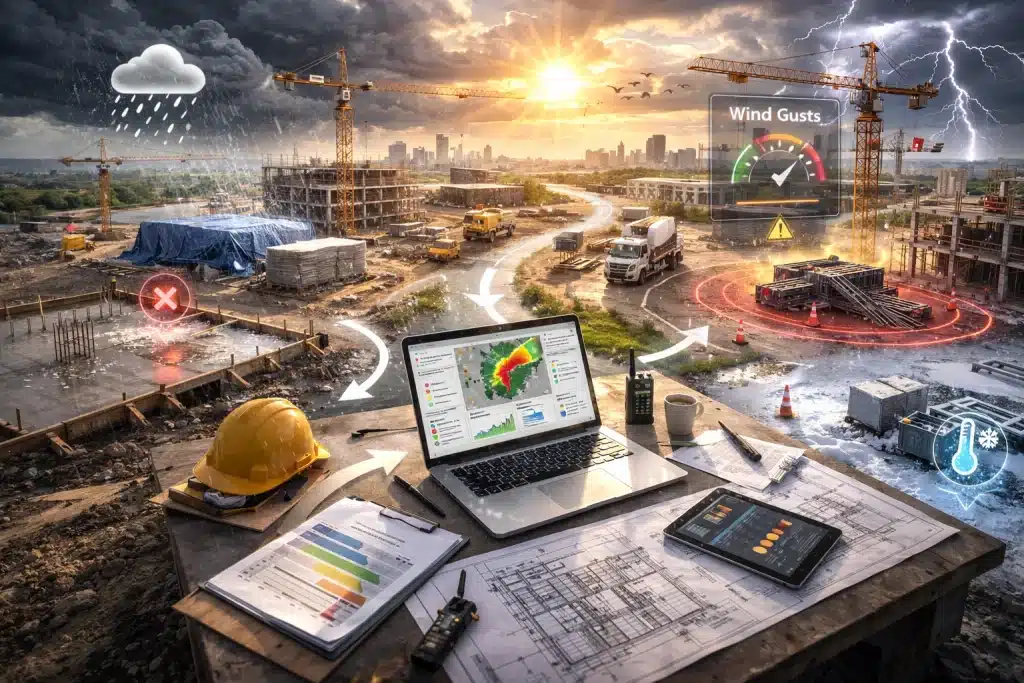
Why Construction Is More Sensitive to Weather Than Most Industries
Construction companies work outdoors, so understanding weather patterns is essential to daily operations. First, construction timelines are based on sequencing: teams must complete some critical tasks before others. Second, certain tasks are both time and weather-dependent, such as curing concrete.
Significant delays due to adverse weather conditions can shift the entire project timeline, costing stakeholders thousands of dollars. There are also safety risks, such as damaged construction equipment, workplace injuries, or OSHA fines due to unsafe work conditions.
The Real Cost of a Weather Delay (Beyond the Schedule)
Unexpected weather events do not represent just a hiccup in the scheduling process, but financial losses for project stakeholders and employees.
- Labor Downtime: Unions and government agencies prohibit construction crews from working in dangerous weather. Specialist contractors may still require payment for their time even if they cannot complete their work.
- Rework: Certain construction activities may be damaged by adverse weather, like ruined drywall or uncured concrete. This requires not just more materials, but additional wages for the construction workers forced to redo their work.
- Rescheduling Contractors: Construction managers know that certain subcontractors are in high demand and may have scheduled jobs months in advance. Rescheduling their time on a construction project may require negotiation and adjustments to the timeline.
- Equipment Rental Extensions: Equipment often comes with strict contracts and return deadlines. When managers fail to plan ahead of weather-related delays, they may have to renegotiate the contract, pay penalties, or stop work until they can rent the equipment again.
- Missed Deadlines: Managers often discuss project momentum, which is how each task flows into the next. Work stoppages at the construction site can have knock-on effects for later deadlines, sending the entire project over budget.
How Inaccurate Forecasts Trigger Cost Overruns
Inaccurate weather predictions can lead to wrong confidence, causing crews to mobilize based on unreliable data. For example, a forecast may provide a severe weather alert for the wrong area, so teams pack up and leave when they could have stayed.
On the other hand, a regional forecast that doesn’t account for localized extreme weather events, such as high wind speeds or microbursts, may put crews and equipment at risk.
The issue is that construction projects have dozens or even hundreds of people on site at a given time, all of whom need to be paid for their time. Sending them home when they could have worked, or bringing them to the construction site only to release them, can cost thousands of dollars.
The Hidden Domino Effect of Weather-Driven Disruptions
Construction activities are tightly sequenced, with each driving the next part of the process. Unexpected stoppages due to sudden weather changes lead to project delays far down the work chain.
For example, heavy rainfall may make it impossible to lay concrete, delaying completion of the foundation. This results in problems for site inspectors, plumbers, scaffold workers, framing teams, masonry specialists, and other teams.
Weather Forecasting Construction Challenges by Season
Each season brings its own unpredictable weather patterns. Spring storms, extreme heat in summer, autumn hurricanes, and freezing temperatures in winter each require contingency plans and safety measures. With early warnings and real-time weather data, planning teams can make informed decisions about stoppages or alternate timelines.
Rain and Storm Risk: The Most Common Cause of Work Stoppages
Rain and severe storms are among the most impactful weather events because they affect multiple aspects of a construction project. Ground conditions, electrical safety risks, and material damage are all influenced by precipitation.
However, the timing and intensity both matter. A light rain over several hours may not require work stoppage, but a sudden downpour could impact project planning for weeks to come.
Wind Forecast Errors and Their Safety Impact
Any project that requires working at height must account for wind speed and direction. Cranes, lifts, and scaffolding cannot be safely operated above certain wind thresholds, while a sudden gust could cause a roofer to fall from several stories up. Accurate forecasting for wind events is essential to ensuring both safety and compliance.
Temperature Uncertainty and Cold-Weather Construction Risk
Temperature affects concrete, asphalt, and adhesives, while extreme temperatures can cause equipment malfunctions. Reliable weather data enables project management to carefully time pours, assess curing times, and choose interventions like additional heating.
Heat and Humidity: Productivity, Safety, and Scheduling Issues
Heat and humidity are some of the most dangerous extreme weather conditions for workers. OSHA, which sets standards for the construction industry, recommends adjusting schedules when the Heat Index is above 80°F and mandates interventions such as water, shade, and rest breaks. During labor-intensive project phases, management must consider schedule compression while accounting for productivity losses.
Snow, Ice, and Freeze-Thaw Impacts on Job Sites
Snowstorms are severe weather events that can disrupt construction sites well after the last snowflake falls, requiring plowing, snow removal, and ice thawing. Crews and equipment may be unable to access the site, and frozen surfaces pose a severe safety hazard. Unstable surfaces can also cause serious injuries.
Visibility, Lightning, and Severe Weather Work Stoppage Rules
No construction project should continue when there is lightning in the area due to the high risk of electrocution. Natural disasters, such as hurricanes or tornadoes, require immediate evacuation and later site cleanup. However, low visibility is a common weather-related challenge that can temporarily pause work. With accurate weather data, teams can adjust schedules to ensure compliance.
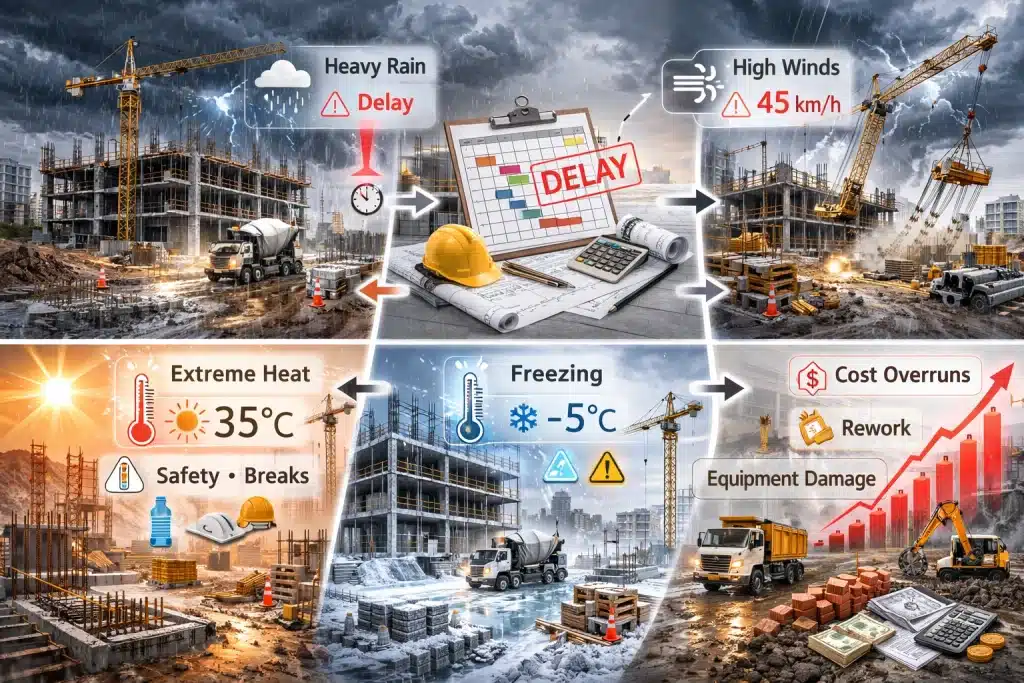
How Weather Impacts Key Construction Phases
The most weather-sensitive phases are site preparation, concrete work, roofing, exterior work such as masonry, and finishing. Each has different safety thresholds for temperature, humidity, wind speed, and precipitation. Forecasting accuracy is critical to keeping project timelines on track, as it enables teams to determine whether it is safe to proceed and how much time may be lost.
Materials and Equipment at Risk During Weather Delays
Drywall, insulation, lumber, coatings like paint or sealant, and electrical components are highly sensitive to weather. Certain pieces of equipment, like pneumatic drills, can also be destroyed by weather exposure. Weather-sensitive storage planning and equipment protection must be considered during the planning phase to ensure fast responses and appropriate resource allocation.
Why Generic Weather Apps Fail for Construction Scheduling
While traditional forecasts are helpful for a general audience, they lack the weather data that construction site managers need to ensure safety. They may only use data from weather stations several miles away or provide only basic overviews of conditions, which could lead to poor decision-making.
Accurate forecasts for construction teams must include hyperlocal data, fast refresh cycles, specific thresholds like wind at height, and historical weather data for project planning.
The Difference Between Forecast Accuracy and Forecast Usefulness
An accurate weather forecast is not enough for construction managers. Rather, they need actionable weather insights, such as timing windows, confidence ranges, and threshold alerts for specific parameters, like wind gusts or lightning radar in a given area.
By integrating weather data into management dashboards, teams can review current and future weather conditions alongside their resource planning and project management tools, making each more actionable.
Planning Around Weather Windows Instead of Weather Events
Seasoned construction professionals know that weather conditions are rarely perfect for a given task. Rather than hoping for optimal conditions, teams can consider workable windows in which weather patterns are expected to remain within safe thresholds for concrete work or crane operations. This mindset can prevent construction companies from stopping work early when conditions still remain operable.
Using Better Forecasting to Reduce Change Orders and Claims
Construction projects can have dozens of stakeholders, from equipment rental companies to investors. When extreme weather events sideline workers, each stakeholder may dispute charges, protest delays, or demand compensation. However, construction companies can reduce this risk exposure through clear documentation.
Contingency plans, including associated weather parameters, should be established at the start of the project. Teams can use both real-time and historical data to guide their timeline development, employing cautious optimism based on potential conditions. Next, weather data should be incorporated into dashboards and project updates so everyone understands why the delay occurred.
How Developers and Project Managers Should Evaluate Weather Data Providers
Not all weather data providers offer tools suitable for the construction industry, making it essential to carefully evaluate each vendor. Consider data resolution, update frequency, weather alert capabilities, historical weather data access, integration documentation, network reliability, and support. Teams should also consider scalability in case their data needs grow with additional contracts.
Another key tool, provided by companies like Visual Crossing, is Multi-Site Forecast Risk dashboards. These allow companies to monitor multiple worksites from a single view, with alerts for potentially dangerous conditions within the next 15 days. Through comprehensive monitoring, managers can deploy resources where they are most needed and adjust timelines for worker safety.
Weather Forecasting for Construction as a Cost-Control Strategy
Given the significant impact of severe weather on construction sites, reliable weather forecasts are essential for cost control. Weather forecasting construction insights can reduce delays, improve project sequencing, protect workers, and boost profit margins through reduced waste.
FAQs about Construction Weather Forecasting
In general, forecasting should be over 90% accurate over a 1-3 day span. Beyond three days, forecasts should be at least 80% accurate. However, the best data comes from hyperlocal weather stations that provide real-time information.
Rain is the primary cause of construction site delays. A single storm could result in a total loss of concrete poured and significant waste if certain materials, such as insulation, are not properly secured.
Construction forecasts differ because they prioritize actionable insights over general predictions. Many use microclimate data from the individual site rather than from a broader area. Additionally, they use thresholds, such as wind gusts that exceed safe crane operation parameters, rather than focusing only on numerical values.
For budgeting and timeline management, construction companies should use a 1-3-month outlook based on historical data. Teams often use a three-week “look-ahead” schedule to adjust work schedules based on the 1-3 month outlook.
Next, seven-day forecasts enable fine-tuning of schedules, such as adjusting concrete placement timing. Real-time data is used when conditions are degrading, or there may be sudden weather shifts, like a wind storm.
Yes, improved forecasting is a valuable way to prevent overruns. Data lets teams adjust schedules, negotiate contracts, protect equipment, and mitigate risks without sacrificing work quality. Whether a company is performing an energy-efficiency upgrade or new construction, knowing the weather enables smarter planning and reduces waste.