

Wind and solar forecasting is crucial for renewable energy production, but inaccurate data can lead to serious issues. When forecasts are overly generic or delayed, renewable energy projects lack the mission-critical information needed to protect assets and ensure optimal performance.
Even small errors can lead to serious consequences in renewable energy operations, including lost revenue. To ensure operational efficiency and safety, energy generation companies need highly accurate weather data tailored to their specific goals.
What Renewable Energy Weather Forecasting Actually Requires
Renewable energy forecasting solutions help predict output from assets like solar farms and wind turbines. This helps asset owners make informed decisions on grid management and resource allocation, and schedule maintenance for solar panels and turbine blades.
Accurate energy forecasts require high-quality weather data with the appropriate resolution, timing, and variables. Additionally, operators need access to historical insights of key parameters, which can help predict future conditions and enhance project planning. These datasets are not typically found in weather apps for the general public, which is why operators must look for sources that specialize in renewable energy forecasting.
Why Generic Forecasts Lead to Expensive Energy Forecast Errors
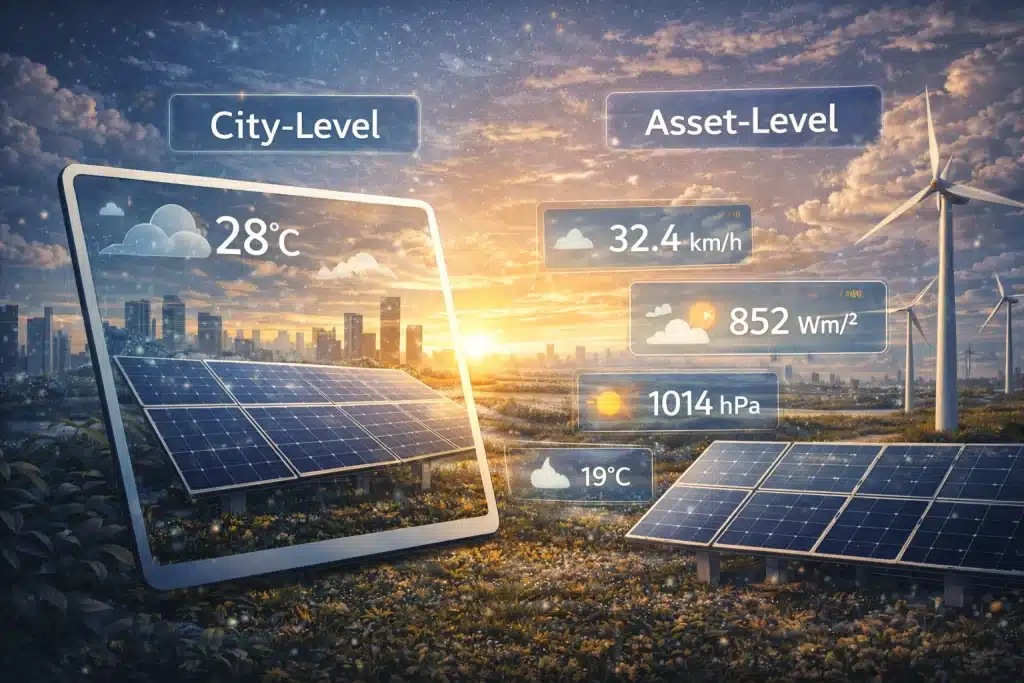
General city-level forecasts are not precise enough for energy production forecasting because weather patterns can vary dramatically across a given region. Small variations, such as increased cloud cover, coastal wake effects, and wind gusts, can significantly affect output from renewable energy sources, even though they go unnoticed by the general public.
These errors affect grid stability and balance. Operational decisions based on generic forecasts may lead to overproduction or underproduction, which causes issues like balancing or storage. Varying output leads to grid strain and could also damage equipment.
To maintain grid reliability, operators need real-time data matched to their precise location. A comprehensive solution will incorporate tools like a weather API that is combined with on-site sensors for a complete picture of current forecasts.
The Role of High-Resolution Weather Data in Solar Forecasting
“Sunny vs. cloudy” is not enough for solar operations. Panels are highly sensitive to small variations in UV radiation, and fast-moving cloud patterns can dramatically alter output within a few minutes.
Key variables in solar energy production forecasting include irradiation, cloud cover, visibility, and temperature. Together, these help grid operators determine how much energy is possible given current weather conditions and balance supply accordingly.
Why Wind Forecasting Breaks Without Hyperlocal Conditions
Wind conditions vary across a small region due to factors such as elevation, terrain, building density, and coastal effects. Even in the same area, the wind speed can be different just a few meters apart. High winds can damage turbines and lead to costly repairs if operators do not monitor weather events.
A comprehensive wind power forecast should include accurate and granular wind speed, direction, gusts, and barometric pressure. This improves grid optimization and prevents asset loss.
Asset-Level Forecasting vs Regional Forecasting for Energy Planning
Regional forecasts can be insightful for some sectors of the energy industry, such as power plants, which must anticipate fluctuations in regional energy consumption and prepare for extreme weather events. However, solar and wind farms depend on weather conditions to generate power. Even small, localized conditions can shift the balance between supply and demand.
Renewable energy operations require accurate weather data for an exact site location and time period. Different renewable sources require different information to optimize operations. Data-driven insights tailored to the given task ensure better grid flexibility and protect an operator’s investment.
How Forecast Accuracy Impacts Grid Operations and Revenue
Renewable energy is a crucial aspect of a resilient energy future, but it must be profitable and sustainable. Inaccurate forecasts can lead to early curtailment and transition to non-renewable sources, increasing carbon emissions while reducing stakeholder trust. Grid integration and reserve planning also require data-driven decision-making to avoid overproduction or waste.
Accurate predictions are also crucial for energy trading for intraday and day-ahead markets. Operational efficiency and profit suffer without the right insights.
What to Look for in Weather Data for Renewable Energy Forecasting
To support a smooth and profitable energy transition, operators need high-quality renewable energy forecasting. This should include the following points.
- High Spatial Resolution: As mentioned, a general regional forecast is not precise enough. High spatial resolution ensures granular insights at the site level. Many data providers use machine learning or artificial intelligence to accurately downscale data and then incorporate IoT sensors to improve resolution.
- Historical Data: Strategic planning depends on accurate assessments of future conditions. A large set of historical weather information can help teams make informed decisions months or years into the future. Ensure that the dataset prioritizes the key factors for renewable energy teams, including wind storms and irradiance. Generalized weather data typically lacks these crucial components.
- Multiple Forecast Horizons: Grid operators look at both the short- and long-term, so having both real-time and long-term data is crucial.
- Availability and Update Frequency: Minute-by-minute updates ensure operators have the information they need to make the right decision. The weather data source should also be consistently available with low downtime.
- Documentation and Support: Those who choose to use weather APIs for forecasting often find them simple to integrate, but there can be problems such as misformatted queries. Having the proper documentation ensures a smooth integration process. A weather data provider should also provide comprehensive support for any issues.
Using Weather APIs to Improve Renewable Energy Forecasting Workflows
To build a sustainable future, operators need the right tools. A weather API supports automated processes, such as adjusting panel angles based on irradiance or shutting off turbines when wind thresholds are too high. APIs are easily integrated into most planning tools, enterprise software systems, and dashboards, which allows a more comprehensive overview of current conditions.
Better data means better energy production with less manual oversight and fewer output issues. Tools like Visual Crossing provide real-time and hyperlocal renewable energy forecasting that is essential for informed decisions.
Renewable Energy Forecasting FAQs
This is a specialized type of forecasting that prioritizes metrics most important for renewable energy sources, such as wind speed and solar irradiance. Renewable energy forecasting provides localized and high-resolution information that can be incorporated into operations planning tools or calibrated for automated workflows.
Wind and solar power rely heavily on local weather patterns, which can vary dramatically across even small distances. A local storm may cause high winds along the coast while a city center remains calm. As such, high-resolution weather data provides “on the ground” conditions at a given site, not a general forecast for a whole region. This ensures operators have the insights they need to make highly precise adjustments to output or schedules.
Understanding hyperlocal weather conditions is crucial for energy production. Small variations in wind direction, speed, and gust patterns can alter turbine functionality or lead to equipment damage. With local data, producers can more accurately assess potential production, identify dangerous wind events, and ensure grid stability.
Certain variables matter more than others for wind and solar, with the most important being the following.
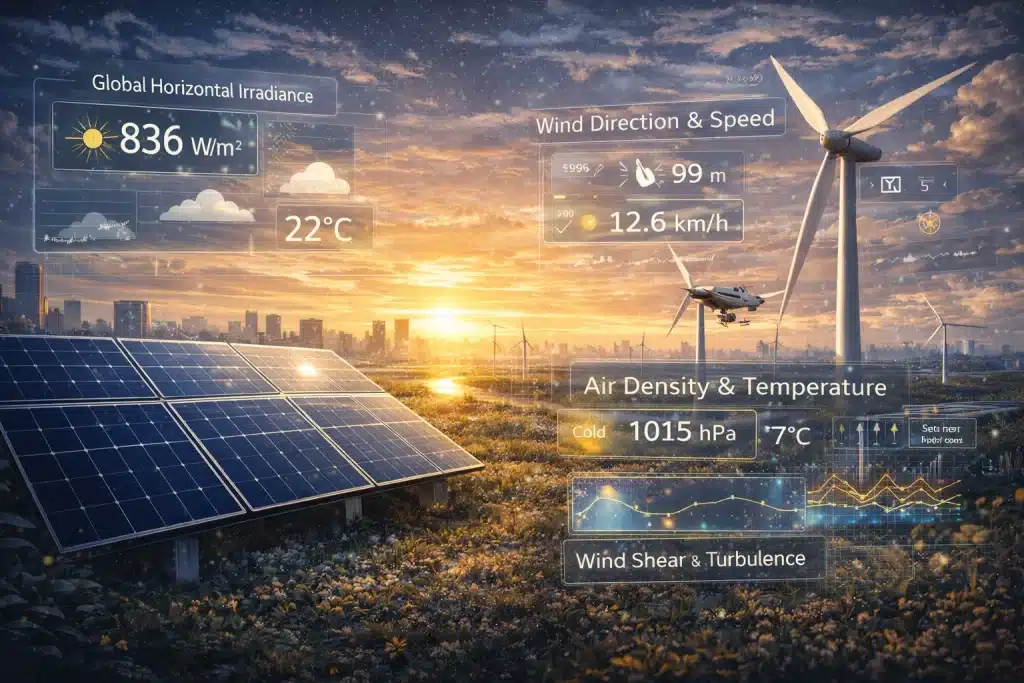
Global Horizontal Irradiance: This measures the total radiation on a horizontal surface like the ground, which helps predict how much energy is available for a solar panel.
Cloudiness: Even a few clouds can reduce output. Cloud tracking helps keep output stable and prevents sudden spikes.
Temperature: The ambient temperature impacts solar power plants, as they lose efficiency in very cold or hot weather.
Seasonality: Winter energy production is lower because there is less UV energy available, while it peaks in summer.
Wind Direction and Speed: A wind farm’s output is directly connected to speed and direction at the turbine hub. Wind blowing in the wrong direction can damage turbines while reducing output.
Air Density and Temperature: Cold, dense air is ideal for turbines and will improve their efficiency.
Wind Shear and Turbulence: Sudden variations in speed and direction can damage equipment and reduce output.
Atmospheric Conditions and Aerosols: Both wind and solar plants must consider air conditions. Fine particulates can damage panels, while changes in atmospheric pressure could suggest changes in large-scale wind patterns.
Yes. A weather API provides real-time and hyperlocal updates, especially integrated with on-site Internet of Things (IoT) sensors. Rather than delivering generalized forecasts, an API can use AI and other methods to downscale data for a given area. Specialized datasets ensure that producers have the specific data points necessary to optimize operations in the energy industry.
Additionally, an API can be integrated with other planning tools, like grid management platforms or scheduling software. This makes it easy to see current conditions at a glance, without having to manually check other sources. By integrating an API with automation software, operators can quickly adjust outputs when conditions deteriorate or improve.
An API is a valuable tool for other aspects of renewable energy production, including estimating output for energy trading or scheduling maintenance.