

Accurate weather forecasting is crucial to ensuring high crop yields, as agricultural management practices rely heavily on climate patterns and soil temperature. Generic, delayed, or unavailable agricultural weather data can affect market value, operational efficiency, and employee safety.
Thankfully, farmers have new tools that combine real-time data, weather forecasts, and historical climate data into one decision layer. Specialized weather APIs for the agricultural sector enable more informed decisions and faster responses to extreme weather events.
Why Weather Data Matters for Planting and Irrigation Decisions
Planting, irrigation, and harvesting depend on real-time factors such as daily temperatures, precipitation, and soil moisture, which cannot be derived from regional averages. Failing to account for these can lead to crop stress, failed germination, irrigation waste, and lower yields. As such, farmers need accurate, frequently updated weather forecasts for their location.
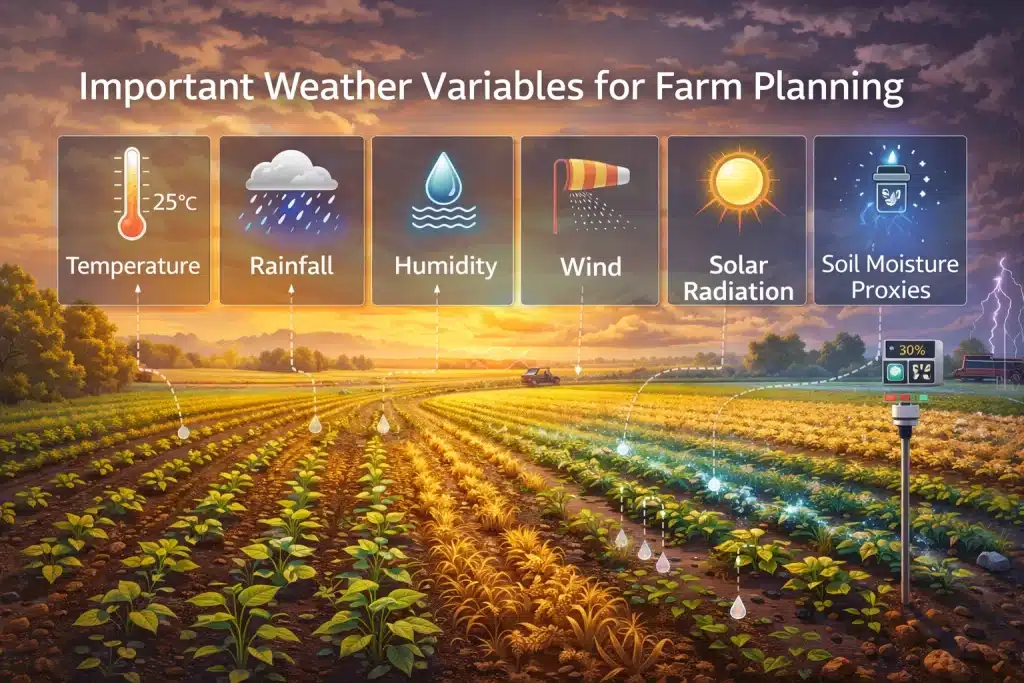
The Most Important Weather Variables for Farm Planning
Certain variables are critical for the agriculture industry, providing a coherent picture of current conditions. These include the following.
- Temperature: Growing degree days are based on temperature and determine plant growth and pest intrusion. Each plant species has a threshold for growing degree days, so tracking this period helps ensure a high crop yield.
- Rainfall: Heavy rain can saturate the soil and damage crops, but drought requires careful irrigation and water management. Knowing when rain is on the horizon allows growers to assess their irrigation needs and avoid wasting resources.
- Humidity: Plants depend on a certain humidity threshold to conduct evapotranspiration, which enables growth. High humidity can slow growth, while extended periods of low humidity can lead to wilting. While farmers can’t control humidity, they can take practical steps to protect their crops, such as adding shade cloths or adjusting soil moisture through mulching.
- Wind: Windstorms can easily destroy a whole field, especially during early growth phases. Farmers can use wind data and wind maxima to plan windbreaks, thereby protecting their crops in the long term.
- Solar Radiation: Plants need a certain amount of sunlight to thrive, but high irradiation can burn them. Tracking cloud cover and solar irradiation lets workers adjust as needed, whether that’s installing shade covers or adding additional irrigation.
- Soil Moisture Proxies: Moisture sensors or proxies help farmers monitor and predict plant growth based on a species’ ideal parameters, enabling interventions such as irrigation or mulching.
Using Historical Weather Data to Plan Planting Windows
Choosing the right planting window is one of the most critical decisions a farmer can make throughout the year. Multi-year historical data can identify optimal planting windows, assess frost risk, and predict precipitation in a given period.
Additionally, comparisons between current conditions and historical baselines allow for precise schedule adjustments. For example, farmers may note that their yields were higher in a year with similar conditions, then choose to plant around the same time this year.
Using Real-Time Weather Conditions to Adjust Irrigation in the Moment
Heat spikes, wind, and humidity can dramatically alter water loss rates, meaning that the same irrigation outputs could result in over- or under-watering. Accuracy in irrigation can be the difference between a successful harvest and a significant monetary loss.
With real-time weather reports from a trusted weather API, farmers can assess expected conditions and adjust their irrigation plans accordingly. This could include delaying irrigation, adjusting volume, or shifting timing.
Forecast Data for Irrigation Scheduling and Water Conservation
One essential benefit of forecast data is that it enables farmers to determine future irrigation schedules. This is especially important in drought-prone regions, where even one mistimed irrigation session could leave crops vulnerable to wilting later in the season.
Upcoming rainfall, wind events, or heat waves can require adjustments. With advance notice, farmers can reduce unnecessary watering and conserve vital resources.
Combining Historical, Real-Time, and Forecast Data in One Workflow
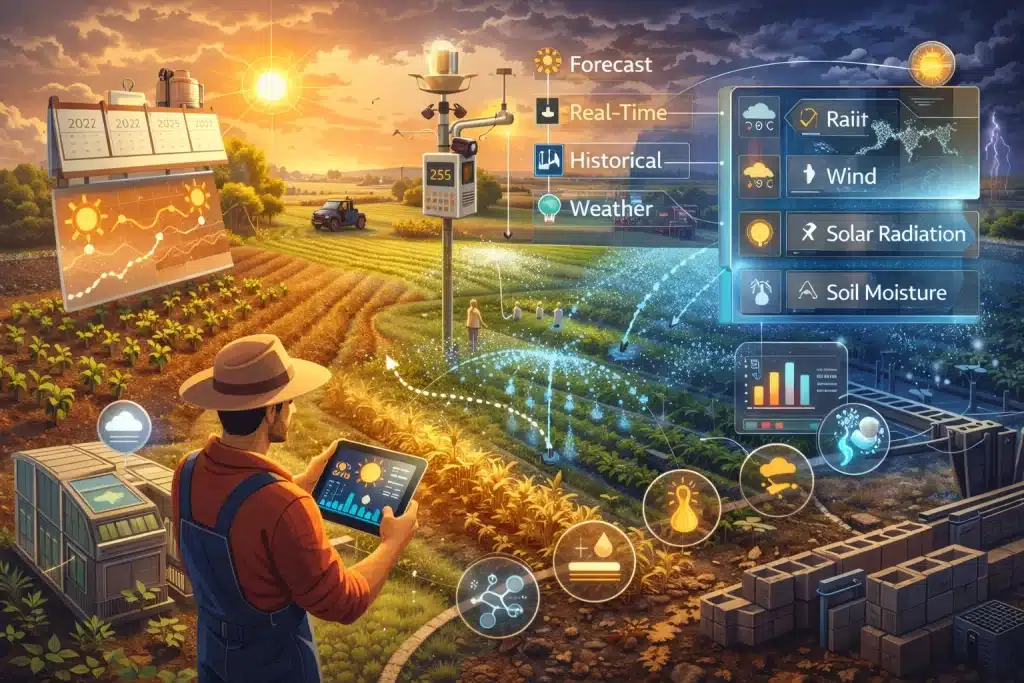
Having to check multiple platforms for weather information wastes resources and can mean that vital insights are overlooked. Companies can use an API to review historical reports, weather models, and real-time weather maps all in one place. This provides a more comprehensive overview of past, present, and future conditions.
This is crucial for automated workflows, such as timed irrigation systems or livestock feeding stations. Users can employ sensors and algorithms to adjust scheduling or output without manual intervention, which saves both manpower and resources.
How Visual Crossing’s Timeline Weather API Supports Agriculture Use Cases
Visual Crossing’s weather API is a business-ready tool that combines historical, real-time, and forecast data into one convenient workflow. The API is easily integrated into farm management, analytics, and automation systems, with an intuitive, consistent structure that enables analysis at a single glance.
Supporting Farm Management Platforms and Dashboards with Weather Data
Farmers, governments, and agribusinesses utilize weather data in farm management software, irrigation control tools, and operational dashboards to support automation and operational decisions. Whether they need to assess hail risk or track climate change, stakeholders across all agricultural sectors require access to consistent and updated weather insights in their dashboards.
Improving Forecast Confidence with Quality-Controlled Data Inputs
Forecast accuracy is not enough on its own. Farmers typically require clean, standardized data from local weather stations that allows comparisons across multiple microclimates and years. This reduces risk and ensures consistent operational outputs.
Scaling Weather Data Across Multiple Fields, Regions, and Crop Types
Large agribusinesses may need granular data spanning multiple states or world regions, which is why scalability and consistency are key considerations for any agricultural weather API. To choose the correct option, consider volume output, refresh cycles, global coverage, and consistency.
Best Practices for Using Weather Data for Agriculture Analytics
For the best results, employ these tips:
- Set thresholds, particularly for severe weather, and tie to automated systems.
- Monitor data trends and compare them with historical averages to identify future issues.
- Develop irrigation scheduling rules and regularly assess crop health.
Common Mistakes Farms Make When Using Weather Data
- Using Generic Forecasts: Agricultural weather requires specialized datasets, making it essential to choose a tool that fits your needs.
- Relying on Distant Stations: Ideally, you would integrate an API with local weather stations that can offer current conditions in your field. A single data point several miles away cannot provide the granular data you need.
- Ignoring Significant Climate Data: Wind patterns and evapotranspiration rates can have a massive role in yield rates. Ensure you incorporate them into your workflows so you can monitor as needed.
- Failure to Validate Conditions: Each field is a microclimate with its own specific patterns, which significantly influence crop health. Ensure you monitor conditions across every field of interest rather than relying on a regional forecast or general history data.
How to Get Started with Weather Data for Agriculture?
To get started, follow these steps:
- Select your key weather elements. These include temperature, precipitation, humidity, wind speed, and solar irradiance.
- Choose a historical range for your comparative assessments. Thirty years is a common range.
- Determine your update cycles. Hourly update intervals are usually sufficient, but some choose a 6-hour refresh cycle.
- Connect data to irrigation workflows and automation systems.
You can always test with a smaller region and then expand to your whole operation.
FAQs About Weather Data for Agriculture
Temperature
Humidity
Precipitation
Wind speed
Solar irradiance
Thirty years, with an emphasis on the last 10 years, is a typical threshold for planting decisions.
Daily is usually sufficient, but some farmers choose 3-4-day cycles.
Yes, this can be invaluable for reducing irrigation costs, as it accounts for expected rainfall and humidity. This ensures optimal moisture levels and can even improve yield.
Choose an API like Visual Crossing, which integrates all of these datasets into a clean, standardized format. The API allows easy integration into most management software and dashboards while supporting automation, such as feed systems and irrigation.