

A renewable energy forecast is critical for today’s clean energy systems. Increasing demand for electricity generation, coupled with high natural gas prices and concerns about global warming, has led many countries to push renewable energy transition as a safer and more sustainable option.
This is where weather forecasting from trusted APIs, such as Visual Crossing, comes into play. With these resources, markets can supply the clean power needed, globally and in regional markets, spurring growth and reducing oil dependency throughout the power industry.
The Role of Renewable Energy Forecasting in Power Systems
Renewable energy forecasting is crucial for balancing supply and demand, ensuring that electric power is distributed as needed and there is adequate battery storage for off-peak times. Through forecasting, companies can determine peak production times and produce enough for expected demand. When conditions are unfavorable, they can either use stored power or switch to other options, such as fuel.
Understanding Power Forecasting Basics
Power forecasting differs from other weather forecasts. In addition to elements such as precipitation, cloud cover, and temperature, it also considers factors like solar irradiation and wind speed, which determine the amount of energy that can be generated from a turbine farm or solar panel. Energy providers can utilize forecasting to prepare for fluctuations in both supply and demand, enabling them to maintain a continuous power supply to the market.
Solar Forecasting for Energy Production
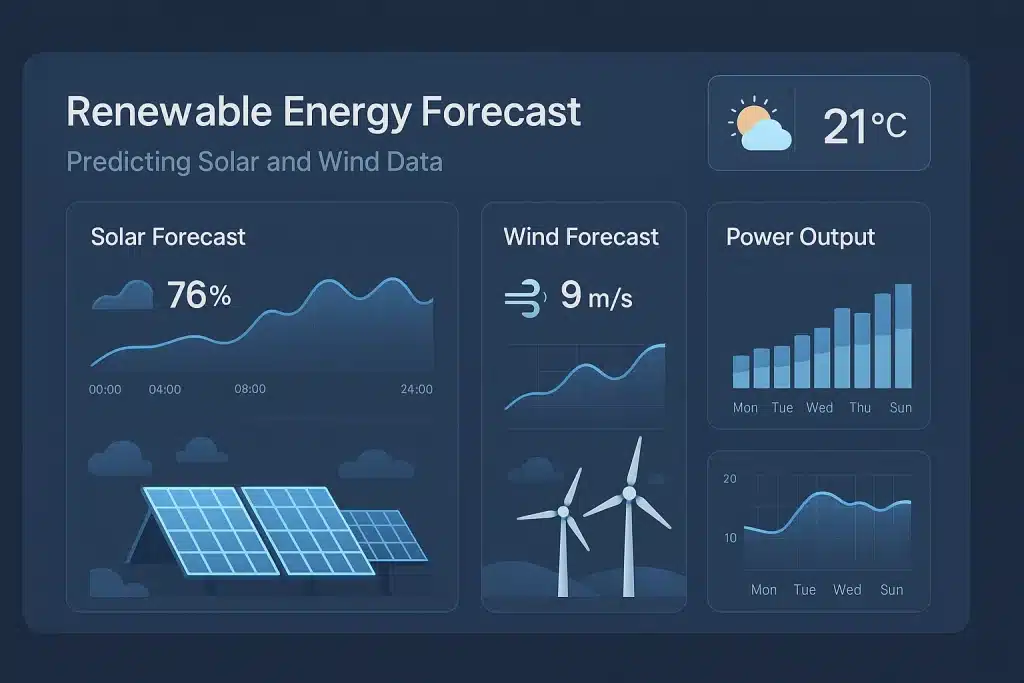
Solar forecasting for energy production focuses on solar radiation and cloud cover, which predict solar panel output. Solar radiance fluctuates by season and region, with the strongest outputs during the summer.
In winter, the days are shorter, meaning there is less time for panels to collect energy. Heavy snow can also cover the panels, which may not produce enough heat to melt it. Together, these mean lower output and may require backup energy sources.
Variations in weather conditions also determine solar output. Cloudy days result in less energy output compared to bright, sunny days, necessitating additional input from stored energy into the system. While a light breeze can cool panels and increase productivity, high winds may damage the delicate photovoltaic cells. Rain can also have sediment or other harmful inclusions that break panels.
Unlike some other industries, where a daily forecast may be enough, utility companies require constant forecasting to assess output, allocate resources, and identify issues with their systems. By integrating weather data into their systems using a weather API, these companies can view the big picture and make immediate adjustments to their output.
Wind Energy Forecast and Grid Planning
A wind energy forecast focuses on wind patterns and speed, which influence how well turbines work. Light gusts may not be enough to move the turbines, while heavy crosswinds may damage the blades. Depending on the turbine’s orientation, gusts from one direction will be more productive than from another.
Additionally, a forecast must consider the varying speeds at different altitudes. A regular estimate for the general public only considers speeds at around 10 meters, but winds can vary significantly at the turbine’s height. This specialized data can help companies schedule energy outputs and stabilize the energy grid on calm or stormy days.
Forecasting is also important during the development stage of a turbine. Road transport of large turbines requires a calm, clear day, while construction cannot move forward when severe weather conditions are expected. They also need to know the typical patterns in the area, such as whether gusts typically come from the north or south, to ensure that they orient their turbines properly for maximum productivity.
By considering every aspect of the forecast, renewable energy companies can protect their employees, equipment, and bottom line.
Wind Prediction and Its Impact on Energy Output
Wind prediction is a complicated science. Factors such as geography, storm systems, and barometric pressure all influence energy production in both the short and long term. As such, energy companies require highly precise forecasting to prevent supply gaps and support efficient operations.
Short-term forecasting helps to identify current outputs and remedy immediate issues, such as strong gusts that may damage the turbines. Long-term predictions can aid in tasks such as scheduling maintenance on calmer days, forecasting demand based on weather conditions, and switching to backup systems during prolonged periods of downtime.
Combining Solar and Wind Forecasting for Grid Stability
Solar, wind, and other renewable energy systems work synergistically to support climate progress. As such, connecting these two forecasting systems can allow for smoother renewable deployment that does not compromise on safety or efficiency.
Through interconnected electricity output and forecasting, utility companies can find the right balance between each of their assets. For example, a calm but clear winter day will likely have high energy consumption, but low wind speeds. In this instance, energy companies can prioritize solar energy while diverting any turbine outputs to energy storage. This helps stabilize the grid and reduces reliance on backup energy sources.
Data Sources Used in Renewable Energy Forecasting
Various data sources are used to forecast renewable energy output, including the following.
- Satellite Imagery: This is invaluable for assessing cloud cover, which influences solar irradiance. It can also identify storm systems that may impact energy outputs.
- Sensor Networks: Weather sensors, both government and personal, provide details on wind speeds, precipitation, temperature, and cloud cover, all of which can influence output.
- Weather Models: Weather models use thousands of data points to forecast future weather in granular detail, which allows energy companies to assess their needs and adjust operations as necessary.
- Historical Data: Historical weather can be combined with weather models to identify trends, such as when storms tend to hit in the winter or when it is likely to rain. In combination, they can offer powerful weather insights that utility companies can leverage for more efficient operations.
Forecasting Tools and Modeling Techniques
Numerical Weather Prediction (NWP) is a complex computer models that use equations to develop accurate forecasts. These take current weather conditions, then simulate future events using the model’s framework. NWP models range from local forecasting to global climatological models.
Another common tool is ensemble forecasting, which runs a single weather model multiple times with slightly different initial inputs. Tiny changes in the initial input can lead to significant variations over time, so an ensemble forecast can provide a range of probabilities.
Both of these tools can be extremely helpful for short-term and long-term energy forecasting. NWP can provide short-term predictions that allow for fast and accurate adjustments to energy systems. Ensemble forecasting, by offering a range of probable outcomes, helps companies prepare for different scenarios and quickly adjust as necessary.
Challenges in Renewable Energy Forecasting
Even as research improves and weather reports grow more accurate, there is still significant uncertainty. The thousands of connections between different weather variables, including global atmospheric patterns, make it impossible to calculate conditions with total precision.
The weather can change suddenly, particularly in certain areas that have more wildly fluctuating conditions. For example, a certain valley may have different weather patterns than the next valley over because of geography, wind patterns, and water sources. This means that even with access to the highest quality data, solar and wind generation may still not match the expected outputs from forecasting models in a given area.
There is also the fact that the world has not yet reached net-zero carbon emissions, meaning the climate will continue to change. As global warming accelerates, the reports published today may not predict future conditions with the same level of accuracy. Not only does this encourage further renewable energy growth, but it also means that companies must remain adaptable.
Benefits of Accurate Renewable Energy Forecasting
Accurate forecasting has a wealth of benefits, both for businesses and for consumers. Some of these benefits include the following.
- Reduced Costs: By more accurately assessing outputs, companies can better allocate their resources and improve energy security.
- Better Integration: Knowing predicted outputs enables companies to estimate demand and smoothly integrate renewables into the energy system.
- Reduced Reliance on Fossil Fuels: While renewable industry growth is strong, wind and solar production are not yet enough to replace fossil fuels. Businesses are now turning to risky methods like enhanced oil recovery or carbon capture to meet energy needs. By optimizing solar and wind development, companies can supply markets with the power they need to thrive.
Renewable Energy Forecasting and Sustainability Goals
The Energy Information Administration notes that in 2022, approximately 30% of the world’s energy came from renewable technologies. However, the US renewable energy sector is growing due to policies such as the Inflation Reduction Act, which includes numerous provisions to boost renewable deployment, reduce carbon emissions, and combat climate change.
These provisions will become even more important as energy consumption increases due to the growth of US data centers for artificial intelligence and the sales of electric vehicles. Currently, these data centers use a mixture of renewable electricity and fossil fuels due to high demand.
The Middle East and North Africa (MENA) region has already significantly reduced emissions by boosting renewable energy production. Meanwhile, China has more than half of the world’s solar panels and is on track to achieve net zero by 2060.
It’s clear that wind, water, and solar generation and energy storage play key roles in global energy security, but they are also highly weather-dependent. As such, forecasting supports these global goals by optimizing grid efficiency, more accurately assessing where to put new energy systems, and encouraging innovation.
Applications of Renewable Energy Forecasting in Grid Management
Forecasting plays a critical role in every element of renewable energy operations, as these systems rely on weather for generation. Some of the most crucial components include the following.
- Energy Storage Management: Knowing when output is likely to dip due to cloud cover, calm conditions, or overheating allows utilities to deploy stored energy more efficiently while capturing as much as possible when the weather cooperates.
- Load Balancing: An energy system that uses multiple inputs must ensure that no single component is overloaded, as this can lead to expensive damage and time-consuming repairs. Through forecasting, utility companies can balance the grid and avoid issues.
- Long-Term Planning for Energy Expansion: Choosing the location for a new plant is a costly and intensive endeavor. By analyzing historical data, companies can identify the optimal location for plant development or expansion, resulting in even more efficient operations.
The Future of Renewable Energy Forecasting
Emerging technologies are reshaping market dynamics, accelerating the energy transition, and improving forecasting.
One of the most exciting developments is artificial intelligence, which the US has harnessed for everything from medical research to renewable energy generation. Large Language Models (LLMs) can analyze millions of variables and run complex algorithms that would take humans hours or days to complete, enabling faster and more accurate decision-making.
Machine learning is also being used to develop new weather models that are based on the world’s changing climate. Researchers feed training data into the machine and teach it what to look for. After data verification, researchers can review the information and find new insights.
The intelligence gleaned from machine learning is creating advanced weather models that are more accurate than those produced by the supercomputers of yesteryear. Together, these are helping power companies more precisely predict demand, improve generation, and usher in a new era of climate-friendly energy development.
Final Thoughts on Renewable Energy Forecasting
Energy providers, businesses, and policymakers all have a role to play in developing a net-zero society. As markets move away from natural gas and fossil fuels, weather has become a dominating factor in supply and demand.
Companies can rely on forecasting to identify demand spikes, effectively store electric power, and pinpoint the best options for expanding their operations. The rise of new tools like AI and advanced weather models is easing the energy transition while uncovering new insights that will revolutionize the industry, such as how much solar radiation is truly necessary for optimal production.
Visual Crossing’s weather API has the robust and highly granular data that the energy industry needs to thrive. Easily integrated into your existing applications, the Timeline Weather API can help companies more effectively manage their resources and meet the rising demand from electricity markets.