

High-pressure industries cannot rely solely on hourly or multi-hour forecasts, as conditions shift quickly and require immediate intervention. As such, real-time forecasting enables businesses to understand current conditions at a moment’s notice, improving response times and reducing uncertainty.
What Real-Time Weather Forecasting Means for Modern Operations
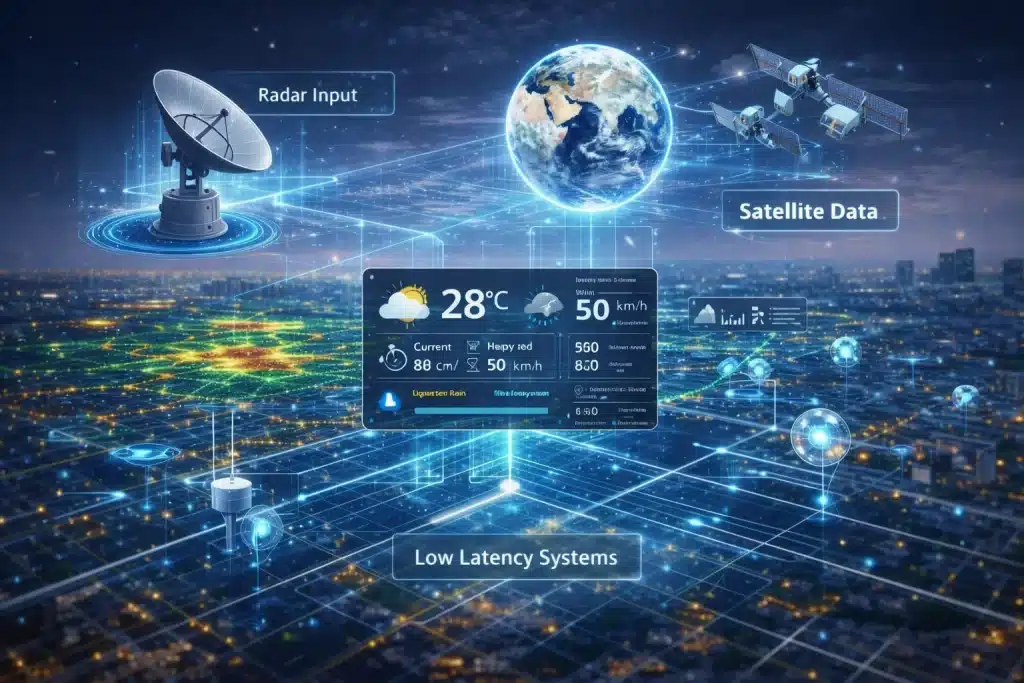
Real-time forecasting draws on continuous weather observations from numerous sources to provide detailed forecasts about current conditions, including temperature, humidity, wind speed, and cloud cover. These are low-latency systems that can update within seconds, not hours, and support immediate decision-making.
Why Speed and Latency Are Critical for Weather-Driven Industries
Time-sensitive operations depend on immediate weather awareness, making fast updates and low latency crucial. Common ways that companies use these tools include:
- Adjusting delivery routes based on storms
- Assessing harvesting windows based on ground temperature and soil moisture
- Managing energy demand changes based on temperature
- Determining safety thresholds for heat, rain, and wind
- Protecting equipment from direct sun, high temperatures, and moisture
The Technical Foundations Behind Real-Time Forecasting
Real-time weather intelligence provides current weather conditions based on continuous observations from a range of sources. These can include the following.
- Ground Radar Inputs: Radar is invaluable for tracking storms, providing maps of expected precipitation and wind speed.
- Satellites: Geostationary satellites remain in fixed positions above the Earth, gathering data on specific regions or locations.
- Observation Networks: Small sensors take continuous measurements of local conditions and transmit them to cloud databases.
These models may store only one day of data, reducing memory usage and ensuring fast responses for operational decisions.
Real-Time Forecasting for Logistics and Fleet Operations
Fleets often rely on minute-by-minute updates because of shifting road conditions. Real-time information can benefit logistics companies in a range of ways, including:
- Efficient routing
- Staggered departure timing
- Hazard avoidance
- Stop planning
- Schedule accuracy
Real-Time Forecasting for Agriculture and Field Operations
Agricultural operations need hyperlocal data, as weather conditions can shift across short distances and time periods. Real-time insights support:
- Spraying schedules
- Irrigation timing
- Frost protection
- Harvest scheduling
Real-Time Forecasting for Energy Production and Grid Stability
Renewable energy requires detailed weather data. The sun’s strength changes throughout the day and year, while wind animation can significantly impact energy output. Load demand also fluctuates based on cloud cover, wind speed, humidity, and temperature.
Grid operators and energy teams can use real-time forecasts for the following mission-critical tasks:
- Maintenance scheduling
- Emergency response
- Energy output selection
- Load balancing across the service area
Real-Time Forecasting for Construction Safety and Project Planning
Construction is one of the most dangerous sectors, requiring extensive safety awareness and asset protection. Displaying real-time weather insights lets crews prevent delays and protect their assets with these insights:
- Crane operations based on wind conditions
- Temperature for concrete work
- Wind safety thresholds
- Lightning awareness
- Shift planning
Why Visual Crossing Supports Reliable Real-Time Forecasting for Business Operations
Visual Crossing enhances real-time operational awareness through high-quality, frequently updated data. Our Weather API integrates easily into planning tools, dashboards, fleet systems, and automated workflows thanks to its model-ready formats. This enables organizations to use real-time insights across complex organizations without making multiple requests.
By using multiple data sources, we can provide hyperlocal conditions for any location in the world; just search by latitude and longitude or enter a city name. Reliable uptime ensures that you’re never without the data you require to keep assets safe and systems running on time.
How Real-Time Weather Intelligence Reduces Operational Risk
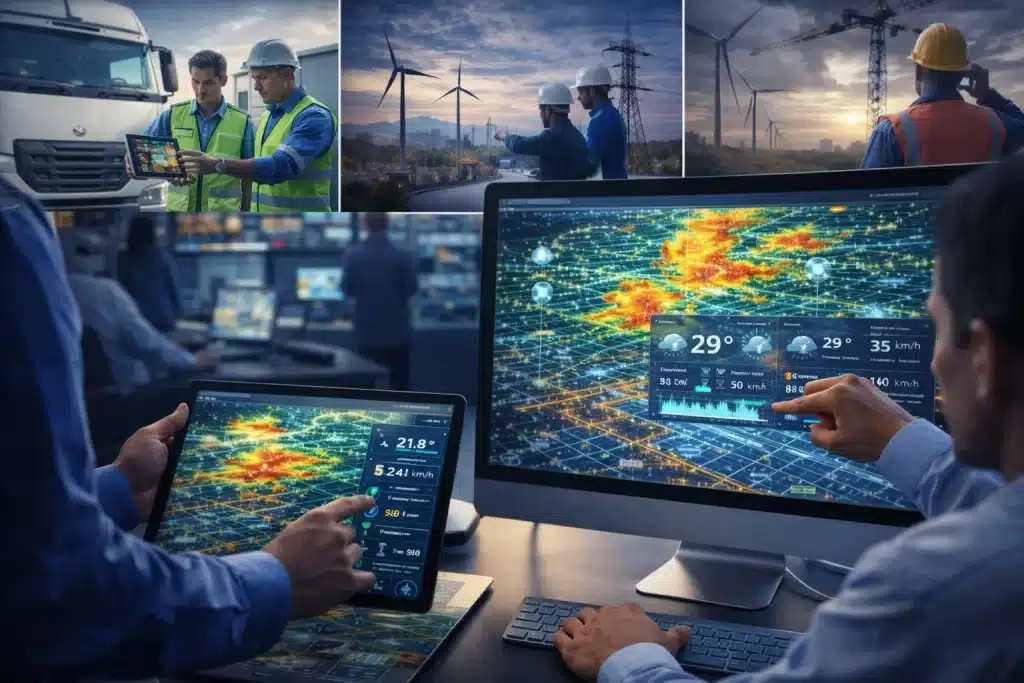
Knowing current conditions is essential for safety. With real-time intelligence, teams can avoid dangerous conditions such as snowy roads, reduce downtime in energy grids, protect assets like expensive construction equipment, and maintain stable staffing and maintenance schedules.
Key Metrics Improved by Real-Time Forecasting
Thousands of organizations have found significant performance improvements through real-time weather insights. These include:
- Reduced travel time for logistics
- Higher crop yields through improved harvest timing
- Better demand planning for utility companies
- Fewer weather-related delays in construction
- Improved resource allocation for municipalities
Practical Steps for Integrating Real-Time Forecasting Into Business Systems
Exploring real-time weather intelligence can feel daunting, as there are numerous data types to integrate. Follow these practical steps to ensure a smooth experience.
- Define alert thresholds for key metrics, such as temperature and precipitation.
- Connect APIs to existing dashboards, displaying specific metrics that users will find helpful.
- Train teams on how to interpret updates and develop weather-specific workflows. For example, note that times are typically displayed in UTC but can be converted.
- Create automated responses for tracked conditions.
Conclusion: Faster Forecasting for Faster Decisions
Real-time weather insights are essential for industries where timing, safety, and responsiveness determine success. If you’re ready to help drive higher ROI and better safety, contact Visual Crossing to learn more about our Timeline Weather API.
FAQs about Real-Time Weather Forecasting
Real-time forecasting is unique because of its higher data frequency and faster refresh times, which give it greater decision-making value.
Understanding the current weather is critical for certain industries, particularly logistics, utilities, agriculture, and transportation. As weather conditions change, so do the hazards that their staff and assets may face. As such, continuous monitoring ensures that organizations can respond quickly.
Real-time weather insights are more accurate due to continuous observations and shorter update cycles.
Businesses use APIs to transmit weather data to dashboards or integrated monitoring systems. Users can also set up automated alerts to track specific conditions, like barometric pressure or humidity.
Visual Crossing supports real-time weather workflows through high-quality data. We use a range of sources, including satellite, radar, and ground sensors, to provide hyperlocal weather intelligence for any location on Earth. This makes our data scalable for large, multinational corporations.
Additionally, we have unique data tailored to specialized operations, such as UV index and soil moisture, that serve specific industries. Our support team can assist you in seamlessly integrating our API into any dashboard, application, or planning software.