

Modern operations depend on instant, accurate weather data to protect their assets and make smart business decisions. Daily forecasts don’t provide the granularity necessary to respond to current or future weather conditions, which can lead to inefficient resource allocation or increased risk.
APIs offer accurate and real-time weather data, updated directly into business software. With this current weather data, companies can automate their tools, monitor emerging situations, and make rapid decisions based on highly local weather models. This is crucial in industries where timing and accuracy matter, like renewable energy or logistics.
What a Real-Time Weather API Delivers That Traditional Forecasts Cannot
Standard weather forecasts provide general estimates of future conditions across a large area, typically updated by the hour. Real-time APIs provide high-frequency data refresh that enables instant decision-making. Additionally, APIs can be directly integrated into tools and workflows, regardless of the tool’s programming language.
The Importance of Immediate Weather Awareness for Modern Operations
Many industries now demand second-by-second or minute-by-minute insight, ensuring accurate weather forecasts for rapidly changing conditions. Shifting weather patterns can influence a range of operational outcomes, including:
- Asset safety for hazardous materials transport
- Courier and delivery service routing
- Transit staffing
- Retail customer operations
With real-time data sources, decision-makers across a range of industries can glean valuable insights for immediate responses.
How Live Data Streams Improve Forecast Interpretation and Risk Detection
Live data streams enable teams to adjust their expectations, particularly during severe weather alerts when conditions can change in an instant. This close monitoring reduces uncertainty, ensures a rapid response, and prevents confusion.
Core Components of a High Quality Real-Time Weather API
APIs differ in terms of quality and granularity, making it essential that you select the correct one for your needs. Look for an API with the following features.
- Frequent Updates: While an hourly forecast may be fine for casual users, businesses need immediate access, such as minute-by-minute updates.
- Reliable Uptime: Free weather APIs do not guarantee uptime, whereas enterprise plans typically offer much higher uptime, ensuring you have the data you need exactly when you need it.
- High-Resolution Data: Look for a service that offers geo-location for anywhere in the world, which is invaluable for multinational corporations.
- Datasets: A quality API will have historical weather data, real-time updates, and specialized datasets like air quality data, UV index, wind speed, solar irradiance, humidity, and cloud cover. This ensures you can access the exact information you need, depending on changing conditions.
- Multi-Parameter Support: You should be able to query multiple parameters in the same request, such as determining temperature and precipitation for a specific location. This reduces downtime and lets your team get the full picture.
- Accuracy Verification: A good API will use a range of data sources, which makes the forecast more accurate. For example, they may blend open data from the National Weather Service with current data from weather stations.
Integrating Real-Time Weather APIs Into Dashboards and Operational Systems
Businesses can connect API feeds to dashboards, monitoring tools, scheduling software, ERP software, and decision support platforms. This way, every member of your team has centralized weather intelligence to visualize current conditions and respond immediately.
APIs like Visual Crossing use a convenient JSON format, which simplifies the integration process for developers.
Automation Triggers That Depend on Real-Time Weather Conditions
Your team can develop a range of automations, streamlining workflows and reducing support team demands. Some of these include the following.
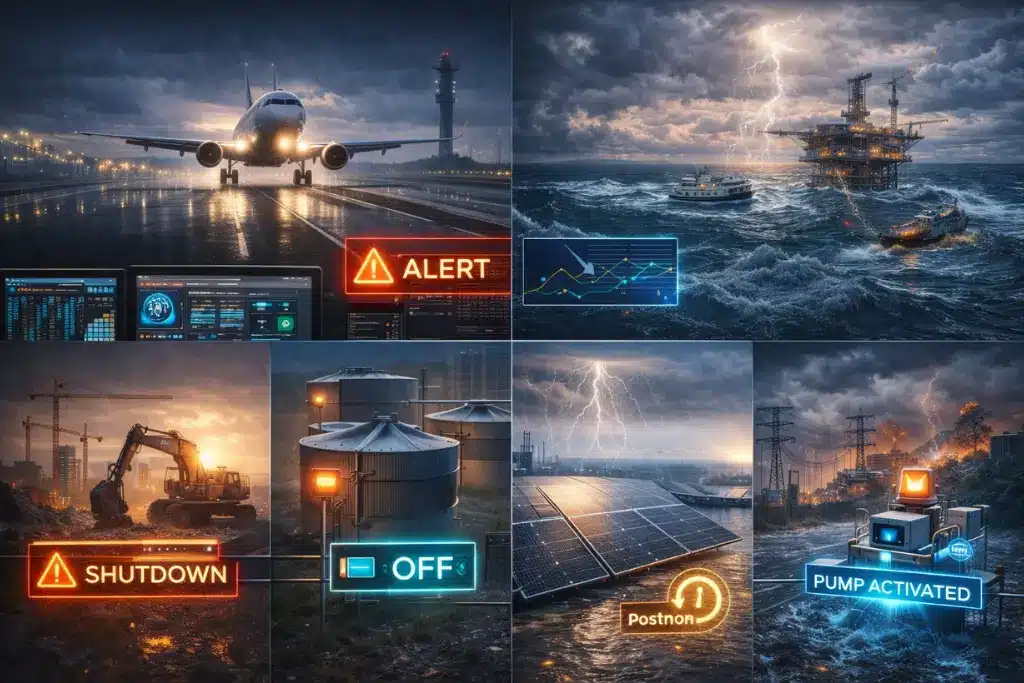
- Pump Activation: Using code, organizers can trigger pumps when precipitation reaches a certain level.
- Safety Alerts: Municipalities can warn travelers about impending snow, low visibility, poor air quality, or high temperatures.
- Equipment Shutdown: Companies can initiate shutdowns based on parameters like sunrise, sunset, high winds, heat, or snowstorms.
- Maintenance Scheduling: Weather forecast data helps teams plan for optimal maintenance conditions. For example, a partly cloudy day may trigger an alert to clean solar panels while switching to other energy sources.
- Energy Usage: Utilities can seamlessly move between power sources depending on the current weather. A calm day with a clear sky is optimal for solar generation, while a cloudy day with high wind can utilize turbines or hydropower.
- Staffing: By combining historical data with real-time insights, organizations can plan optimal scheduling.
How APIs Support Real-Time Validation for Forecast Accuracy
Using APIs, teams can compare real-time observations against historical forecasts to understand trending conditions. If there were multiple snowstorms on a past date but the weather has been dry, organizations can adjust their plans, such as reducing maintenance staff or canceling scheduled maintenance.
Why Real-Time Data Strengthens Safety and Compliance Protocols
Sudden storms or heavy snow can influence safety compliance, hazard prevention, and operational risk. As such, live weather information is essential for making smart safety decisions in a range of industries, such as:
- Aviation
- Construction
- Utilities
- Forestry
- Renewable energy
- Offshore oil operations
- Coastal operations
With minute-by-minute weather data, companies in high-risk industries can ensure they are complying with all relevant regulations and mitigating risk to both employees and assets.
The Role of Real-Time Weather APIs in High Frequency Operations
Certain industries require split-second thinking, such as logistics and delivery, marinas, sports venues, roadside assistance, and entertainment. A real-time weather data API enables fast reactions to changing conditions for the protection of both customers and equipment.
Why Visual Crossing Is a Strong Data Partner for Real-Time Weather Intelligence
Visual Crossing’s API is the key to effective real-time weather monitoring. Our weather data solution provides reliable, live observations in a model-ready format, perfect for integration into any business system.
With hyperlocal accuracy and comprehensive historical weather data, businesses are armed with the tools they need for real-time automation of mission-critical systems, such as pumps and solar panels. A continuous stream of weather insights also increases operational efficiency and awareness.
We provide scalable efficiency, from free access to enterprise pricing. Our real-time and historical weather data spans the globe and is sourced from a range of stations to ensure the highest data quality.

Data Quality Challenges That Real-Time APIs Must Solve
One of the major problems that real-time APIs tackle is incomplete station coverage and sensor drift. Some areas, especially more rural ones, do not have dense hyperlocal sensor networks, and sensor quality degrades over time. Aggregation techniques help to correct minor errors while still providing reliable data.
Latency and unreliable update intervals can lead to patchy data, while inconsistent formatting makes it difficult to integrate API data into an application. Visual Crossing tackles this through strong data validation and JSON format, which is easy to incorporate into almost any software.
Machine learning has also been an invaluable way to address incomplete datasets by identifying patterns and predicting weather conditions. When combined with real-time IoT sensors, AI weather models are disrupting the way that researchers track and interpret global weather systems.
How Real-Time APIs Support Digital Twins and Predictive Systems
Digital twins are an invaluable resource for organizations with expensive and sensitive equipment. These are digital models of physical systems, whether that is a power plant or vehicle, that can simulate real-world conditions.
Live environmental data makes it possible to predict asset behavior and optimize performance by using a digital twin. For example, utility companies can use digital twins to assess energy loads and prepare for demand surges without damaging their equipment.
The Growing Role of IoT Networks in Real-Time Environmental Monitoring
The Internet of Things (IoT) is an exciting development in real-time environmental monitoring. Internet-connected devices, mobile sensors, and smart infrastructure expand the reach of weather observations and make it possible to collect real-time data from almost anywhere.
IoT data can be seamlessly integrated into other data sources for more granular, hyperlocal weather intelligence.
Real-Time Weather APIs in Climate Resilience and Adaptation Planning
Climate resilience is a key concern for both businesses and governments. As climate variability increases, real-time monitoring has become a crucial way to protect communities and save lives.
Continuous monitoring supports flood response and drainage monitoring, especially when paired with automated pump systems with flood level sensors. Wildfire monitoring helps emergency response teams determine when to issue evacuation orders and track air quality, which is key to public health.
Using both historical weather data and real-time updates enables municipalities to refine their emergency responses and identify infrastructure upgrades that will improve resilience.
Business Metrics Improved by Real-Time Weather Integration
Real-time weather integration offers significant ROI, including business metrics such as:
- Reduced downtime
- Improved schedule accuracy
- Lower operational costs
- Improved compliance
- Fewer safety incidents
- Better customer experience
- More efficient resource allocation
Weather data has a direct and measurable impact on both profits and user experience, making it a key driver of business success.
Best Practices for Organizations Implementing Real-Time Weather APIs
Businesses can enhance their weather data by following these steps.
- Define your automation threshold to reduce extraneous triggers.
- Validate sources and ensure data is in a clean, model-ready format.
- Integrate APIs with existing platforms rather than building new ones.
- Ensure monitoring is visible on dashboards, apps, and planning systems.
- Train teams on live data interpretation.
- Regularly review your data usage to determine whether other datasets will better serve your goals, such as solar irradiance or UV index.
Conclusion: Real-Time Weather APIs as a Foundation for Faster and Smarter Decisions
Real-time weather intelligence helps organizations become safer, more precise, and more agile. Being able to monitor weather systems enables faster responses to changing conditions and greater automation, which reduces manual inputs. Overall, real-time weather data and highly accurate weather forecasts improve ROI through improved resource allocation.
Visual Crossing’s Weather API provides high-quality data in a model-ready format, easy to integrate into any software or workflow. With thousands of sources around the world, we have global coverage with local detail. Our API is scalable for multinational corporations, municipal governments, and international research teams that need specialized datasets.
Contact our team today to discuss how real-time weather intelligence can enhance your workflow while reducing unnecessary spending.
FAQs about Real-Time Weather API
A weather data API delivers continuously updated weather information directly into applications, planning software, or other operational tools.
Accurate forecasts are essential for risk mitigation and scheduling. Knowing current conditions can avoid disruptions and protect assets, including human lives.
The refresh rate varies depending on the API and subscription. If you have a non-commercial free API key, then you may get hourly or quarter-hourly updates. Enterprise APIs provide an almost unlimited number of requests, meaning near-constant refresh cycles.
Industries that benefit from real-time insights can include hospitality, event planning, agriculture, construction, transportation management, and urban planning.
Visual Crossing is the best weather API for current weather conditions, seamlessly integrating into almost any application. We offer consistent, high-resolution, global weather data, including hyperlocal information and specialized datasets.