

Renewable energy infrastructure is highly weather-dependent. Even small shifts in wind speed or solar irradiance can influence energy yield and grid stability.
As such, renewable energy operations require hyperlocal and highly accurate weather data to maximize efficiency and reduce operational costs. Real-time forecasting is a foundational element of solar or wind power grid management, impacting every aspect of energy distribution.
Why Renewable Energy Systems Depend on Real-Time Weather Forecasting
Wind and solar energy outputs fluctuate rapidly with weather patterns, making it difficult to balance supply and demand without precise forecasts. Cloud cover, UV index, and wind patterns all determine which renewable energy source has the highest output at any given moment.
Real-time data provides critical information for grid operators, enabling more precise energy production forecasting and ensuring operational efficiency. A quality API is a game-changer for project success.
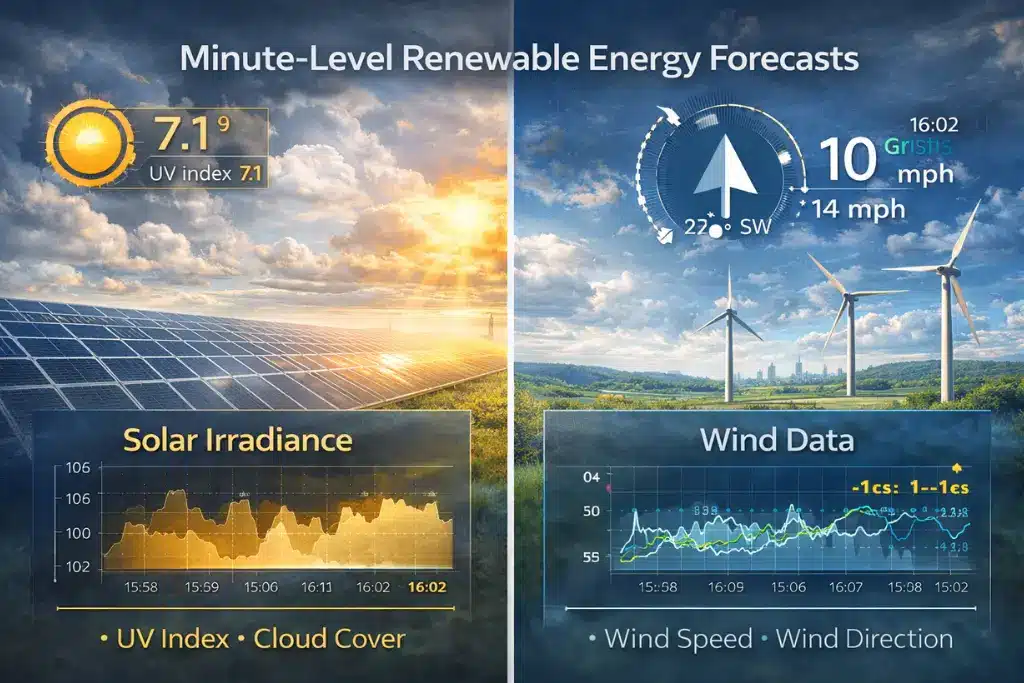
How Minute-Level Forecasting Improves Renewable Energy Responsiveness
The intermittent nature of renewable energy generation means that hourly forecasting alone is insufficient. Short-term fluctuations can overtax the power system or reduce resource availability, which more generalist weather forecasts could miss.
Minute-level forecasting enables asset managers to make informed decisions in real time, which ensures better grid integration for renewable sources.
Solar Irradiance Prediction and the Importance of Hyperlocal Data
Solar panels are highly sensitive to small shifts in cloud cover, but regional forecasts may not yield actionable insights because they focus on general trends. Radar or satellite data typically doesn’t show solar forecasting for a single site.
Hyperlocal irradiance forecasts can provide weather predictions for a single solar farm. This enables data-driven decisions about storage management, curtailment, and panel efficiency.
Wind Variability and the Need for Fast Updating Forecast Systems
Wind turbine performance can change significantly depending on wind speed, direction, and turbulence. A general forecast does not predict wind patterns for a single site, leaving wind farm operators without accurate predictions for their specific location.
Real-time forecasting tools provide the highly granular data that wind power companies need to protect their turbines, optimize grid flexibility, and reduce mechanical stress.
Using Real-Time Weather Intelligence for Grid Load Balancing
Because renewable energy resources can shift rapidly, operators must closely monitor grid conditions to maintain stability. With live forecasts, renewable energy project managers can plan distribution or adjust import and export flows. This ensures system stability and optimizes operations.
Why Hyperlocal Forecasting Matters for Distributed Energy Resources
Rooftop solar power systems, community batteries, and small-scale renewable installations have become key elements of the energy transition away from fossil-fuel power plants, especially in dense urban areas. However, local conditions can vary significantly due to microclimates, even within the same city.
Hyperlocal forecasting tracks distributed energy production based on current wind and solar data, which enables better grid management. Operators can prevent overloading or prepare for sudden production drops.
Storage Optimization Driven by Real-Time Weather Conditions
Storage units ensure steady output, but they depend on accurate weather predictions. Real-time forecasts help operators assess resources, including charging, discharging, and backup strategies for extreme weather events.
Managing Curtailment With Faster and More Accurate Forecast Insight
Curtailment prevents damage to grid infrastructure by shutting down wind or solar farms when output exceeds capacity. However, standard forecasts may cause unnecessary curtailment based on general predictions for a large region. Real-time forecasting improves resource utilization and ensures that energy production remains stable.

Why Visual Crossing Supports Real-Time Renewable Energy Forecasting
Visual Crossing provides the real-time and hyperlocal data necessary for the renewable energy industry to thrive while reducing carbon emissions. Our API offers multiple benefits for grid operators, including the following.
- Rapid Update Frequency: Enjoy continuous data streams in a model-ready format.
- Global Coverage: Query data for anywhere in the world, which is invaluable for multinational strategic planning and portfolio management.
- Specialized Renewable Energy Forecasting: Highly accurate solar and wind parameters ensure you have the high-quality data you need to thrive.
- Easy Integration: Visual Crossing’s Weather API integrates easily with any grid software, web platform, or application.
Visual Crossing’s flexible API offers the speed and precision grid operators need to plan with confidence.
How Real-Time Forecasts Improve Demand Forecasting for Utilities
Accurate predictions of renewable energy production are essential for smooth transitions between traditional and renewable resources. This ensures optimal grid performance, reduces overproduction, and prevents costly last-minute adjustments.
The Role of Real-Time Forecasting in Renewable Energy Trading
Traders and market participants both need highly accurate data to predict supply conditions and market volatility. With accurate short-term forecasting, traders can assess when to buy or sell, while operators can avoid penalties for under- or overperformance. Additionally, this enables operators to determine when to store or release for maximum economic benefit.
Forecast Accuracy Metrics That Matter for Renewable Energy Systems
Choosing the right renewable energy forecasting requires understanding which metrics influence real-world performance. These are some key requirements for forecast accuracy.
- Root Mean Square Error (RMSE) Trends: This shows how well a model predicts real-world conditions. A lower RMSE means that data points are close to actual values. Certain models are better under specific weather conditions, such as on sunny or cloudy days, but a good model will be mostly accurate all of the time.
- Irradiance Accuracy: Ground sensors are typically best at measuring local solar conditions but require more frequent maintenance. Satellites offer broader coverage but are less accurate for local measurements and long-term estimates. AI has shown immense promise in improving irradiance forecasting, and newer models blend both traditional and AI models.
- Wind Ramp Prediction: This forecasts significant and abrupt changes in wind power. A good model will be able to pinpoint wind ramps in a specific area to ensure grid stability and infrastructure protection.
- Latency: Latency refers to how long it takes for data to appear. Low latency is crucial for time-sensitive projects like renewable energy production.
- Update Intervals: While in some industries, an hourly forecast is sufficient, renewables require quarter-hourly or even minute-by-minute updates.
- Hyperlocal Resolution: A citywide or regional forecast will not show specific solar outputs and wind activity at a specific plant or site, making it essential that you choose an API with high-quality, hyperlocal data.
Integrating Real-Time Forecasting Into Grid and Control Room Operations
An API enables operators to integrate forecast data into SCADA systems, visualization dashboards, and energy management software, allowing a comprehensive look at current conditions and future trends. By incorporating a weather API into workflows, operators can also automate tasks based on weather parameters, such as UV index or wind speed, to ensure safety and optimal functionality.
How Real-Time Weather Data Supports Preventive Maintenance for Renewables
Sudden changes in weather conditions can put significant stress on turbines, inverters, solar panels, and monitoring equipment. Through real-time forecasting, teams can plan ahead for preventative maintenance or asset protection.
For example, a severe windstorm can break turbine blades or damage panels. Advance notice enables operators to make real-time adjustments, thereby reducing downtime.
Future Innovations in Renewable Energy Forecasting
Renewable energy forecasting continues to advance thanks to new technologies. AI has proven invaluable for predicting irradiance, as it can process data much faster than traditional models. LiDAR integrations can create detailed 3D maps of a proposed site that offer more sophisticated site planning, assessment, and risk mitigation.
Improved wind modeling helps operators better predict wind ramps and adjust turbine construction to handle abrupt changes in speed or direction. Lastly, ultra-dense sensor networks generate more data, thereby improving the predictive power of any model.

Financial and Operational Gains From Faster Forecasting
Better forecasting reduces curtailment losses and balancing charges, as there will be fewer unexpected supply drops. This also ensures better storage usage and higher output efficiency, which improves profitability across the board.
Conclusion: Real-Time Forecasting as a Foundation for Renewable Reliability
Renewable energy needs fast, precise, and hyperlocal weather intelligence to maintain operational efficiency and boost financial stability. Visual Crossing provides the model-ready data that the industry depends upon, all with scalable plans for enterprise users and a range of specialized datasets unique to renewables.
FAQs about Real-Time Forecasting for Renewable Energy
As solar and wind output change quickly, renewable energy systems need real-time data that tracks current conditions.
Each location has specific irradiance and wind patterns, which will impact output and planning. General forecasts do not have the high-resolution data required to track conditions at a specific site, making it essential to use hyperlocal forecasting.
These forecasts can provide minute-level updates and continuous corrections, which is especially valuable when energy demand is high or conditions are rapidly fluctuating.
Forecasts can guide load balancing, storage decisions, and distribution planning. They can also determine the best time to perform scheduled maintenance or initiate curtailment to avoid overloading the grid.
Visual Crossing provides highly accurate data for any location worldwide, which is invaluable to energy traders and multinational renewable energy companies. Users can enjoy rapid updates with low latency and guaranteed uptimes.
The Visual Crossing Weather API is easy to integrate into any system, dashboard, or app and requires only a simple API key. We also provide specialized datasets tailored to renewable energy, including solar irradiance and wind patterns. Users can query historical, real-time, or forecast data for any location with a single query, and our support team is available 24/7 to troubleshoot issues.