

Weather conditions can differ widely across an area, meaning that crucial site-specific information may not appear on generic forecasts. As a result, organizations that use regional forecasting may miss essential details that could have protected their assets from storm damage or flooding. Hyperlocal forecasting offers the granular, street-level detail required for safety, resource allocation, and customer service.
What Makes a Hyperlocal Weather Forecast Different from a Regional Forecast
While regional models provide general estimates for large areas, hyperlocal forecasts capture weather conditions at a small scale, such as a grid point, neighborhood, or facility. These forecasts use local weather stations to continuously monitor relevant data points, enabling frequent updates and high-resolution details.
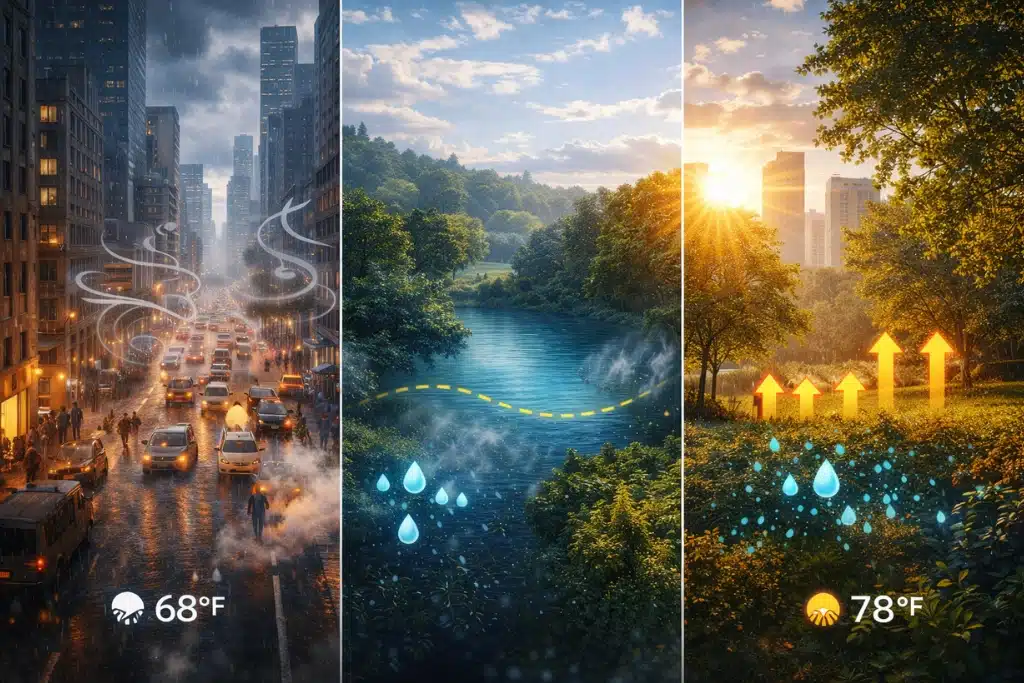
Why Weather Can Change Within Short Distances
A range of factors influences the weather at a specific place, meaning that businesses and municipalities cannot use regional data to predict conditions on the ground at a given spot.
- Elevation: Small changes in atmospheric pressure due to land masses can influence precipitation patterns.
- Land Cover: Vegetation cover changes humidity and temperature, while concrete traps heat.
- Bodies of Water: Deep lakes or rivers will modulate local temperatures, something that larger forecasts may smooth out.
- Building Density: Tall buildings alter wind speeds, creating vortices that can make the surrounding area colder than the regional average.
- Traffic Heat: A neighborhood with heavy traffic will be warmer than a similar neighborhood farther from busy roadways.
- Micro-Wind Patterns: Wind gusts are not continuous across a region but can still have a significant impact on workflows, making it crucial to know local conditions.
How Hyperlocal Precision Improves Decision Making Across Industries
Site-specific weather insights improve productivity, staffing, routing, and security across a range of industries, such as the following.
- Delivery and Courier Operations: Enable workers to text immediate delivery updates to customers, improving customer service.
- Agriculture: Outdoor work crews can review future conditions in a specific plot or field, including specialized information like dew point and UV index.
- Roadside Services: Localized data helps road crews determine travel times and prepare for incoming storms.
- Education: Teachers can make weather more accessible to students by showing how infrastructure changes conditions.
- Entertainment and Hospitality: Theme parks, hotels, and sports facilities can contact people by phone, email, or text before snow, rain, or high winds might interrupt their travel plans.
- Solar Farms and Utilities: Utilities can simplify their planning process by assessing the UV index and wind speeds at a specific location.
- Autonomous Vehicles: Drivers can use satellite images to navigate snowy roads or receive advance warning about windstorms that could damage drones.
The Role of High-Resolution Data and Rapid Updates in Forecast Accuracy
Hyperlocal forecasting uses dense, immediate data observations from weather stations and frequent refresh cycles to create smarter predictions at the street level. When combined with radar inputs and localized model corrections, this ensures highly accurate short-term predictions. Businesses can anticipate sudden weather shifts that are invisible in larger-scale forecasts.
Why Visual Crossing Is a Strong Data Partner for Hyperlocal Weather Forecasting
Visual Crossing makes it simple to track hyperlocal conditions through our historical, real-time, and forecast data designed for hyperlocal accuracy.
Our real-time weather API allows teams to pull precise data for any route, street, or facility anywhere in the world. It is easily integrated into any tool, with model-ready data for your specific workflow. Better yet, it is affordable and scalable for organizations of any size.
Conclusion: The Growing Need for Site-Level Weather Intelligence
Whether out on the town with friends or preparing for hurricanes, weather forecasting is essential. However, businesses need more granular detail than is possible with a generic weather app.
Local forecasting improves accuracy, reduces operational inefficiencies, and streamlines resource allocation. This is especially important as industries switch to automated systems that apply adjustments based on weather parameters. Visual Crossing’s weather API is an invaluable resource for developers who need the most precise weather data for their mission-critical projects.
FAQs about Hyperlocal Weather Forecast
The difference between hyperlocal and regional forecasts is that localized forecasts deliver high-resolution data for small areas, such as a one power plant or construction site. This enables developers to predict changing conditions by the minute, hour, or day.
Localized data improves risk mitigation, scheduling, staffing, and safety preparedness.
These can be updated every quarter-hour for a free app. If you upgrade to an enterprise weather app, you can get updates every minute.
Industries like energy, logistics, construction, hospitality, and transportation can all be supported by the ability to share street-level weather insights with their teams.
Our high-performance API is easily integrated into any weather app, whether it is on iOS, Android, or desktop. Download high-resolution daily or hourly data from anywhere in the world, including customized API calls for your specific needs. We offer a range of subscription models perfect for personal, business, or enterprise use.