

Business decisions often depend on accurate weather forecasts, especially during extreme weather events or seasonal shifts. Artificial Intelligence (AI) models have advanced weather forecasting systems to deliver faster, more precise, and more localized forecasts than traditional physics-based models can produce.
AI weather forecasting provides tangible benefits for businesses through asset protection, efficient resource allocation, improved safety, and cost reduction. By embracing AI weather models, companies can do more with less.
What AI-Powered Weather Forecasting Means for Modern Operations
AI tools use massive amounts of training data to identify patterns that traditional methods, like numerical weather prediction, may have missed. The enhanced computing power also allows artificial intelligence to incorporate sophisticated concepts like atmospheric physics.
While these models are valuable on their own for the global community, they are a game-changer for industries that must make informed decisions on tight deadlines. Sectors like energy trading, wind farms, and logistics rely on precise timing, precision decision-making, and risk reduction – exactly what AI innovations can provide.
How Machine Learning Models Improve Forecast Accuracy
An article published in the Journal Nature found that Google DeepMind outperformed state-of-the-art systems used by the European Centre for Medium-Range Weather Forecasts (ECMWF), widely considered the best technology in the world. In fact, the meteorologists at ECMWF are now using aspects of GenCast in their own forecasts.
The reason AI tools outperform human expertise is that machine learning can identify subtle relationships between historical and real-time data that humans may miss. This improves predictions for temperature, precipitation, wind speed, and severe weather events.
Businesses can then utilize these predictions for better scheduling, more precise resource management, and increased safety.
Faster Forecasting Through Automated Data Processing
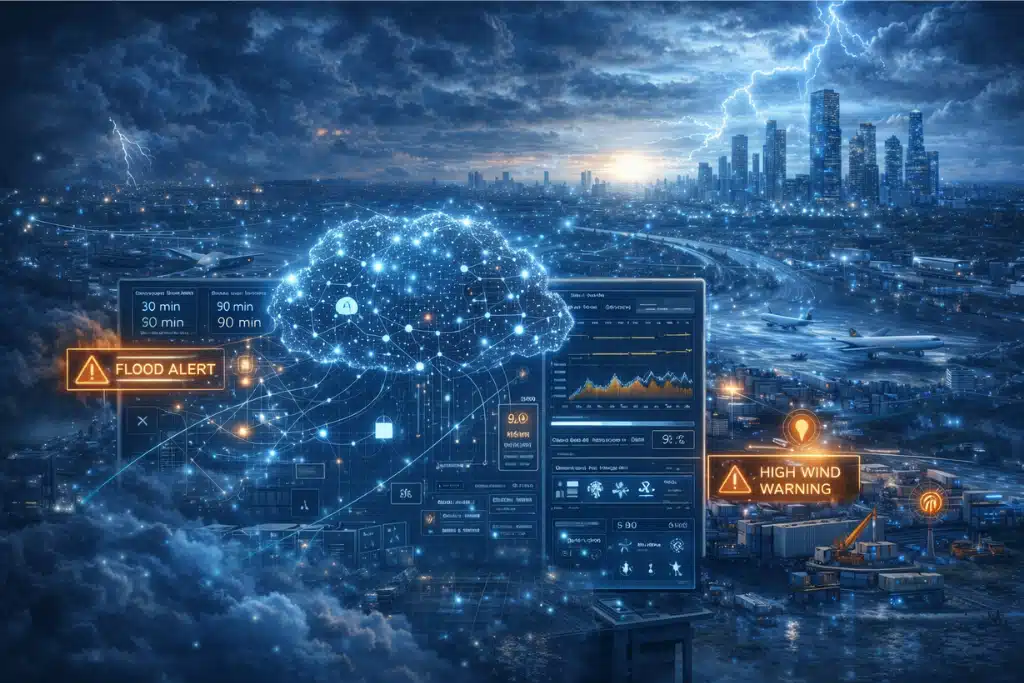
Because AI models can process incoming data quickly, their analysis can be completed in minutes, not hours. With this new approach, organizations can access near-instant forecasts that can be used in early warning systems, logistics adjustments, and real-time storm monitoring.
Nowcasting: AI’s Role in Short-Term, High-Precision Forecasts
The AI revolution has upgraded short-term forecasting, enabling predictions within minutes to hours. This is invaluable for industries that require minute-by-minute weather updates, including airport operations, event planning, construction planning, and traffic management.
Most importantly, emergency response is safer than ever with AI weather forecasting, enabling municipalities to dispatch resources where they are needed most.
Improving Hyperlocal Accuracy With AI and High-Resolution Data
Numerical weather prediction can’t provide accurate forecasts for a specific location; rather, it provides estimates for a general area. With these new models, businesses that require location-level accuracy can get the data they need to succeed. Utility companies, municipalities, ports, and retail teams can all benefit from AI weather forecasting.
The Importance of High-Quality Historical and Real-Time Data
A significant benefit of this new era of forecasting is that AI integrates both historical and real-time data into its modeling. Using open data sources, sensors, radar, and local weather reports, AI incorporates both current and historical datasets to improve forecasting reliability.
Better data means better decision-making, crucial for operational efficiency in every business sector.
AI Techniques Used in Weather Prediction
AI uses a range of techniques to evaluate the weather, which include the following.
- Neural Networks: Using the human brain as a model, these systems can identify complex relationships between different data points.
- Ensemble Learning: This method combines multiple machine learning models to create a stronger, more accurate forecasting than one model could do alone.
- Pattern Recognition: Machine learning is based on identifying patterns in large datasets, which can then be used to estimate future events.
For businesses, these techniques yield faster, more refined modeling, enabling better operational decisions with less wasted time or resources.
How AI Detects Subtle Weather Signals That Traditional Models Can Miss
The weather has always been a black box because of the millions of variables involved. Even esteemed researchers at the National Weather Service and the World Meteorological Organization cannot perfectly determine storm timing or hurricane patterns, especially with climate change.
AI can find micro-patterns in moisture, wind shifts, cloud patterns, and temperature. Together, these improve storm timing and sudden weather changes that can impact operational efficiency.
Machine Learning for Extreme Weather Forecasting and Risk Reduction
AI identifies severe weather more quickly and accurately. This is especially valuable for logistics and utility companies that must protect their assets during extreme conditions. Early flood awareness and wind safety alarms let businesses plan for emergencies and quickly move employees out of dangerous situations.
Integrating AI Forecasts Into Business Planning Systems
AI-powered forecasting can be incorporated into your business operations using APIs such as Visual Crossing. These APIs seamlessly integrate into mobile apps, desktop computer dashboards, planning software, and automated workflows.
To reduce manual monitoring, consider using automated triggers for certain thresholds, such as high winds or snow alerts. This frees up more human expertise for planning while still enabling the full benefits of AI.
The Operational Advantages of AI-Powered Forecasting
There are countless advantages to AI-powered forecasting, with examples including:
- Better scheduling for retail, event planning, and construction
- Reduced downtime
- Optimized logistics routing
- Improved business staffing
- Fewer weather-related safety incidents
- Better demand forecasting for consumer behavior
Why Visual Crossing for AI-Powered Weather Forecasting
Visual Crossing provides the data foundation for AI models through historical, real-time, and long-range forecast information across the world. Our easily integrated API delivers model-ready datasets that support AI workflows.
Our high-quality data is hyperlocal, scalable, and affordable, including unique datasets like UV index and solar power. Whether you are an enterprise company or an AI researcher, our API provides reliable performance in real operational environments.
Real-World Business Scenarios Enhanced by AI Forecasting
Organizations across every sector need reliable forecasts to reduce delays, protect resources, and deliver exceptional service. These representative scenarios reveal how critical AI forecasting can be for your workflows.
- Logistics: Extreme weather like snowstorms or tornadoes can lead to damaged assets while putting employees at risk. Through real-time forecasting, AI can help companies plan the most efficient route.
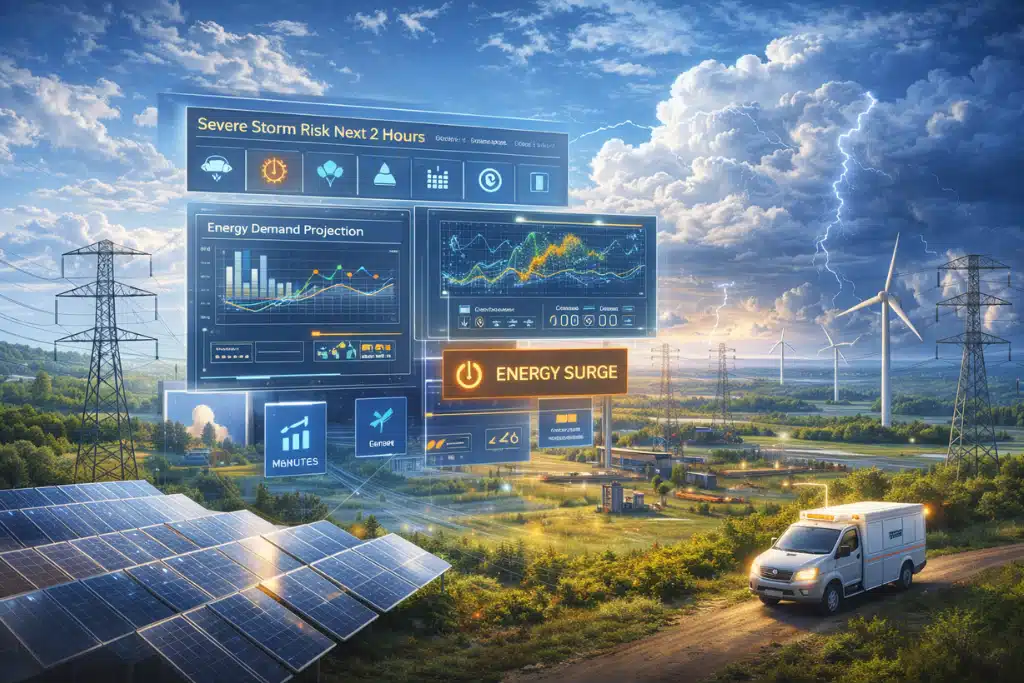
- Utilities: Understanding weather can help utility companies prepare for demand surges, redeploy crews to damaged systems, and estimate energy production.
- Transportation Agencies: Airport crews can use AI to guide air traffic, while regional transit companies can prepare for severe weather that may delay travel times.
- Retailers: Consumer behavior is highly weather-dependent, with shoppers choosing different products or sales channels depending on current conditions. Through AI, retailers can deliver targeted advertising, manage stock, and schedule staff more effectively.
- Field Service: Outdoor technology is more prone to breakdowns during extreme heat, cold, or precipitation. By knowing current and near-future conditions, field service technicians can prepare for higher demand and address potential operational risks.
- Emergency Response: Flooding, severe storms, tornadoes, and snowstorms heighten demand for emergency services but also increase risk to responders. By tracking storm systems and assessing damage, EMS, police, and other first responders can prepare for surges while keeping their employees safe.
- Event Planning: Every event planner wants the perfect weather conditions for their day. Through AI, planners can determine the correct date and location for an event while also making quick adjustments to schedules or activities in response to changing weather.
Common Challenges in Traditional Forecasting and How AI Solves Them
While traditional models can be helpful, they also have downsides, which AI addresses.
- Slow Processing: The immense computational power of AI means that forecasts are delivered within minutes, not hours.
- Low Resolution: Traditional forecasting cannot capture hyperlocal changes, making it difficult to determine conditions on the ground in a given area. By using larger datasets, AI can more accurately assess local conditions.
- Difficulty With Shifting Conditions: Sudden changes, like cloud bursts or changing wind direction, can completely change current conditions. Because it can look at millions of variables, AI provides more precise forecasting that accommodates these shifts.
Measuring the Business ROI of AI-Enhanced Forecasting
AI forecasting systems can significantly enhance ROI in several ways, including:
- Reduced Operational Losses: Especially valuable in logistics, this prevents damaged packages or wasted time driving through storms.
- Enhanced Staff Efficiency: Retail companies can schedule more efficiently, while utility companies can deploy resources exactly where they’re needed most.
- Lower Maintenance Costs: Logistics companies can reduce vehicle wear and tear by preventing damage from snow, ice, rain, or wind.
- Better Long-Term Planning: Companies can prepare for seasonal shifts and schedule events, leading to reduced operational costs over time.
Best Practices for Organizations Using AI Forecasting Tools
To get the most out of AI, consider using these tactics.
- Integrate forecasts into automated systems to receive instant alerts.
- Review your trigger thresholds regularly to avoid “alert fatigue.”
- Validate model performance on a regular basis, employing more sophisticated systems as they become available.
- Use both humans and AI for critical decisions.
The Future of AI in Weather Prediction and Climate Intelligence
AI continues to become more refined with each update, providing faster and more sophisticated processing. Advanced neural networks can dig deeper to find subtler patterns, while greater computing speed means that businesses can receive forecasts almost instantly.
Another exciting possibility is AI-driven digital twins. These replicate real-world systems so you can run simulations and predict potential adjustments, all without manipulating the physical asset. For example, you could use sensors to predict how a wind turbine may respond to different conditions, then automatically calibrate the turbine when certain conditions are met.
Urban micro-forecasting continues to advance, making it easier to predict small shifts across a city. This enables businesses and municipalities to deploy resources effectively. Overall, companies will greatly benefit from AI advancements, leading to safer, more profitable workflows.
Conclusion: AI as a Foundation for Faster and More Reliable Weather Intelligence
AI offers businesses invaluable benefits by enabling faster, more accurate forecasts for mission-critical decisions. However, AI needs large datasets: exactly what Visual Crossing provides. We are your partner in AI-driven weather intelligence, with a wide range of high-quality datasets covering every part of the globe. With Visual Crossing as your API provider, you can make faster decisions, boost operational efficiency, and protect your assets.
FAQs about AI-Powered Weather Forecasting
AI weather models learn from patterns in historical and real-time data, boosting their predictive abilities.
Through real-time data processing, artificial intelligence weather models can identify rapid changes in weather conditions more accurately than traditional models.
Yes, AI models support neighborhood-level or site-specific accuracy for organizations, such as ports, utilities, emergency response teams, and construction companies.
Visual Crossing has complete data sets from all around the globe, including local weather stations and sensors in developing countries. Most importantly, we offer enhanced support for AI workflows, all at an affordable price.