

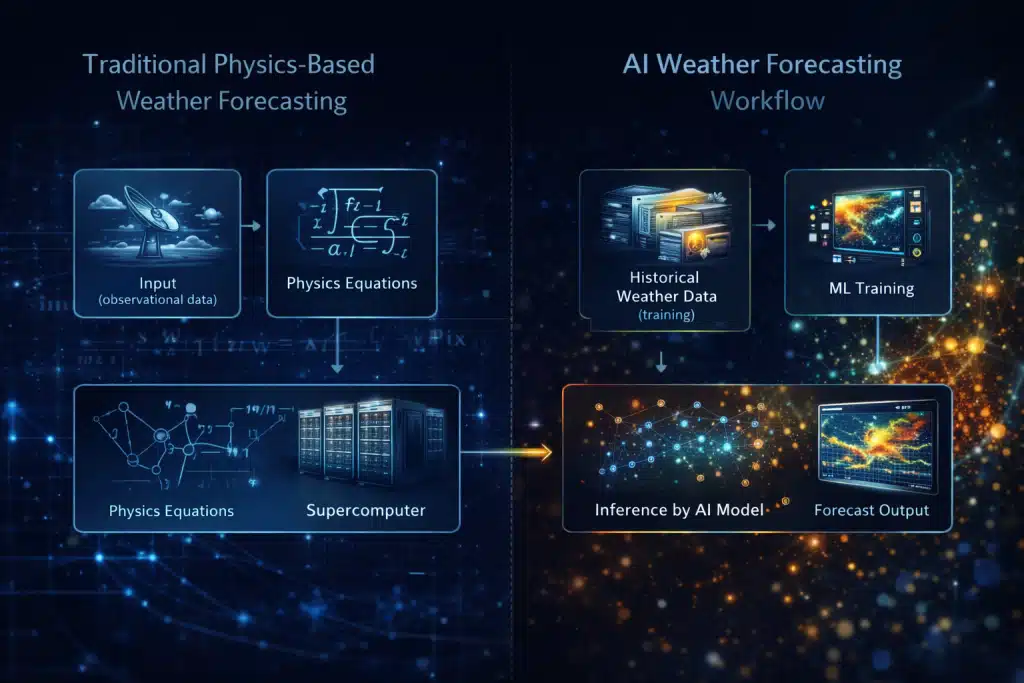
Traditional forecasting uses numerical weather prediction, which is based on physics equations and run on supercomputers. In contrast, Artificial Intelligence (AI) weather models use a vast amount of training data to identify patterns and develop accurate weather forecasts.
Both traditional forecasting methods and AI models play valuable roles in predicting weather patterns, but they have different strengths based on time scale, required accuracy, and available forecast data.
Organizations like the European Centre for Medium-Range Weather Forecasts (ECMWF) and the National Oceanic and Atmospheric Administration (NOAA) have begun combining both in their own forecasts. Each tool has its place in extreme weather prediction and operational decisions, showing that the future will embrace both methods.
What Traditional Weather Forecasting Systems Are Designed to Do
Traditional physics-based models generate forecasts using the physical sciences, such as atmospheric dynamics. Computationally efficient supercomputers will run thousands of fine-tuned equations to simulate atmospheric processes, then combine them to develop probabilistic forecasts.
For example, conventional models may state that there is a 70% probability of heavy rain in a given area, meaning that 70% of weather simulations run for that time period predicted heavy precipitation.
These models have global coverage through partnerships with government organizations like the Met Office, the National Weather Service, and the European Centre for Medium-Range Weather Forecasts, along with private-sector partners.
While these models can provide highly accurate forecasts that save lives, they have long computational cycles and produce outputs covering a large geographic area.
How AI Weather Forecasting Models Learn and Predict
AI systems use machine learning models, which involve ingesting large datasets and searching for patterns. Some will employ neural network learning processes, a type of machine learning that mimics the human brain.
Rather than simulating physics, AI systems find patterns between historical weather systems and current observations with surprising accuracy. However, the outcomes are inferred rather than computed, and the forecast skill depends on the specific AI model.
Strengths and Limitations of Physics-Based Weather Models
Traditional models are based on decades of thorough research into atmospheric physics and storm processes, including the growing body of research into climate change. This makes them invaluable for complex weather conditions, such as extreme events known as “gray swans.”
However, these models require immense computing power, which is extremely expensive. As such, its updates are slower, and it is restricted in terms of geographic and temporal resolution.
Strengths and Limitations of AI Forecasting Models
During 2023’s Hurricane Lee, Google DeepMind’s GraphCast predicted the Nova Scotia landfall 9 days ahead of time, while the ECMWF’s model only determined landfall 6 days in advance.
DeepMind’s speed, hyperlocal support, and rapid update cycle were invaluable for protecting people and property. AI weather models are also more scalable, as algorithms can downscale or upscale as necessary.
While this demonstrated an AI model’s ability to forecast such events, it relies on large volumes of past data for training. Without this, it cannot produce its own predictions. Machine learning also struggles to predict rare extreme weather events like numerical weather prediction can because it does not run its own physics equations.
Comparing Forecast Accuracy Across Models and AI Systems
Accuracy depends on region, timescale, and event type. While AI weather systems outperform traditional systems for short-term predictions, traditional methods can better predict specialized atmospheric conditions like once-in-a-lifetime storm systems or cold fronts.
Why AI Matters for Nowcasting and Hyperlocal Predictions
AI is highly valuable for operational weather forecasting, particularly for very short-term predictions that support immediate decision-making. By using training data to predict weather patterns, these models can provide a single forecast within seconds rather than hours.
Where Traditional Models Still Perform Better
Traditional forecasting models are stronger for predicting extreme weather events that require in-depth knowledge of atmospheric behavior. They are also better for long-range prediction, which can be very valuable for certain industry sectors. For example, if an event planner needs to know the weather for a given date in a year, a traditional model will provide a better prediction than an AI model.
How Large-Scale Models and AI Systems Are Beginning to Work Together
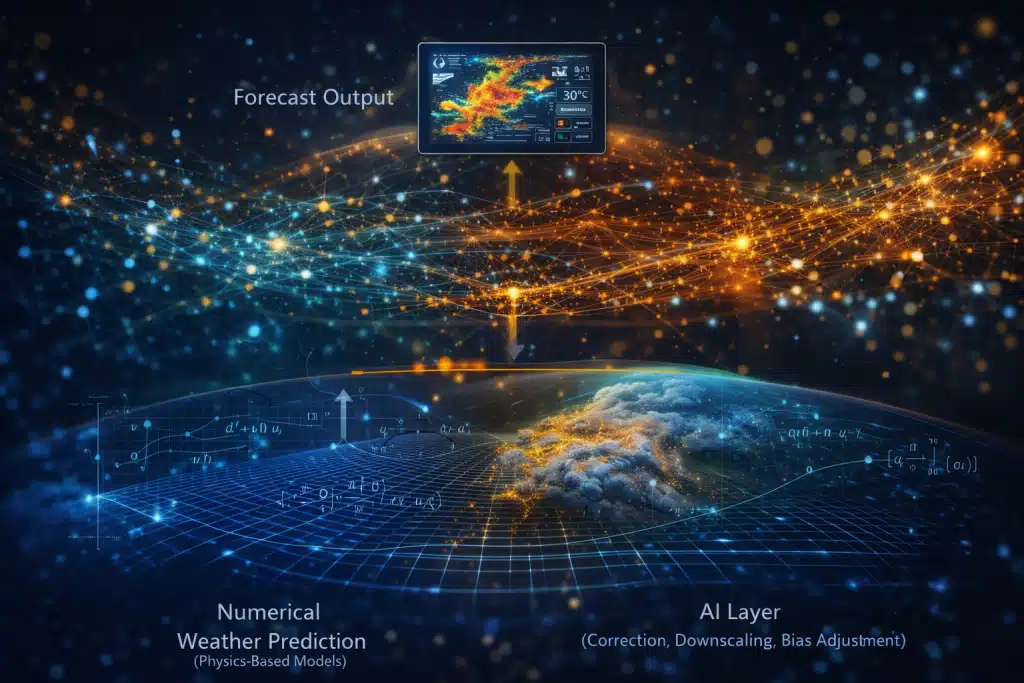
Organizations like the NOAA and ECMWF are now combining numerical weather prediction and artificial intelligence to get the best of both worlds.
Physics models can train AI models on the subtleties of atmospheric physics, while AI can use inference to correct or enhance model outputs.
For example, ECMWF collaborated with Huawei Technologies and other meteorological agencies to create Pangu Weather, which was trained on decades of meteorological data to provide surprisingly accurate predictions for a range of weather scenarios. It is 10,000 times faster than supercomputers, offering almost immediate outputs.
However, Pangu still struggles with extreme weather forecasting, which is where traditional models can come into play. By using both, weather agencies can choose which option will provide the highest resolution for the given circumstances.
Scalability Differences Between Traditional and AI Forecasting Approaches
Traditional models rely on extensive computer infrastructure, typically owned by large governmental agencies like the ECMWF or the NOAA. Few organizations can afford to develop their own supercomputer, meaning that they are limited to the datasets provided by these agencies.
These supercomputers have slower computing cycles due to the massive amounts of physics equations they must run to develop forecasts. They are also limited in the resolution they can provide, balancing cost and speed versus utility.
In contrast, AI scales more easily in cloud environments. Using tools like Google DeepMind or ChatGPT, organizations can code and develop their own AI-based tools tailored to their specific needs. While these models are not as accurate for long-range forecasts, they are faster, cheaper, and more accessible for the average organization.
Data Requirements and Sensitivity Differences Across Systems
The two model types utilize different types of data. AI requires massive quantities of high-quality, consistent data to compare current inputs. It cannot train on its own outputs to avoid data poisoning or hallucinations, which can limit its advancement. However, AI is not as dependent on boundary state accuracy, meaning small terrain inconsistencies, so it can provide strong short-term accuracy.
On the other hand, traditional models need a steady stream of observational inputs, such as data from satellites and weather stations. Additionally, these models require good boundary state accuracy. This refers to how well a model can capture Earth’s surface conditions, such as terrain elevation, ice depth, or ocean currents. Small inconsistencies can lead to poor predictive power, especially for short-term forecasts.
How Business Teams Interpret Results from Each Approach
Businesses can use both approaches depending on their specific needs. With Visual Crossing, businesses can benefit from both AI models and traditional tools in one coherent forecast. As such, users can see current conditions at a single site through AI-powered downscaling, while also receiving a long-range forecast from traditional forecasting models.
Traditional forecasting tools still outperform AI for long-term planning and climate modeling, but they may require expert interpretation to understand the operational value. For example, numerical models can provide estimates of daily conditions, while AI can show what conditions will be like an hour from now.
Areas Where AI Forecasting Drives Operational Advantage
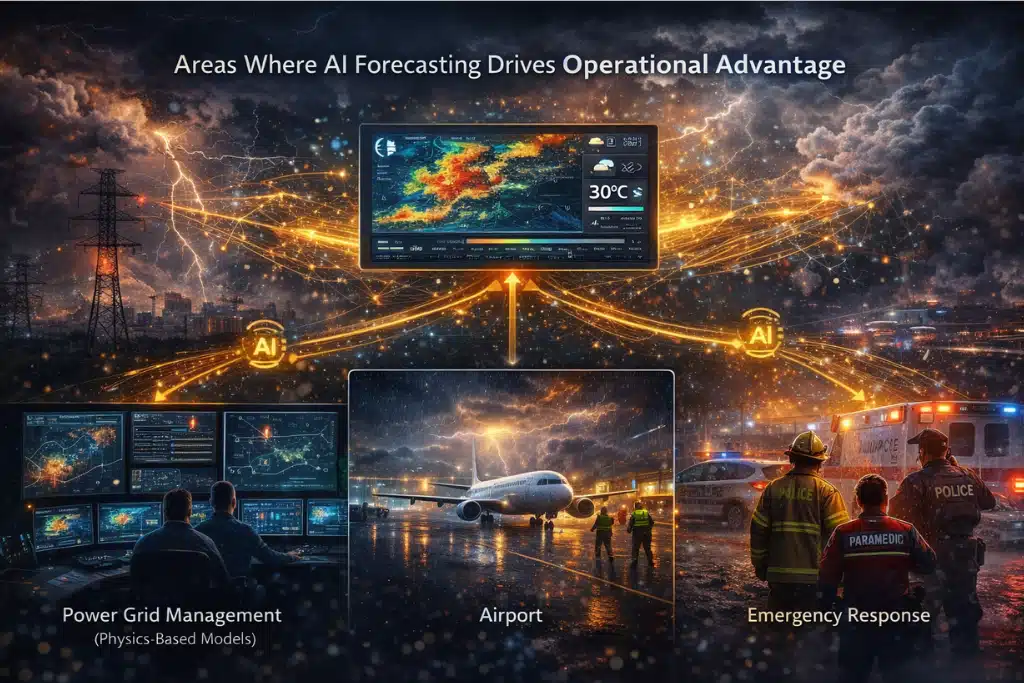
AI forecasting is invaluable for mission-critical and time-sensitive operations. Outage management and grid efficiency are one area where minute-by-minute updates are essential. Flight timing and route management rely on short-term rain or snow prediction to assess delays, reroute based on weather, and check for visibility.
Emergency response also requires immediate forecasting, as this can ensure that responders can be deployed to the correct areas while maintaining their own safety. For these fast-paced roles, AI can be an essential ally.
Areas Where Physics-Based Models Maintain Forecast Leadership
Physics-based weather prediction is valuable for long-term forecasting and research applications, such as climate modeling and atmospheric science. It also provides granular insight into large-scale weather patterns, which can be useful for research applications.
The Growing Role of Machine Learning in Weather Correction Layers
AI tools are not diametrically opposed to more traditional methodology. They can be used to refine existing model output through bias correction, downscaling, or narrowing uncertainty windows, as was seen with Google DeepMind.
What the Future Likely Holds for Hybrid Forecast Systems
Meteorological agencies are increasingly embracing hybrid forecast systems, which use combined modeling to fine-tune existing methods. Ensemble learning, which trains AI using multiple models, is providing deeper insights into weather patterns. Together, these can enable broader access to real-time and hyperlocal weather intelligence.
Why Visual Crossing Supports Both AI-Enhanced and Traditional Forecasting Needs
Visual Crossing integrates both model outputs and advanced data methods for a comprehensive weather API. Reliable global datasets are ready for input into any model, while the convenient API can be easily integrated into dashboards or applications. This makes for simpler automation with custom weather parameters.
The Timeline Weather API provides scalable intelligence for enterprise use, whether you are a multinational logistics company or a regional agricultural business. Tiered subscription levels ensure that organizations of all sizes have access to a steady stream of reliable weather data.
Conclusion: A Forecasting System Built on Complementary Strengths
Recent advances in ML-based models do not mean that traditional forecasting is obsolete. Each method has unique strengths, and operational benefits from combining them. Visual Crossing delivers reliable data for modern businesses that require high-quality, robust datasets, whether for training an AI or gleaning real-time weather insights. Our scalable systems and model blending allows organizations to benefit from both traditional and AI tools in a single forecast output at an affordable price for organizations of any size.
FAQs about Traditional vs AI Weather Forecasting
AI weather tools pattern learning based on large training datasets, while traditional tools predict weather conditions using complex physics equations.
Neither method is inherently better than the other, as their strengths are context-dependent. AI is better for short-term forecasting of standard weather in a small area, while traditional models are better for large-scale, medium or long-range events. Questions remain about AI’s overall accuracy for more complicated weather systems.
AI has lower computing requirements and can perform rapid pattern recognition, enabling near-instantaneous weather insights.
Forecasters use traditional methods because they are grounded in natural law, including complex physics equations that AI models do not have. They are scientifically consistent and can be used to simulate large-scale, long-term weather events, such as seasonal patterns or large storms.
Visual Crossing enables unified data access, model blending with traditional and AI tools, real-time data, and forecasting, which can be called with a single query. The API is easy to integrate into any planning software or app, while reliable uptime and scalability make it suitable for businesses of all sizes and industries.