

Multi-site Weather Risk Monitoring
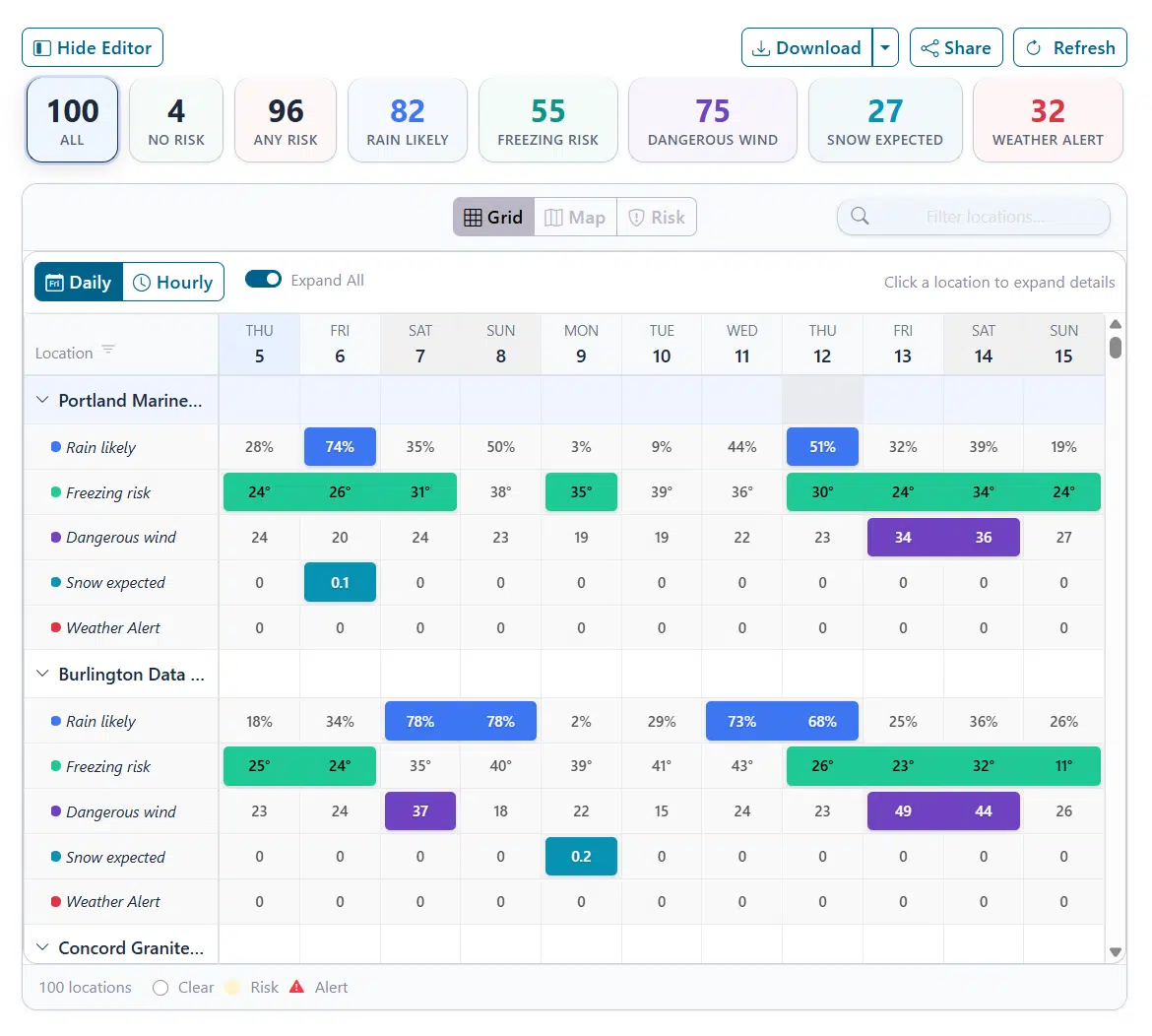
Stop checking forecasts. Start managing risk.
Standard weather apps are built for people; the Multi-site Weather Risk Monitor is built for operations. Instead of manually checking individual cities, this solution allows you to input thousands of precise locations and instantly see which ones hit your specific “stop-work” or “danger” thresholds.
Whether it’s wind speeds for crane safety, temperature floors for concrete pouring, or lightning risks for outdoor events, you get a color-coded bird’s-eye view of your entire organization’s weather risk.

Multi-Site Monitoring

Custom Thresholds

Hyperlocal Forecasts

Risk Maps

Weather Alerts

Team Sharing
Key Features of Weather Risk Monitor
Track and analyze custom weather risks across thousands of global locations simultaneously via a centralized, color-coded dashboard.
Location Management
-
Flexible data entry allows users to add sites manually, paste lists from a clipboard, or upload CSV files exported from Excel.
-
Geographic versatility supports identifying locations using latitude/longitude coordinates, city names, full addresses, or postal codes.
-
Custom naming enables you to assign recognizable labels like “Chicago Store” to technical addresses for easier identification on the dashboard.
Risk Criteria and Thresholds
-
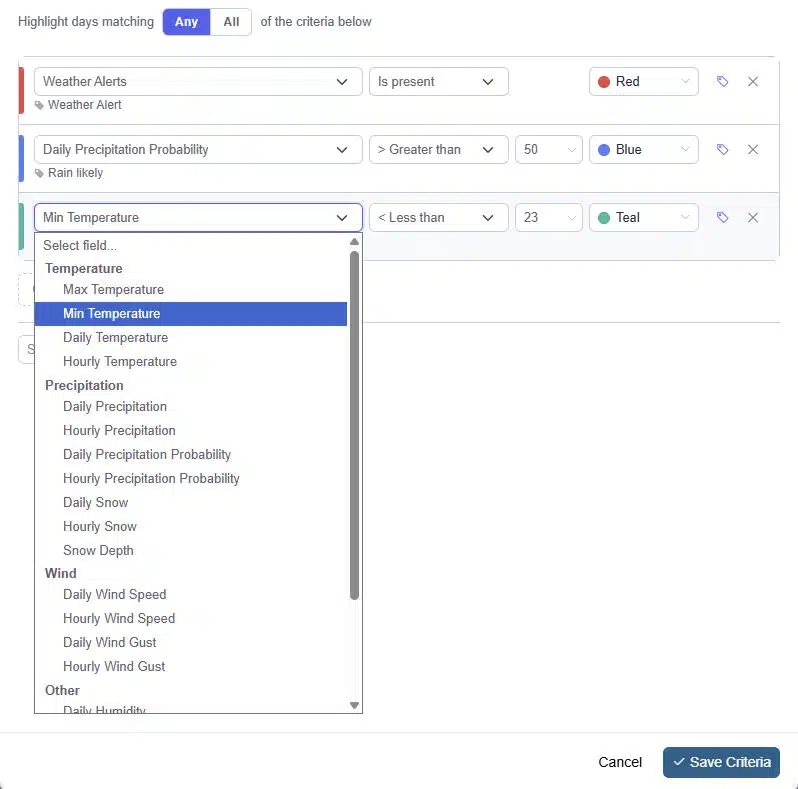
Customizable weather fields include parameters such as temperature, precipitation amounts, wind speeds, humidity, and severe risk levels.
-
The Criteria Editor provides a way to define specific operators (like “greater than” or “between”) and assign distinct colors to different risk types.
-
Industry presets offer “Quick Start” configurations for sectors like construction to instantly set up relevant risk thresholds.
Advanced Filtering and Scheduling
-
KPI Filter Cards allow users to instantly narrow the dashboard view to show only sites with “Any Risk,” “No Risk,” or specific weather threats.
-
Automated scheduling ensures data is refreshed at up to four specific times daily, which is ideal for teams relying on updated morning reports.
-
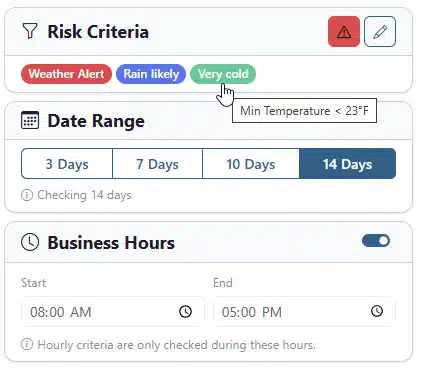
Business hour filters allow users to restrict risk analysis to specific times of day, such as an 8:00 AM to 5:00 PM work shift.
Interactive Visualization Modes
-
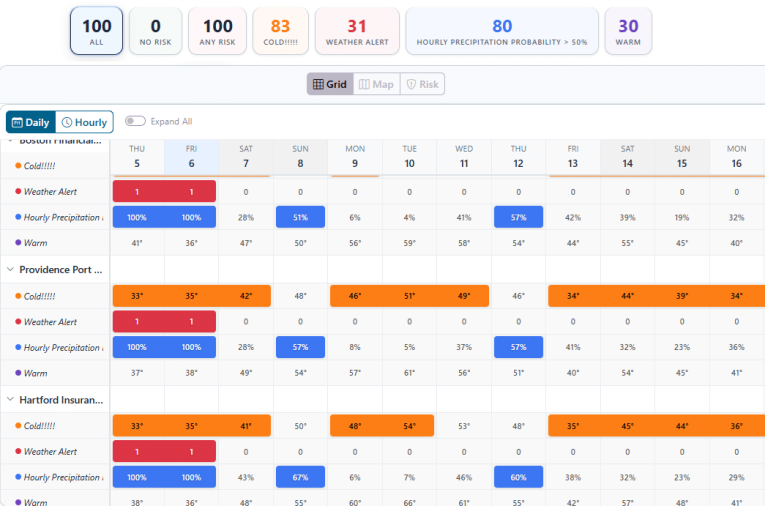
The Grid View provides a matrix of locations versus dates where colored cells highlight exactly when a specific risk threshold is triggered.
-
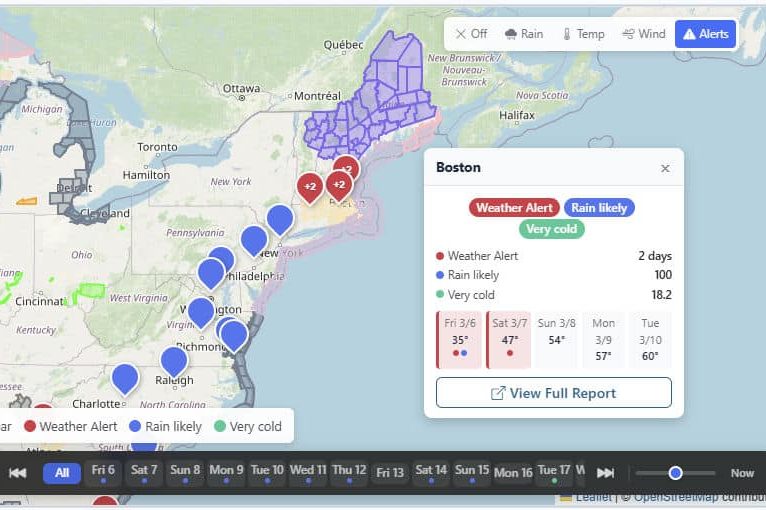
Interactive Map Views display color-coded markers and allow for data overlays such as precipitation radar, temperature contours, and wind fields.
-
Granular toggle switches let users flip between daily and hourly views to drill down into the specific timing of a forecasted weather event.
Weather Intelligence Built for Your Industry




Logistics & Shipping
Weather risk monitoring is essential in logistics and shipping because transportation networks are highly sensitive to changing weather conditions that can disrupt routes, damage cargo, and delay deliveries. Heavy rain, snow, high winds, extreme heat, and severe storms can affect road safety, port operations, rail schedules, and flight reliability. Logistics teams increasingly use weather forecasts and real-time monitoring to anticipate disruptions and proactively adjust routes, schedules, and transportation modes. By integrating weather intelligence into dispatching and planning systems, companies can reduce delays, improve on-time delivery performance, protect sensitive cargo, and maintain more reliable supply chains.
For example, a trucking company transporting temperature-sensitive food across multiple states may monitor forecasts for freezing conditions and high temperatures along its planned route. If a significant storm is expected or summer heat threatens, dispatchers can reroute trucks to safer highways, adjust departure times to avoid the worst conditions, or stage inventory at intermediate distribution centers until the weather clears. These proactive decisions help prevent accidents, reduce spoilage risk, and keep delivery commitments to retailers. Using a tool such as Weather Risk Manager becomes a key operational tool for maintaining efficiency and reliability in complex logistics networks.
Construction
Weather risk monitoring plays a critical role in the construction industry because projects are highly exposed to environmental conditions that can affect safety, productivity, scheduling, and material quality. Construction managers track weather variables such as precipitation, temperature, wind, and severe weather alerts to anticipate disruptions and protect workers. Proactive monitoring allows teams to adjust schedules, secure job sites, protect sensitive materials, and reduce the likelihood of costly delays or safety incidents. With modern forecasting and interactive data tools such as Weather Risk Monitor, construction planners can incorporate weather risk into project planning, enabling more reliable timelines and better allocation of labor and equipment.
For example, consider a highway paving project scheduled during the summer. Pavement quality is highly sensitive to both temperature and precipitation, and unexpected rain can ruin freshly laid asphalt while extreme heat can affect curing and worker safety. By monitoring short-term forecasts and hourly precipitation probabilities, project managers can shift paving operations to optimal weather windows and schedule alternate tasks, such as grading, equipment maintenance, and staging materials, when rain is likely.

Energy & Utilities
Weather risk monitoring is critical for the energy and utilities sector because weather conditions directly influence both energy demand and infrastructure reliability. Temperature extremes can drive sharp increases in electricity or natural gas usage, while severe weather such as storms, high winds, ice, or heat waves can damage transmission lines, substations, and other critical infrastructure. Utilities and energy providers closely monitor forecasts and historical weather patterns to anticipate demand spikes, schedule crews, and ensure generation and distribution resources are properly allocated. By incorporating weather intelligence into operational planning, utilities can improve grid reliability, reduce downtime, and respond more effectively to changing conditions.
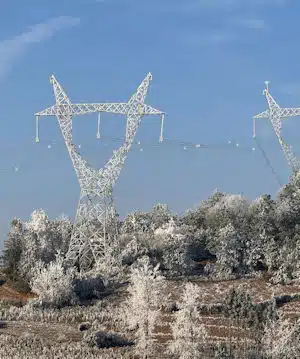
For example, during an approaching winter ice storm, a regional electric utility can use weather forecasts to predict areas most likely to experience heavy icing and high winds. Based on that information, the utility can pre-position repair crews, stage replacement equipment such as transformers and poles, and coordinate with emergency response agencies before outages occur. At the same time, demand forecasts driven by expected temperature drops help operators prepare generation capacity to handle increased heating loads. Tools such as Weather Risk Monitor allow the utility to restore service more quickly and maintain stability across the electrical grid despite challenging weather conditions.
Retail & Facilities
Weather risk monitoring is an important operational tool for retail businesses and facilities managers because weather conditions strongly influence customer traffic, staffing needs, and inventory demand. Temperature swings, precipitation, and severe weather events affect when customers choose to shop, what products they purchase, and how facilities must be managed to remain safe and comfortable. Retailers and facilities teams rely on weather forecasts and historical data to anticipate these shifts, allowing them to adjust staffing levels, prepare inventory for weather-driven demand, and manage building systems such as heating, cooling, and snow removal. Integrating weather insights into operational planning helps businesses improve customer experience while reducing operational disruptions and unnecessary costs.
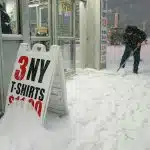
For example, a regional retail chain preparing for a forecasted winter storm may increase inventory of cold-weather items such as ice melt, shovels, and winter clothing at stores in the storm’s projected path. At the same time, facilities teams can schedule snow removal contractors, prepare parking lots and walkways for icy conditions, and adjust staffing schedules to account for expected changes in customer traffic. By using intelligent tools such as Weather Risk Monitor to inform decisions ahead of time, a retailer can ensure stores remain safe and well-stocked while capturing increased demand for seasonal products

Ready to eliminate weather blind spots?
Join thousands of businesses using Visual Crossing to protect their operations.
Already a Visual Crossing Subscriber?
During the preview release, Weather Risk Monitor is included in all plans. Start building your Risk Monitor today to take your Operational Weather Intelligence to the next level!