

The science behind air quality forecasting is a composite of environmental science, computational modeling, and meteorological data. Through air pollution prediction science, researchers can better understand pollutant behavior in relation to weather variables and then apply this to improve public health.
What Is Air Quality Forecasting?
Air quality forecasting science predicts how meteorological variables such as temperature, humidity, and wind speed will influence the behavior and concentration of air pollutants. This is combined with environmental monitoring of common pollutant sources to gain a more complete evaluation of current air quality.
Using air quality predictions, government agencies such as the Environmental Protection Agency can collaborate with state and local partners to enhance air quality management, while also monitoring industry actors to ensure they remain compliant with regulations.
The general public can also utilize air quality data to protect themselves from hazardous pollutants, thereby significantly enhancing their quality of life.
The Role of Weather Data in Forecasting Accuracy
Meteorological factors share a complex relationship with air quality. Pollutants are not inert; they are chemicals that can react in the presence of heat or with added moisture.
On hot days, the climate has more energy, which leads to increased chemical reactions. For example, nitrogen oxides and volatile organic compounds (VOCs) react to become ground-level ozone, a key element of smog.
Humidity also traps fine particles, such as particulate matter, allowing them to remain suspended in the air and contributing to higher contaminant levels. Strong winds will disperse pollutants from the local area and improve air quality, while the direction determines where they are carried next. Lastly, precipitation can wash contaminants out of the air, but it may also initiate different chemical reactions that lead to acid rain.
A highly accurate weather data source allows researchers to develop more refined models, run comparisons between different meteorological conditions, and provide more accurate predictions.
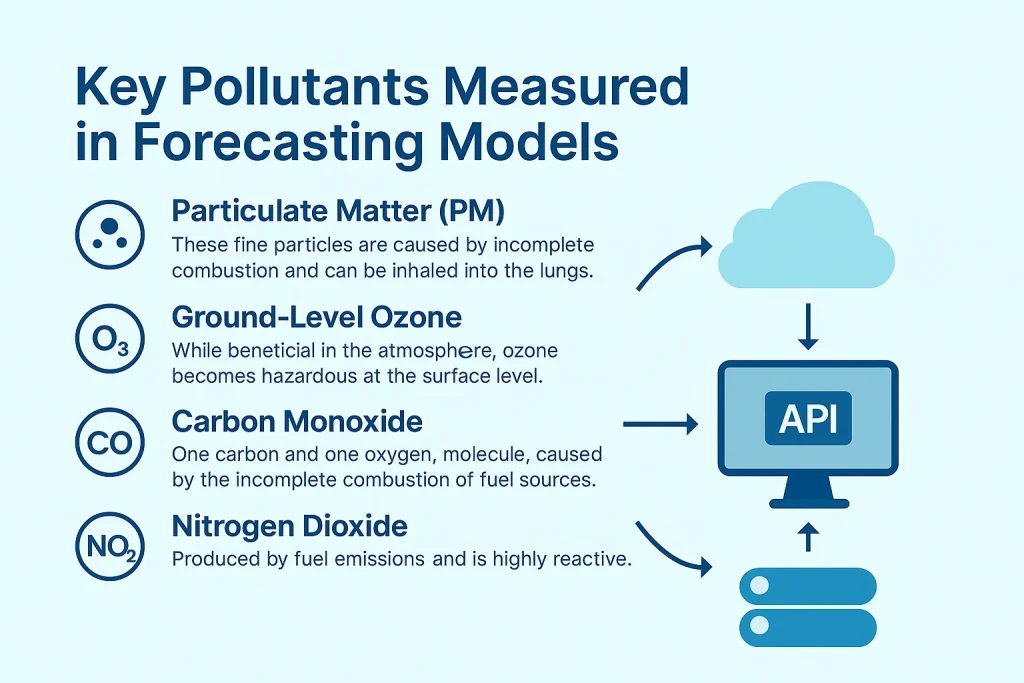
Key Pollutants Measured in Forecasting Models
Certain chemicals are considered contaminants of concern because they are more reactive, more plentiful, and more dangerous. These are some of the components included in air quality data.
- Particulate Matter (PM): These fine particles are typically caused by incomplete combustion and can be easily inhaled into the lungs. They are classified by size, with PM2.5 being the smallest and PM10 being the largest. In humid conditions, PM absorbs water and grows larger, causing it to settle closer to the surface.
- Ground-Level Ozone: While beneficial in the atmosphere, ozone becomes hazardous at the surface level. It is generated through chemical reactions, including the formation of volatile organic compounds (VOCs) and nitrogen oxides. Heat accelerates chemical reactions and contributes to the formation of smog.
- Carbon Monoxide: Carbon monoxide is one carbon and one oxygen molecule, caused by the incomplete combustion of fuel sources. It is more prevalent in cold weather because people burn more fuel to stay warm, which increases the risk of carbon monoxide poisoning.
- Nitrogen Dioxide: This chemical is produced by fuel emissions and is highly reactive. When heat is added to the system, it combines with other sources to create ozone and smog.
- Sulfur Dioxide: Produced through industrial activities, sulfur dioxide combines with precipitation to create acid rain, which damages plants and structures. It also irritates the mucus membranes and can contribute to asthma.
Computational Air Quality Prediction Models
Computational air quality prediction is a key element of atmospheric science. It uses complex algorithms to visualize the spatial relationships between contaminant concentrations and weather, then develops a model that can be used to predict different outcomes.
However, models require continuous weather inputs and refined knowledge of atmospheric chemistry, making it essential that researchers have a wealth of data to work from. Weather APIs, such as Visual Crossing, can provide a constant flow of weather data necessary to develop robust models.
Machine Learning in Air Quality Forecasting
Artificial intelligence and machine learning have significantly improved forecasting models, as they can process vast datasets much faster than existing methods. By training on large datasets and then utilizing neural networks to identify trends, these methods detect shifts in contaminant trends and enhance forecasting accuracy.
For example, a machine may be trained on 50 years of historical air quality and weather information. It will assess how pollution changes by season and location, considering factors like prevailing winds, local factories, and nearby landmasses. Each of these is then weighted by its significance to determine what conditions may look like, even down to the hour.
Any predictive model will be imperfect, but AI can incorporate thousands of parameters all at once and assess which ones have the most impact on air quality in a given location. Researchers can then run predictions, such as what would happen if policymakers imposed a higher fuel tax on automobiles, thereby reducing the number of cars on the road.
The Connection Between Air Pollution and Weather Patterns
The weather-air quality relationship is complex and interdependent. Temperature inversions can either increase or reduce contaminant concentrations, while wind speed and direction determine how quickly it disperses and where it travels. Precipitation flushes particles from the air but also causes it to acidify soil, degrade structures, or damage foliage.
As such, understanding each of these factors helps governments, industries, and individuals determine the best course of action based on current conditions.

Data Sources for Air Quality Forecasting
Using more than one weather data source improves predictions and allows for more thorough analysis. High-quality, real-time data ensures that governments and people are aware of minute-by-minute changes in granular detail, which leads to faster and better decision-making.
Common data sources include satellite imagery, weather APIs, personal weather stations, and local monitoring stations. Radar can also help track storm systems, which can play a key role in air quality. When combined, these sources provide a better picture of what to expect in the coming hours and days.
Benefits of Accurate Air Quality Forecasts
Accurate models are critical to success in nearly every aspect of public policy, which includes the following.
- Public Health: An air quality forecast allows individuals to plan their activities for safety, and it also ensures that governments can declare an air quality emergency when necessary.
- Environmental Policy: Tracking regulatory efforts requires refined data on air pollution. This can also help researchers understand how climate change impacts air quality and how to mitigate the effects of hazardous air.
- Business Applications: Air quality has a significant impact on business activities, from cutting emissions to keeping outdoor workers safe. Monitoring air quality allows companies to make smart decisions about their daily operations.
- Urban Planning: Building smart, clean cities should be at the top of every urban planner’s list. Considering air quality and building mitigation efforts into infrastructure improves human health, tourism revenue, and even population change.
Challenges in Air Quality Prediction
Due to the thousands of different factors involved in air quality, it’s impossible to predict it with perfect efficiency. Data may be imperfect, and different models may only work in certain conditions. Additionally, computational processing power is a limiting factor, even as models improve and data collection becomes faster.
The weather is always slightly unpredictable; otherwise, we would be able to perfectly estimate where a tornado will move or when a storm system will make landfall. Human activities, such as burning fossil fuels or driving to events, also impact air quality.
When these two unpredictable factors combine, they add significant uncertainty to modeling. However, the future of forecasting is bright, as more refined techniques offer lower margins of error and greater data processing.
Future of Air Quality Forecasting
While current knowledge of air quality is highly refined, the development of new technologies promises even more robust research into the environment, global climate change, and emissions.
Artificial Intelligence and deep learning methods, such as convolutional neural networks, can enhance data mining from satellite imagery by providing a sharper focus on tiny details that engineers may have missed.
The Internet of Things (IoT) will enable community multiscale air quality measurement by transforming everyday objects into new weather stations, vastly expanding the total number of monitoring sites in researchers’ systems.
Finally, global collaboration allows researchers to pool their knowledge for the best performance of all modeling systems. Researchers can share insights into deep neural networks, information engineering, and computational modeling studies, which can then be replicated across the world.
Conclusion
Weather and air quality are intertwined, meaning that data collection should focus on both for the greatest benefit. As computational modeling improves and innovative technologies are incorporated into the research ecosystem, governments and businesses will be able to improve environmental outcomes and safeguard the public like never before.
FAQs about Air Quality Forecasting
What is the main purpose of air quality forecasting?
An air quality forecast assesses how pollution moves through a region, how weather impacts its concentrations, and what health effects the general public can expect. This ensures public safety, advances understanding of the overall climate, and helps policymakers take decisive action to mitigate the harmful effects of pollution.
How do weather conditions impact air pollution levels?
The weather plays a key role in air quality. Heat accelerates chemical reactions, leading to the production of smog. Humidity traps particles closer to the ground and, in the case of PM, causes it to swell and grow heavier. Wind moves air through the region, dispersing pollution far from its source. While precipitation washes these chemicals from the air, it also allows it to enter groundwater systems and damage buildings.
What role do computational models play in forecasting air quality?
Computational models process large amounts of weather data and build models based on thousands of parameters, which helps researchers consider how different factors may influence air quality. However, because weather is such a fluid component of a computational model, these systems require continuous data collection in order to refine their predictions and ensure more accurate forecasts.
Why is accurate weather data essential for air quality analysis?
Weather is intricately connected to air quality because factors such as precipitation, heat, and wind all influence how particles move and interact with the environment. A hot, humid day is going to have higher ozone production than a cold, wet day.
Because of this, any comprehensive air quality research will also incorporate real-time weather data collection, which can then be integrated into computational models for enhanced predictive power.
How does machine learning improve air pollution prediction?
Machine learning is improving prediction by accelerating data processing and analysis. These machines have been trained to learn like a human would, but exponentially faster. As such, they can make connections between different data points, analyze margins of error, and develop highly refined predictions of what future conditions may look like based on current information.