

The future of weather forecast models is faster, more precise, hyperlocal data that leverages artificial intelligence for real-time insights. Internet of Things (IoT) sensors, dense observation networks, mobile devices, and APIs provide high-resolution data that is shaping how organizations predict extreme weather events or handle micro-scale weather fluctuations.
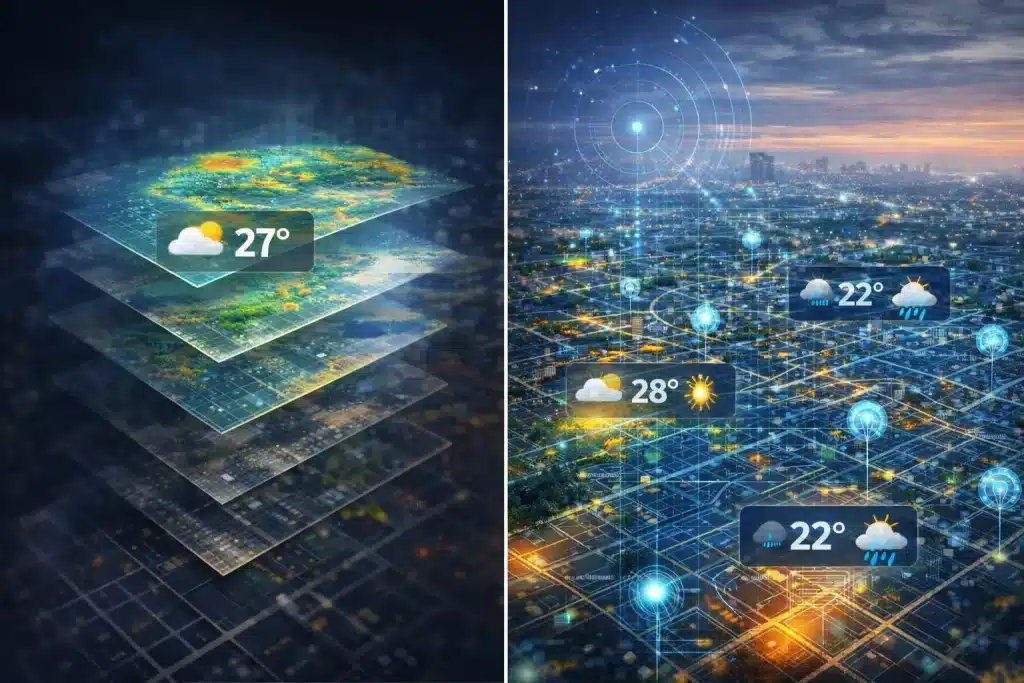
How Weather Forecasting Is Evolving in a Real-Time World
The global community depends on continuous, reliable forecast data for public safety and private-sector profit. Conventional models have slow update cycles and general observations that miss hyperlocal weather phenomena.
The AI revolution and other advancements have shifted how organizations use weather data. For example, public sector organizations can set up fully automated systems based on streaming data, which can protect lives during extreme weather. Constant recalibration of weather prediction means highly precise, local forecasting.
The Rise of IoT Sensors and Dense Local Observation Networks
Traditional modeling relied on scientists deploying stationary sensors or weather balloons to take regular measurements. However, the Internet of Things (IoT) has contributed significantly to faster, more accurate weather forecasting.
Low-cost stationary sensors, IoT-connected devices, vehicle-based weather reporting, and even city infrastructure have created a dense, hyperlocal network. These have the ability to track temperature, precipitation, wind speed, and air quality from thousands of data points in a given area.
More data means more accurate weather predictions. With these tools, forecasters can give hyperlocal predictions that are more accurate than ever.
Why Hyperlocal Intelligence Is Becoming Central to Accurate Forecasting
The weather can vary significantly across short distances, especially in cities, but generic weather forecasting often misses these nuances. Precise forecasts for specific areas are invaluable across industries such as transportation, logistics, utilities, agriculture, and renewable energy. Using sensors and machine learning, municipalities and private businesses can receive the weather intelligence they need to thrive.
Real-Time APIs as the Backbone of Next-Generation Forecasting Systems
APIs are the engine behind real-time weather prediction. These data gateways constantly ingest and transmit forecast updates for business applications, including planning software, automation, alert tools, and digital twins. Accessible, model-ready data from providers like Visual Crossing enables organizations to respond quickly when conditions shift.
How Machine Learning Enhances Real-Time and Hyperlocal Forecast Accuracy
Artificial Intelligence (AI) models have revolutionized meteorology, as the immense computing power can provide more high-quality data than traditional methods. A recent study found that Google DeepMind could more accurately predict the weather than the European Centre for Medium Range Weather Forecasts (ECMWF), whose weather models are considered the best available.
By using neural networks and machine learning (ML) models, AI ingests vast amounts of training data from open data sources like the National Oceanic and Atmospheric Administration and national weather services. It then uncovers subtle patterns that numerical weather prediction may miss. AI systems can also run complex fluid dynamics equations in real-time, which is impossible for older physics-based models.
AI-based models allow faster data assimilation from a larger range of inputs. Together, this means better short-term forecasting, improved weather event timing, and more reliable hyperlocal predictions.
Why Visual Crossing Supports the Future of Weather Intelligence
Visual Crossing offers the data foundation for modern forecasting and weather research. Our Weather API provides historical, real-time, and forecast data in one unified, application-ready format.
We give organizations the ability to query a specific location anywhere on the globe with hyperlocal precision, all in a model-ready format. You can then feed this data into IoT networks, analytics platforms, or automated tools for seamless weather modeling.
Whether you are a computer science researcher or a municipal forecaster, Visual Crossing’s robust Weather API lets you capitalize on next-generation forecasting in any operational setting.
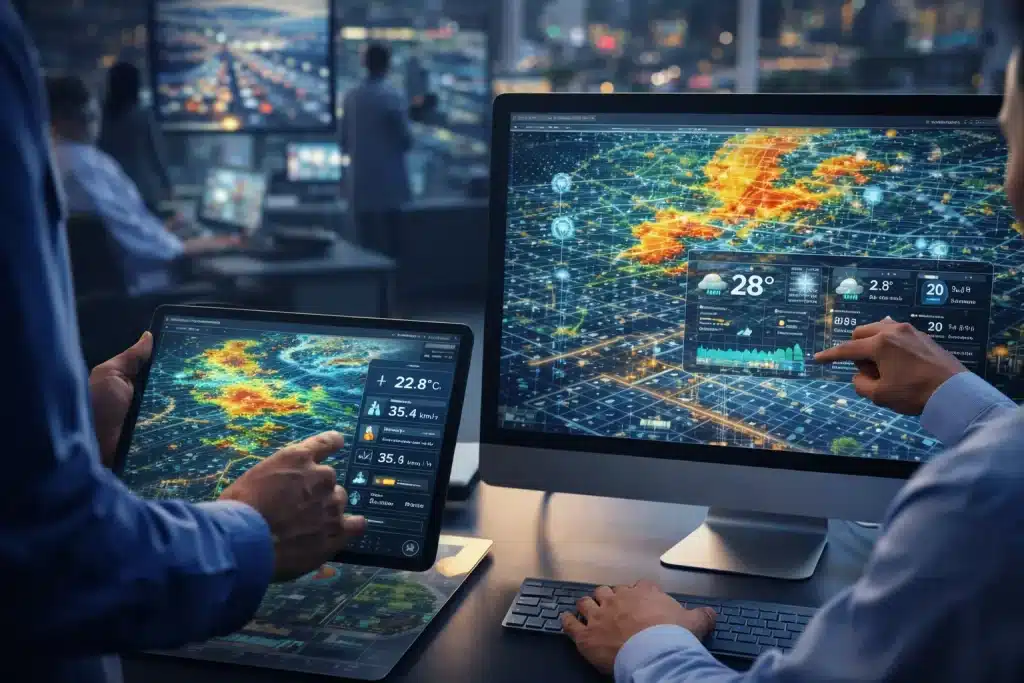
Business and Municipal Use Cases Shaped by Real-Time and Hyperlocal Forecasting
Real-time and hyperlocal forecast models are invaluable to almost any industry, with hundreds of use cases depending on your specific needs. These are some ways that real organizations have utilized hyperlocal forecasting to protect assets and improve resource allocation.
- Utilities: Grid operators can assess current UV indices and wind speeds to determine which renewable energy source will provide the best output.
- Emergency Responders: Hyperlocal forecast models give first responders the insights they need to dispatch resources to where they are needed most. Municipalities can also issue advisories or alerts specifically to the households most likely to be affected.
- Traffic Management: Atmosphere conditions can impede travel, such as heavy fog or blizzards. Smart city systems can use real-time intelligence to adjust traffic patterns, issue warnings, and remotely turn on streetlights via sensors.
- Hospitality: Providing a perfect experience is essential for hotels, resorts, and entertainment venues. Using real-time monitoring, companies can quickly adjust to changing conditions, such as triggering automatic ice melt sprinklers or issuing alerts about a snowstorm.
- Retail: Localized demand shifts are often weather-dependent and can vary significantly by store location. Using real-time insights, retail teams can adjust staffing, determine daily sales offers, and arrange stock to capture impulse buys.
Obstacles That Must Be Solved to Enable the Next Forecasting Breakthroughs
Questions remain about how these new ideas will remain viable over time, but human expertise and collaboration can significantly improve the quality and viability of these tools.
- Inconsistent Sensor Coverage: Some areas, especially rural and remote regions, lack sufficient sensors to deliver highly accurate local measurements. Technology vendors can work with municipalities and government agencies to install sensors where they are most needed.
- Inconsistent Data Quality: Different providers may provide varying granularity and quality, making it essential that organizations research which provider offers what they need.
- Integration Complexity: Smaller organizations may lack in-house human experts to guide them through automating systems or defining API parameters. In these instances, technology vendors and API providers must offer tailored solutions.
- Gaps in Real-Time Infrastructure: Ideally, all measurements are synchronized across different sensors, each taking continuous readings and submitting them to APIs. However, proprietary sensors may work on different timelines, leading to coverage gaps. Collaboration between tech vendors and API providers can help solve this issue.
Solving these issues can create a safer, smarter world. Through collaboration with public and private stakeholders, businesses and municipalities can identify gaps, brainstorm solutions, and develop the next generation of smart tech.
Conclusion: A Future Built on Continuous, Hyperlocal Weather Intelligence
Current weather models have provided valuable insight, and next-generation weather intelligence is advancing this knowledge.
Instant, hyperlocal, and continuously updated insights allow for better resource allocation, more resilient communities, and a deeper understanding of the natural world. IoT sensors, AI tools, and hyperlocal intelligence make it possible to pivot quickly and protect assets from extreme weather events.
Organizations must embrace this shift to a world where information is always updated and deeply integrated into operational processes. Visual Crossing is a foundational partner in this transition, ensuring that communities and private organizations have the knowledge they need to thrive.
Our API provides real-time conditions for anywhere in the world and is easily integrated into existing systems. We provide flexible, scalable subscription models that range from personal use to enterprise licensing, depending on your needs. Most importantly, we offer unique datasets like UV index and soil temperature that may be difficult to find elsewhere.
Contact our specialists today to learn more about our services.
FAQs about the Future of Weather Forecasting
A range of new technologies has emerged to assist in better understanding local weather.
IoT Networks: By taking measurements from thousands of sensors, easily embedded into consumer products or specialized sensors, IoT networks can develop a comprehensive picture of current conditions and trigger automated systems.
Machine Learning: AI networks ingest large volumes of training material, then identify correlations that older models may have missed. This can find subtle nuances of local weather.
Hyperlocal Sensors: These small sensors continuously transmit information about temperature, precipitation, humidity, and air quality, which can then be incorporated into datasets and analyzed for hyperlocal insights.
Real-Time Datasets: Platforms like Visual Crossing can transmit continuous weather forecasts to users, which can then be used to trigger systems, send alerts, or make operational decisions.
Weather is fluid and changes quickly. It is a complex interchange between atmospheric pressure, humidity, temperature, wind, and local landmasses that can vary significantly across a small region. As such, businesses need immediate insight to respond effectively to changing conditions that may endanger their operations or damage resources.
For example, a heavy localized rainstorm may cause work stoppages at a construction site. With older weather models, this may appear to come out of nowhere, but real-time updates enable companies to predict where this may occur and prepare.
Location-specific forecasts are crucial, especially for outdoor operations or utility companies. Older models show general estimates for a large area that may miss microclimates and small fluctuations, which may occur across even one city block.
By using location-specific information, organizations can understand the precise conditions they will face on a specific street, city block, or work site, helping them to plan their activities with greater confidence.
APIs serve as a gateway to weather databases. When a company utilizes an API, it unlocks real-time weather insights that are stored in the cloud and transmitted to an application. This is a stream of information that can be analyzed or used to trigger automated systems.
Using an API saves time and money, ensures seamless business operations, and improves decision-making.
Visual Crossing’s API is highly accessible and uses the highest quality data sources. Our API’s global reach is invaluable for multinational companies that need consistent, accurate, and continuous insights across large areas, with highly granular insights for local decision-making.
Our flexible API can be easily integrated into any software, dashboard, or app, and we offer tiered pricing that supports scalable business growth.