

Weather conditions influence how goods move, when crews can work, how much energy is required to maintain buildings, and how customers behave in local markets. These shifts happen daily, and the financial impact stacks quickly. Companies that operate on tight timing, thin margins, or complex networks feel it most.
Predictive weather analytics brings weather data into the same decision systems that already guide routing, scheduling, production, and risk planning. Forecast inputs become part of the operational workflow, not something checked after the fact. The organization gains more flexibility in how it sequences work and allocates resources.
This approach relies on structured, location-specific weather information accessed through a weather API. The data is formatted so it can feed directly into existing tools and models. Nothing is interpreted manually or depends on someone refreshing a dashboard at the right moment.
The result is fewer surprises and less scrambling. The team has more time to plan rather than react at the last minute.
Turning Forecasts Into Business Decisions and Measurable Outcomes
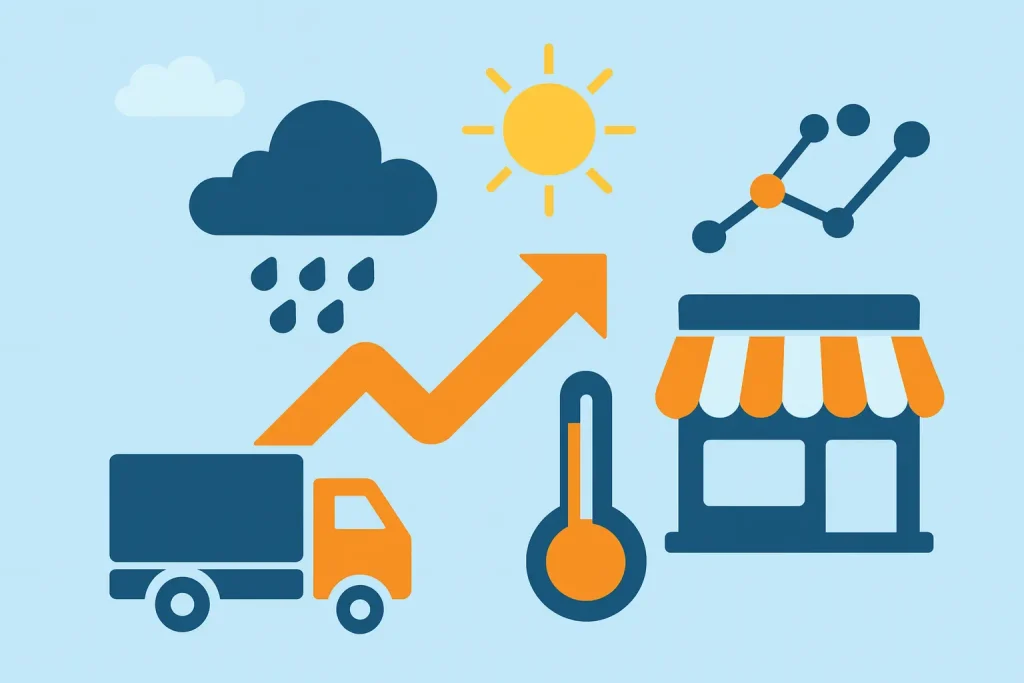
Predictive weather analytics helps teams look at the forecast and understand what it means for the work ahead. A change in temperature affects how much energy people will use. Rain can shift customer traffic and delivery timing. Developing storms can narrow routing windows or pause outdoor work. These signals shape workload pacing, staffing decisions, and workflow timing.
Teams already respond to these things, but often only once the weather is actively causing pressure. With predictive weather analytics, those adjustments are built into the plan rather than made in the moment.
- A logistics team can reroute freight before a storm closes a corridor.
- An energy provider can prepare for higher heating or cooling demand before usage surges.
- A retailer can adjust staffing and promotions when they know foot traffic will rise or slow.
The forecast becomes one of the inputs that guides scheduling and resource allocation.
The Foundation: Historical Weather Data and Real-Time Observation
Predictive analysis depends on blending historical weather data with real-time measurements.
Historical data shows how past weather patterns have played out. It helps you understand how storms tend to form and how seasons usually unfold. Real-time data shows what is happening right now and whether those patterns are accelerating or shifting.
Meteorologists collect extensive data from satellites, radar, sensors, and weather balloons. Weather models convert this information into forecasts that can inform routing, staffing, and resource planning.
Through a weather API, companies can access model-ready data rather than static summaries.
Seeing patterns in past and current conditions makes forecasts more practical for day-to-day planning.
Accurate Forecasts, Reliable Plans
Forecast accuracy is less about knowing every detail and more about having enough confidence to act. Teams plan more effectively when they trust the forecast’s timing and general direction, even if the exact numbers shift a little.
Most organizations already have access to weather information. The real advantage comes when that information is structured so that planning tools and workflows can automatically draw on it.
When forecasts feed directly into scheduling and resource systems, routes are chosen with more certainty, staffing aligns more consistently with demand, and safety measures are activated with fewer disruptions.
Accuracy, here, means the forecast is solid enough to plan against.
Decision Making Under Uncertainty, Deterministic vs Probabilistic Forecasts
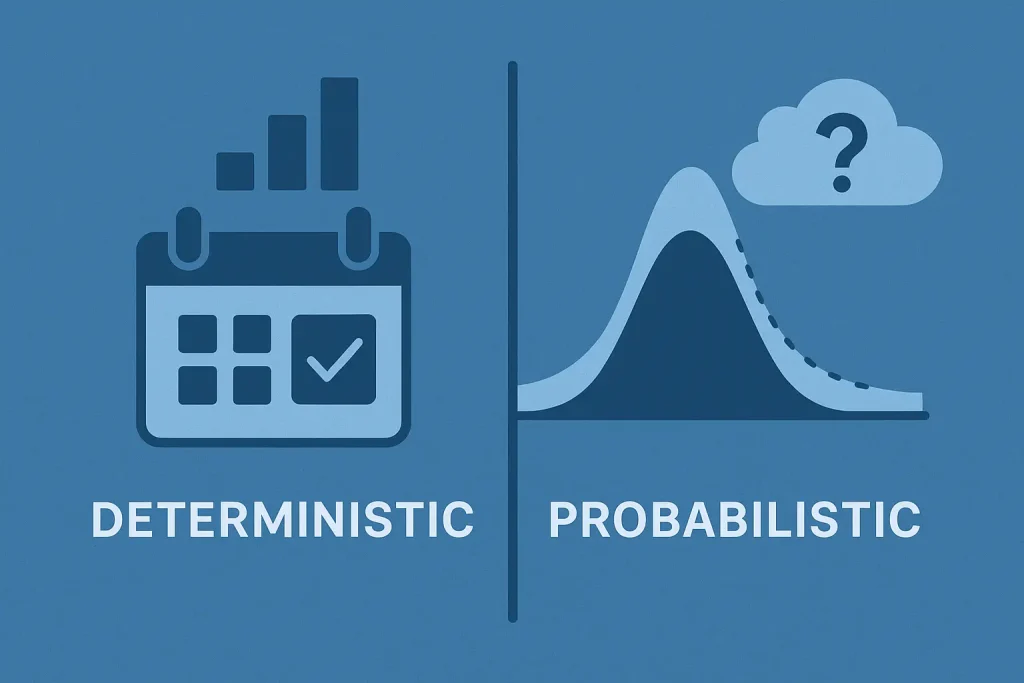
Forecasts generally fall into two categories.
- A deterministic forecast gives a single expected outcome and works well for setting day-to-day schedules.
- A probabilistic forecast shows a range of possible outcomes and how likely each one is, which helps when conditions are shifting or when planning needs room for adjustment.
Most teams use deterministic forecasts because they are familiar and easy to read. Probabilistic forecasts add value when the environment is less stable.
Seeing the range of possible outcomes helps planners choose routes, allocate labor, and position equipment to preserve schedule stability.
Extreme Weather, Bigger Stakes for Lead Time
Major weather events have become more frequent and disruptive, increasing operational strain and financial exposure. Flooding, heatwaves, severe storms, and regional weather disruptions can slow supply chains, reduce labor availability, and push energy and transportation networks past comfortable levels.
When conditions tighten, the amount of advance notice often determines whether operations stay on track or fall behind.
Predictive weather analytics expands the planning window, giving teams more control over how work is sequenced and resources are deployed.
Global Weather Signals, Local Operational Impact
Large-scale weather patterns shape what happens at the local level. Changes in ocean temperatures can shift rainfall and humidity across vast regions. A shift in the jet stream can determine where storms travel and where conditions stay calm. These signals develop long before their effects appear on the ground.
When planners understand these broader patterns, they can sequence work and allocate resources in ways that hold up under changing conditions.
What the American Meteorological Society Says About AI and Human Expertise
Artificial intelligence and machine learning can process large volumes of weather data and identify relationships that are difficult to spot through individual weather events.
The American Meteorological Society notes that this capability improves forecasting most when it is used alongside human expertise. Meteorologists provide context, check assumptions, and confirm whether model output makes sense for the situation at hand.
AI accelerates processing, and meteorologists validate the reasoning behind the output. The combination yields forecasts teams can trust when making operational decisions.
From Data to Critical Decisions in Operations
The value of predictive weather analytics shows up when it becomes part of how teams plan, not just something they check when conditions change. Many organizations already have standard operating procedures for routing, staffing, maintenance, and safety. Weather data enhances those procedures by defining when to act and how to prioritize.
For example, a logistics network can set clear thresholds for when shipments switch routes based on forecasted wind, precipitation, or visibility. An energy provider can tie forecasted temperature bands to expected load profiles and schedule supply accordingly. Construction and field operations can incorporate weather timing into daily plans to make work flow more predictably.
The goal is consistency. Weather becomes something the organization plans around in the same structured way it plans labor, equipment, and time.
Forecasting Energy Demand From Temperature and Precipitation
Energy usage tracks closely with the weather. As temperatures rise or fall, heating and cooling systems respond almost immediately. Rain and seasonal precipitation patterns affect how hydropower facilities schedule flow and reserve capacity. These patterns become clearer when weather signals are tracked alongside demand and operational data.
With predictive weather analytics, energy providers can link forecasted temperature bands to expected load curves, then adjust procurement, generation schedules, and storage accordingly. This reduces the need for last-minute market purchases, avoids unnecessary strain on infrastructure, and supports a steadier grid. The result is greater stability in both system performance and cost planning.
Advanced Weather Modeling and Tools, From Ensembles to GraphCast
Modern weather models look at how conditions are developing, not just what they are now. Ensemble modeling runs multiple forecast scenarios at once to show the range of possible outcomes. Emerging systems like GraphCast use artificial intelligence to process vast datasets quickly, which helps reveal shifts in weather patterns sooner.
Forecasters use these tools to understand how much confidence to place in a forecast and where uncertainty may affect timing. When uncertainty is visible, planning can account for it, reducing rushed adjustments.
Weather as a Planning Input, Not a Disruption
Predictive weather analytics makes weather something teams can plan around. When weather data is delivered through a weather API and integrated into the tools that schedule work, move goods, and allocate resources, the organization gains stability.
Plans hold longer, schedules stabilize, and work can move without constant re-coordination.
The weather will constantly shift. The advantage goes to the companies that treat it as part of the plan.
Why Visual Crossing for Predictive Weather Analytics
Visual Crossing provides the complete weather data foundation needed to operationalize forecasting. The platform combines reliable historical weather data, real-time conditions, and hyperlocal forecasts in a single weather API. This allows teams to incorporate weather signals directly into routing, staffing, scheduling, demand forecasting, and risk planning.
Organizations choose Visual Crossing because the data is:
- Accurate enough to support business-critical decisions
- Scaled to global operations, from single facilities to large networks
- Affordable for continuous use across systems and teams
For developers and analysts, the Query Builder and AI-assisted coding tools streamline the process of turning raw weather data into clear, usable inputs. Teams can generate the exact data they need in seconds and feed it directly into models and applications without manual formatting or interpretation.
The result is straightforward weather intelligence that fits into existing workflows and makes planning more predictable, efficient, and proactive.
FAQs about Predictive Weather Analytics
Traditional weather forecasts describe meteorological conditions such as temperature, wind, and rain. Predictive weather analytics uses predictive analytics to go one step further by translating forecast signals into actionable insights for routing, staffing, scheduling, and cost planning. The focus is on applying the forecast to real decisions rather than simply noting the weather itself.
Many organizations already monitor weather, but forecast quality varies, and raw data is not always easy to interpret. When weather information is structured for planning workflows, teams can adjust before high-impact weather events tighten schedules or reduce capacity. This is especially important in industrial environments, where timing and resource allocation drive costs. Reliability improves when weather is incorporated into the planning process rather than treated as a last-minute adjustment.
Yes. Weather patterns influence more than short-term scheduling. Predictive models can identify seasonal shifts, long-range demand signals, and climate-linked patterns that affect resource planning. This is useful as organizations prepare for extreme events that have become more common and costly, including billion-dollar disasters. Planning is easier when weather signals are tied to operational timelines.
It applies to both. Routine changes like light rain can shift staffing or foot traffic just as reliably as major storms can disrupt logistics. The difference is scale. Predictive weather analytics helps teams understand how both routine and severe conditions will influence work, then plan accordingly. It turns weather into a variable that can be managed rather than an interruption.
Weather data is complex data. Artificial intelligence and machine learning can process large amounts of it quickly, but they work best alongside meteorological expertise. Meteorologists interpret model behavior, evaluate uncertainty, and confirm whether outputs make sense for the location and season. This pairing improves reliability because both data and context inform decisions.