

An enterprise weather API is a key element of effective operations management. Accurate weather forecasts reduce weather-related risks while enhancing decision-making. Regardless of your industry sector, comprehensive weather data gives you a competitive edge over other companies in your niche.
What Is an Enterprise Weather API?
An enterprise-grade weather company API provides you with real-time access and more API requests than a free or basic API. Additionally, you’ll gain access to more specialized datasets, including decades of historical weather data and details like solar irradiance or air quality.
Enterprise customers can enjoy faster API responses with guaranteed uptime, including more accurate collection through the use of personal weather stations in addition to government datasets. This is crucial for those who need to make customized weather maps, provide severe weather alerts, or analyze global weather data for international supply chains.
Why Businesses Need Scalable Weather API Solutions
Scalable weather data is crucial for enterprise businesses. For example, logistics companies may need real-time updates across thousands of global locations, while agriculture operations require a wealth of historical data at one particular location so they can make accurate predictions about planting and harvest times.
A large company may make thousands of requests per hour, which isn’t possible with a free API key. As such, working with a provider who can provide scalable, reliable, and comprehensive solutions is key to success.
Key Benefits of Enterprise Weather APIs
Benefits of enterprise weather data include:
- Highly Accurate Forecasts: Receive daily and hourly forecasts in granular detail to make minute-by-minute adjustments to your operations.
- Uptime Reliability: Visual Crossing offers a 99.9% uptime guarantee, ensuring your weather data needs are always covered.
- Customizable Endpoints: Customize your parameters and URL HTTPS endpoint to query for different needs, such as current conditions or historical weather data.
- Flexible Integration: Select between CSV and JSON formats to easily integrate with your applications.
Comparing Enterprise vs. Standard Weather APIs
Standard weather data APIs have request caps and utilize only a limited dataset, which may result in less precise forecasts. Additionally, response times may be throttled during high-demand times, and uptime is not guaranteed.
An enterprise-level API eliminates these concerns, ensuring you’re always the first to know about weather events as they happen. You’ll be guaranteed prompt response times, accurate data, and consistent uptime regardless of server loads.
Reliability and Performance for High-Volume Users
A high-volume weather API provides consistent uptime and lightning-fast responses. Additionally, you can access a wealth of historical weather data with global coverage, allowing you to explore weather conditions from anywhere in the world across the past 50 years.
This is vital for numerous enterprise companies, such as retail companies whose supply chains span continents, or insurance agents that need to assess premiums based on historical weather events.
Weather API for Business Efficiency and Growth
By utilizing a weather API for business purposes, you can plan your operations around the current forecast, which enhances efficiency and returns on investment. You’ll also receive immediate government weather alerts, allowing your team to avoid dangerous conditions that may imperil your investment or staff.
How to Boost Business with a Weather API?
How to boost business with a weather API depends on your specific industry. These are just a few examples of how weather data can drastically improve your operations.
- Logistics: National alerts, satellite weather maps, and radar details help truckers get advance warnings for heavy snow, thunderstorms, or high wind speeds that could lead to dangerous travel conditions.
- Energy Generation: Learn whether the forecast calls for a clear sky, which improves solar generation, or a cloudy day, when companies should switch to other options like wind power.
- Retail Operations: Temperature, precipitation, cloud cover, pollen count, and humidity all influence consumer behavior, meaning that this cutting-edge technology could help you plan purchases and store displays to capture the most revenue.
Data Accuracy and Update Frequency in Enterprise APIs
Enterprise companies need more than just hourly data to thrive. Using both real-time and historical data from global weather stations allows for highly accurate forecasting, while continuous data refresh ensures that you never miss a single detail.
Integration and Customization Options
Enterprise-level APIs seamlessly integrate with CRM, ERP, and other analytics systems. Flexible data formats allow you to receive the weather data you need in a simple-to-use format, such as integrating with Google Maps or your proprietary app.
Visual Crossing also offers 24/7 technical support to reduce downtime, and our high-quality documentation ensures you can quickly troubleshoot any issues.
Security and Compliance in Enterprise Weather APIs
Enterprise APIs utilize robust data security to ensure that your information stays private at all times. For example, Visual Crossing does not store any of your data or access your servers. This ensures compliance with data standards like GDPR and ISO as required by your industry.
Pricing Models for Enterprise Weather APIs
There are different pricing models based on how much weather data you need and what parameters you’d like to access. Choosing one depends on the level of service you require.
- Subscription: This allows you a certain number of records per month or day, with limited access to historical and specialized data like UV index and air quality maps.
- Usage: The pay-as-you-go model allows you to pay per record, which is useful when testing a certain API before purchasing the full license.
- Metered: A metered API service charges you for the number of records you use in a given timeframe, which means that your charges may fluctuate depending on how much you use per month.
- Enterprise: With an enterprise system, you have access to unlimited records and specialized datasets depending on your industry. Additionally, you receive guaranteed uptime and personalized support.
Managing High Data Volume with Reliability
Weather APIs manage massive data loads through caching, which reduces the number of requests and balances the load across multiple servers. Our optimized server architecture ensures that every customer receives fast record retrieval with no lag or downtime. By requesting data with your key, you can keep your servers open for your own needs without needing to store any information locally.
Support and SLA Commitments for Enterprise Clients
Enterprise users receive dedicated customer support, including detailed assistance with integrating data into your apps. By customizing Service Level Agreements (SLAs), you ensure that you maintain access to the data you need to thrive while also receiving guaranteed uptime.
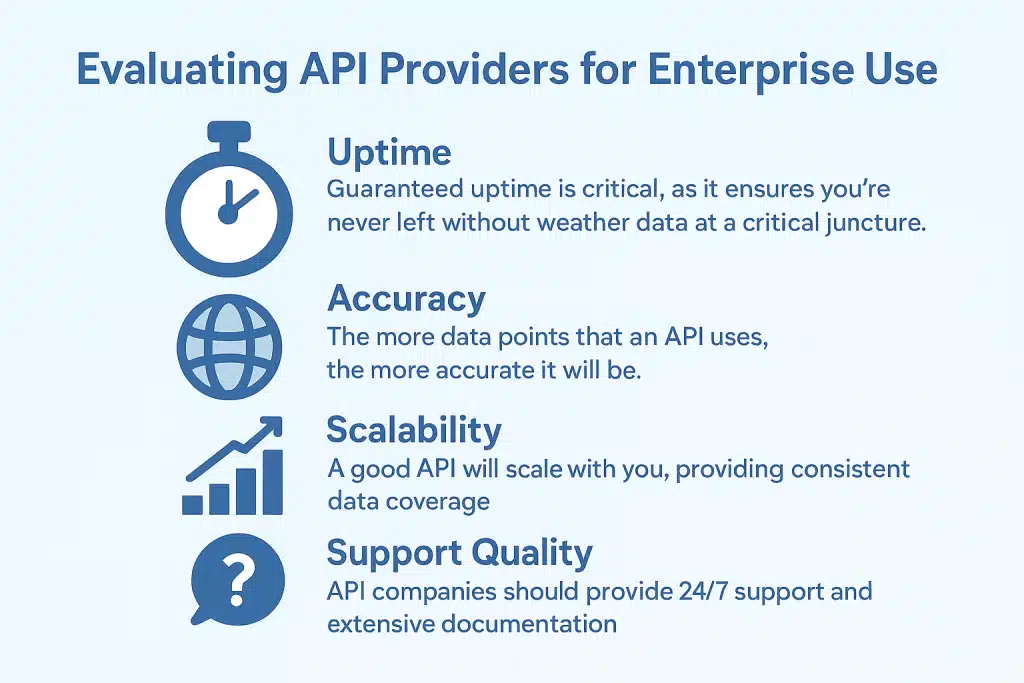
Evaluating API Providers for Enterprise Use
Choosing a service provider is not just about price, but also about reliability and accuracy. These are the primary considerations to keep in mind when shopping for the right API.
- Uptime: Guaranteed uptime is critical, as it ensures you’re never left without weather data at a critical juncture. The provider should be upfront about what uptime guarantees they offer, and you should ensure this is written into your SLA.
- Accuracy: The more data points that an API uses, the more accurate it will be. Consider the coverage they provide across different world regions. Some platforms are ideal for hyperlocal data, while others are more suitable for less granular, global coverage.
- Scalability: A good API will scale with you, providing consistent data coverage regardless of the number of records you request per hour. Discuss the maximum number of records that an API provider can guarantee over a given time period and compare it to your estimated requirements.
- Support Quality: API companies should provide 24/7 support and extensive documentation to ensure you have all the necessary information to get started. If the API’s support team is unresponsive or unknowledgeable, this may severely compromise the quality of your implementation.
Common Integration Challenges and How to Overcome Them
While APIs can be powerful, implementation is not always seamless. Common problems that may arise include the following.
- Request Limits: Free APIs often provide limited weather data, as they may be restricted to a certain number of requests per day. Enterprise systems offer unlimited requests and guaranteed uptime.
- Response Latency: When lives depend on real-time data, response latency can be extremely hazardous. This latency may be caused by poor API calls, such as improper formatting, or it may be due to the provider having insufficient servers to meet your needs. Ensure that your SLA explains the guaranteed response times and utilize the company’s documentation to format your calls.
- Authentication Issues: Common problems here include overly restrictive network firewalls or using the wrong authentication format. Our support team can double-check your authentication and suggest how to reformat your firewall to prevent authentication issues.
Future Trends in Enterprise Weather API Technology
AI, the Internet of Things (IoT), and predictive weather modeling promise exciting innovations in the future of weather API. Each of these will provide more accurate forecasting, with IoT allowing for more local data collection.
With AI, weather APIs can run thousands of simulations simultaneously and more accurately predict future conditions, while predictive modeling enables forecasts to reflect the evolving nature of the climate.
Final Thoughts on Scaling Business with Weather APIs
Reliable, enterprise-grade weather APIs enable you to access scalable weather data tailored to your specific needs. Accurate, reliable data, when combined with long-term support, ensures that you’re never without the data you need to make smart operational decisions based on your industry.
Visual Crossing’s enterprise API provides unlimited requests, dedicated support, and guaranteed uptime. We also offer specialized datasets for specific industry applications, such as irradiance or soil moisture. Contact us today to learn more about our enterprise solutions.
FAQs about Enterprise Weather API
Enterprise weather data provides more granular detail, unlimited queries, and guaranteed uptime, while a standard API offers limited weather data, request limits, and no guaranteed uptime.
Forecasts and severe weather alerts help companies protect their investments and employees while also planning their operations to ensure maximum efficiency.
When choosing a provider, consider the available weather data, global and national coverage, guaranteed uptime, and any request limits.
Yes, these weather APIs provide real-time and high-volume data through unlimited requests and customizable datasets.
Enterprise weather data supports scalability by providing unlimited access to data, including national and global coverage.